4 Best Practices for Effective Email Ending Lines
Many marketers underestimate the impact of a well-crafted email closing, often viewing it as a mere formality rather than a strategic opportunity
Sophie Grant
Email Signature Specialist, Scribe
Introduction
Many marketers underestimate the impact of a well-crafted email closing, often viewing it as a mere formality rather than a strategic opportunity. Understanding audience preferences and context allows marketers to turn their email communications into powerful tools for connection and conversion. However, how can one ensure that their email closings not only resonate but also drive action? This article outlines four best practices that can elevate email endings from mere formalities to impactful elements of effective communication.
Get started with Scribe
Manage signatures across your whole team
Free 14-day trial — no credit card.
Understand Your Audience and Context
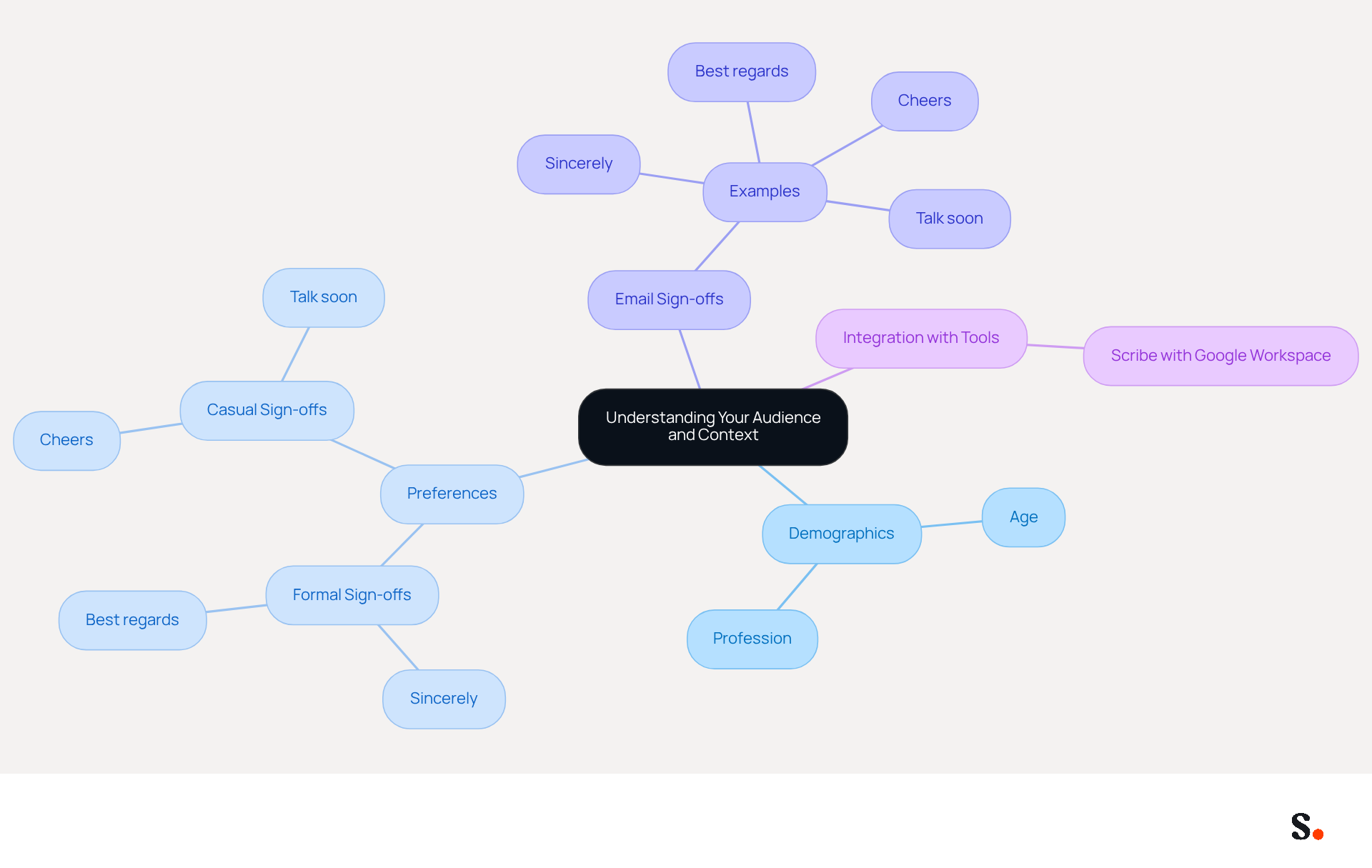
Effectively closing a message involves using appropriate email ending lines, which requires a nuanced understanding of your audience and the context of your communication. This requires examining demographic factors, preferences, and your connection with the individual. For instance, a formal message directed at a potential client should conclude with a professional sign-off such as 'Sincerely' or 'Best regards,' while a more casual note to a colleague might appropriately end with 'Cheers' or 'Talk soon.' Customizing your email ending lines to suit the audience not only demonstrates respect but also greatly increases the likelihood of a positive response.
Research indicates that messages customized to the recipient's context can achieve engagement rates that are significantly higher than standard communications. For instance, segmentation strategies can yield up to 30% more opens and 50% more clicks, underscoring the necessity of understanding your audience's demographics. Recent studies show that 60% of young adults open and read less than half of the messages they receive, emphasizing the significance of creating content that aligns with their preferences. By prioritizing audience analysis, marketers can significantly enhance their communication strategies and foster stronger relationships.
Additionally, integrating Scribe with Google Workspace streamlines signature management, allowing for automatic updates and time savings. This means that any changes in your Google Workspace, like moving teammates or updating their details, will automatically show up in Scribe, ensuring that your signatures are always current and consistent. This integration not only saves time but also enhances the professionalism of your interactions, making it easier to maintain brand consistency across all correspondence.
Choose the Right Tone and Language
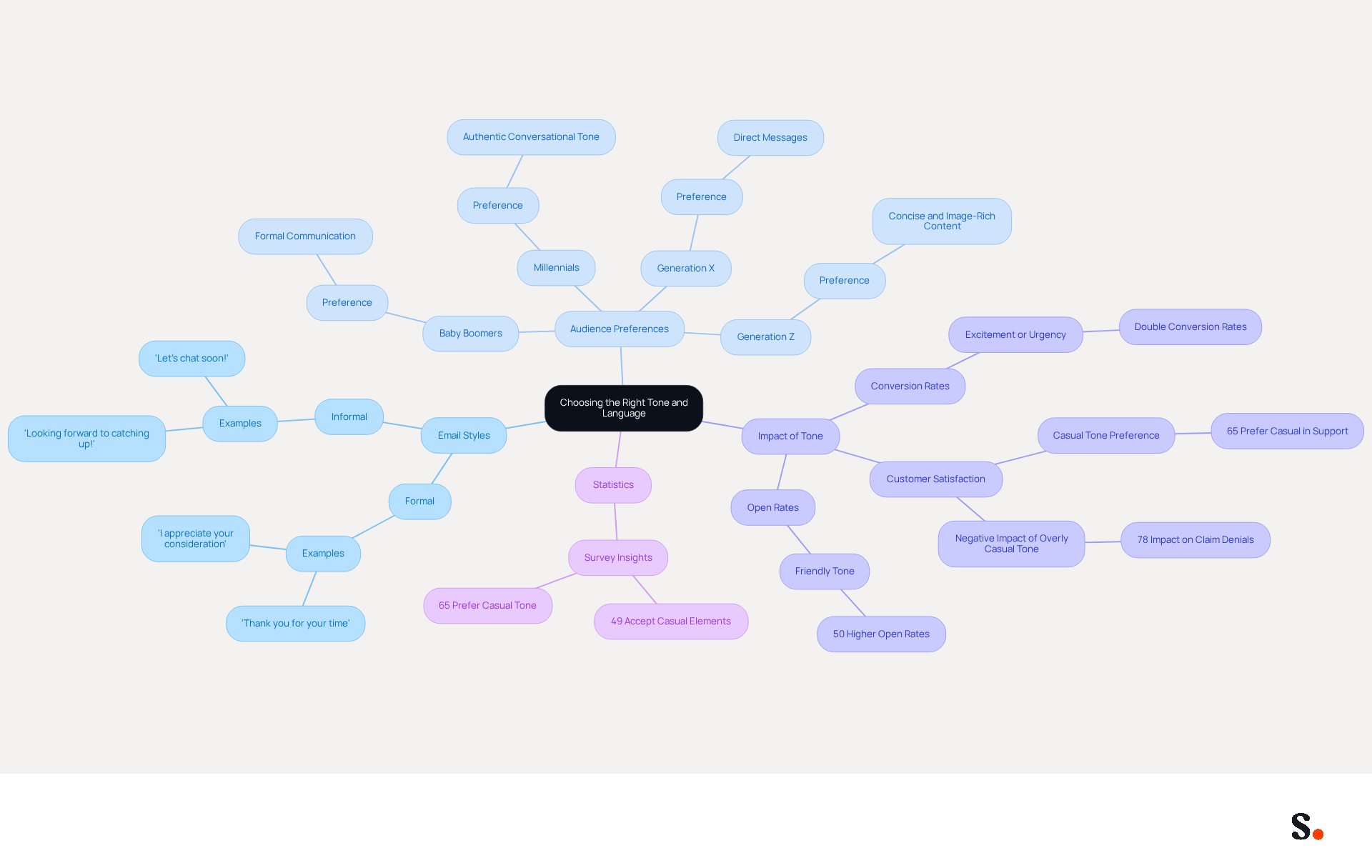
Crafting the right email style is essential for effective communication, as it directly influences how your message is received. For official interactions, choose a courteous manner using expressions like 'Thank you for your time' or 'I appreciate your consideration.' On the other hand, a relaxed style works well in friendly exchanges - think phrases like 'Looking forward to catching up!' or 'Let’s chat soon!' The language you select should align with the recipient's expectations and the context of your interaction.
For example, using industry-specific jargon may be appropriate in a technical discussion but could alienate a general audience. Striking the right tone can be challenging, especially when navigating different audience expectations. Statistics show that messages written in a friendly, conversational style see open rates about 50% higher than those that are more formal (Campaign Monitor), highlighting the importance of style in effective communication.
Furthermore, emails expressing excitement or urgency in their delivery saw conversion rates double compared to neutral emails in A/B tests (Experian). Understanding your audience's preferences - such as the fact that 65% of customers prefer a casual style in customer support - can guide your approach, ensuring your messages are well-received and impactful. Yet, caution is necessary; being too informal in sensitive situations can negatively impact customer satisfaction, according to industry experts.
Incorporating generational preferences, such as Baby Boomers' inclination towards formal communication and Millennials' appreciation for authentic conversational tones, can further enhance your messaging effectiveness. Ultimately, aligning your communication style with your audience's preferences can transform your interactions and drive better results.
Incorporate Clear Calls to Action
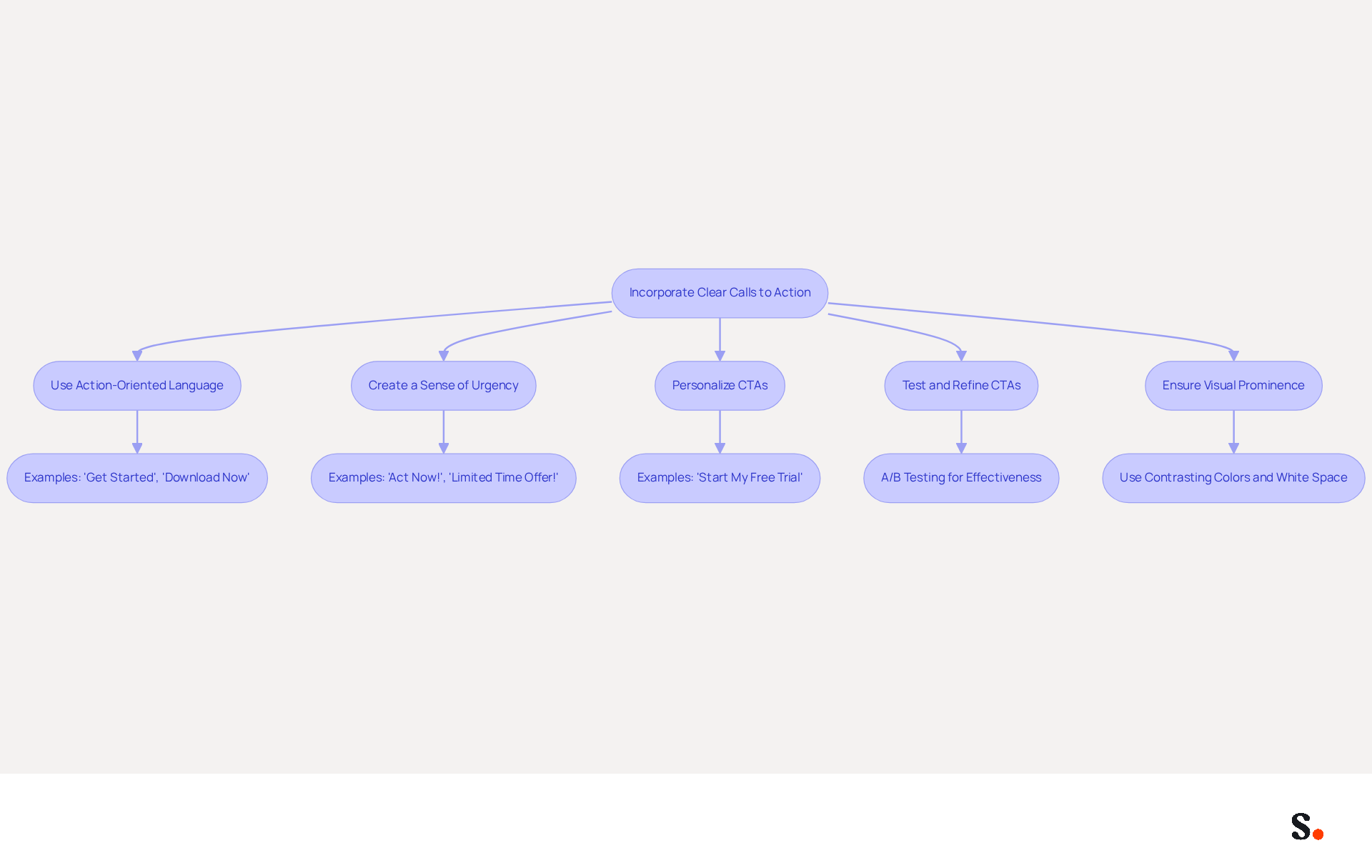
Many marketing messages fall short due to ineffective calls to action, leading to missed engagement opportunities. Research shows that messages with clear CTAs can boost click-through rates by as much as 371%. Using button-based CTAs can further enhance effectiveness, increasing click-through rates by 28% compared to link-based CTAs. To enhance effectiveness, use action-oriented language and create a sense of urgency, such as 'Don’t miss out on this opportunity!' or 'Act now to secure your spot!' By guiding individuals toward a specific action, you not only enhance engagement but also facilitate the next steps in your communication.
Case studies reveal that placing CTAs strategically, such as above the fold, significantly boosts visibility and engagement. For instance, changing the wording of a CTA from second person ('Start your free trial') to first person ('Start my free trial') resulted in a remarkable 90% increase in clicks. This shows just how impactful personalization can be in your CTAs. Additionally, incorporating urgency in your messaging can compel immediate action, as seen in examples like '50% off today only.' Including a sense of urgency in your CTAs helps garner those high click-through rates.
Ultimately, effective CTAs are crucial for directing recipients towards desired actions, enhancing overall marketing success. Consistently testing and refining your CTAs based on audience preferences and engagement metrics can lead to ongoing enhancement in your campaigns. Furthermore, ensuring that CTAs are visually prominent, using contrasting colors and adequate white space, can significantly enhance their effectiveness. By refining your CTAs, you can significantly enhance engagement and drive desired actions from your audience.
Leverage Email Signatures for Brand Consistency
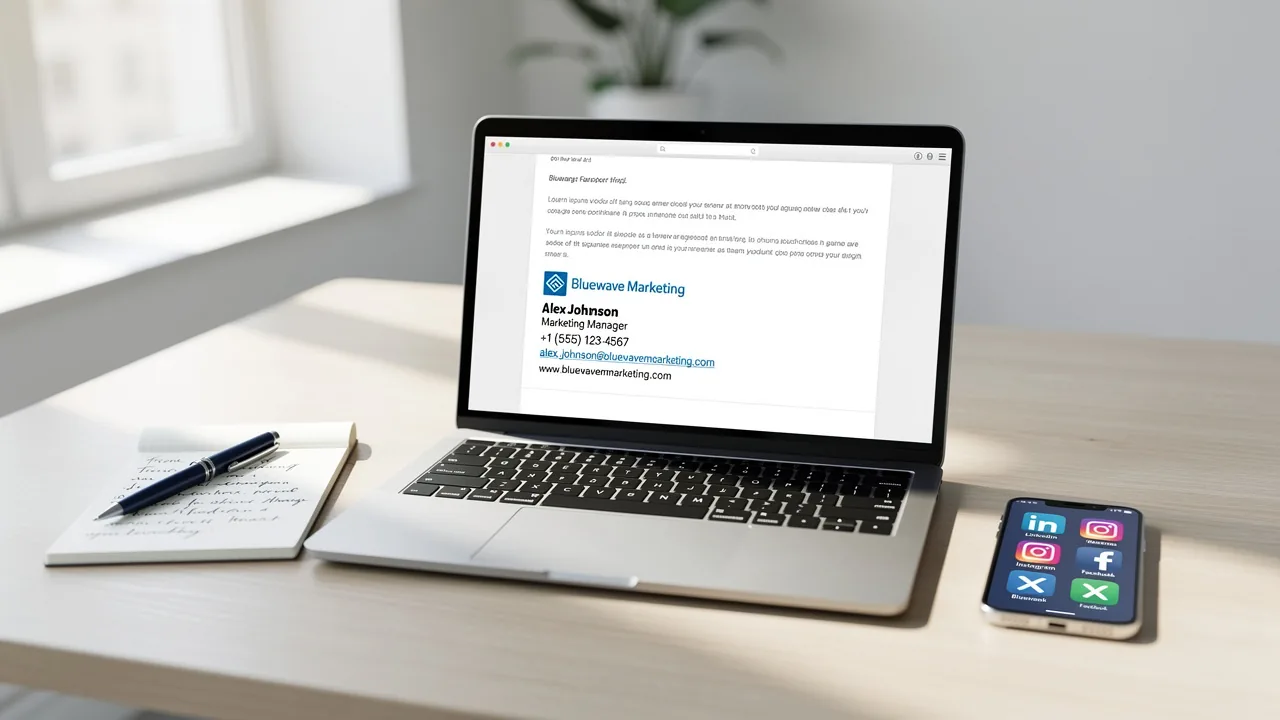
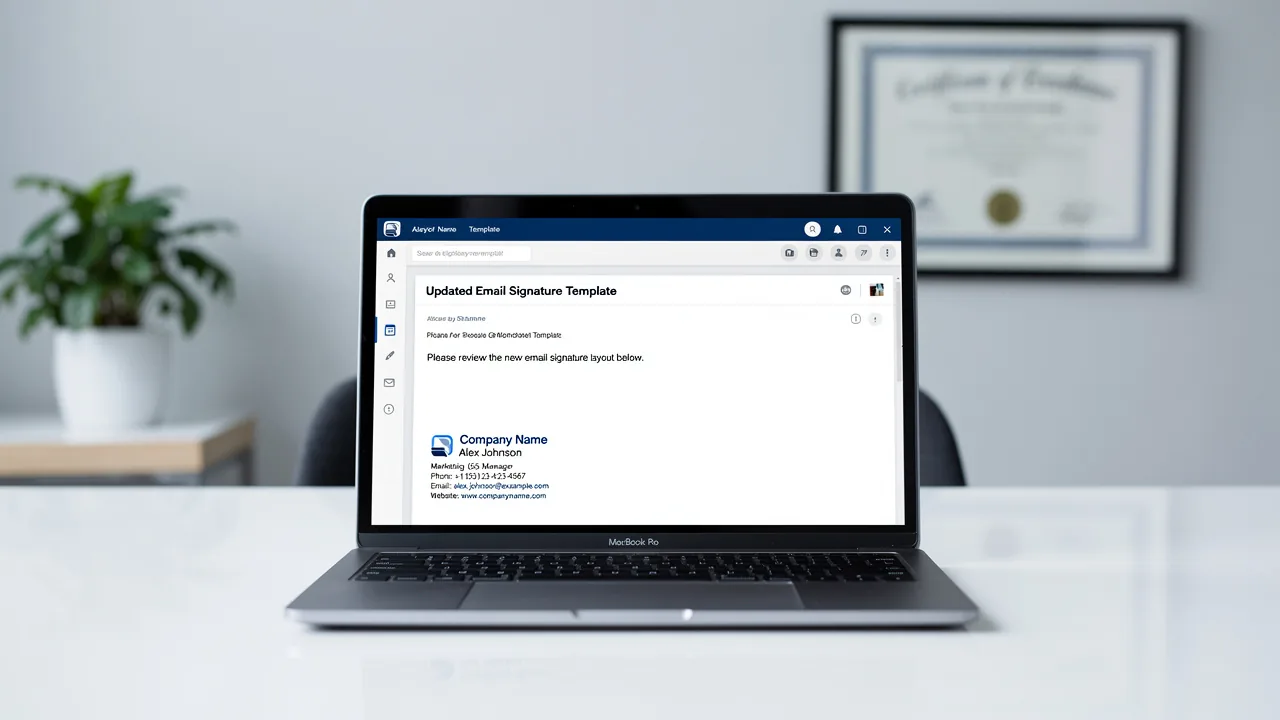
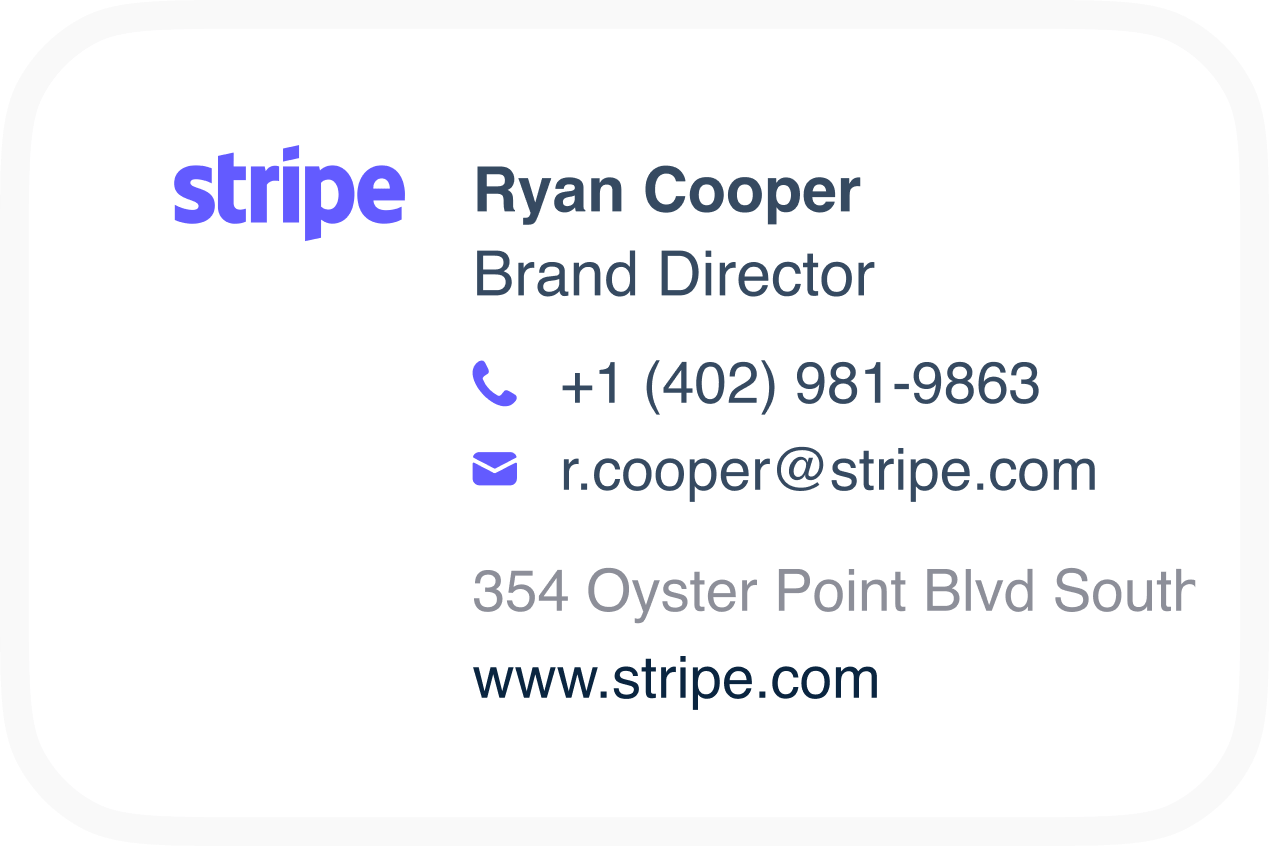
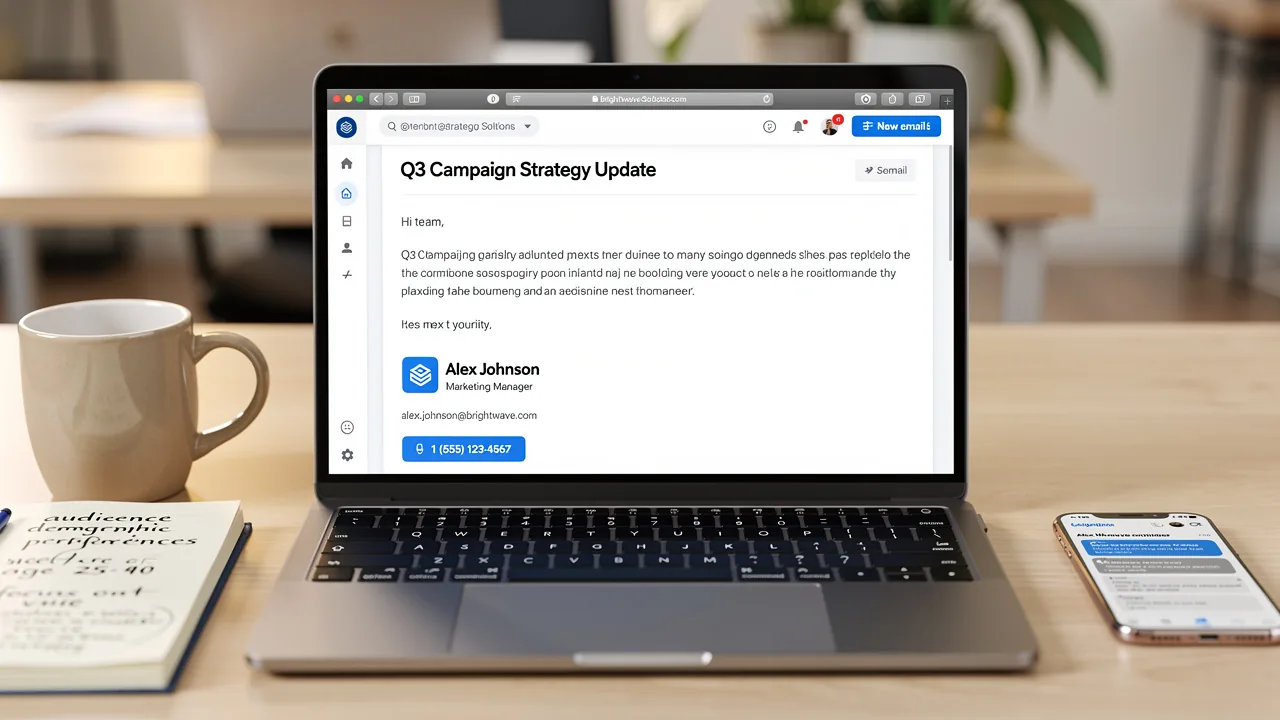
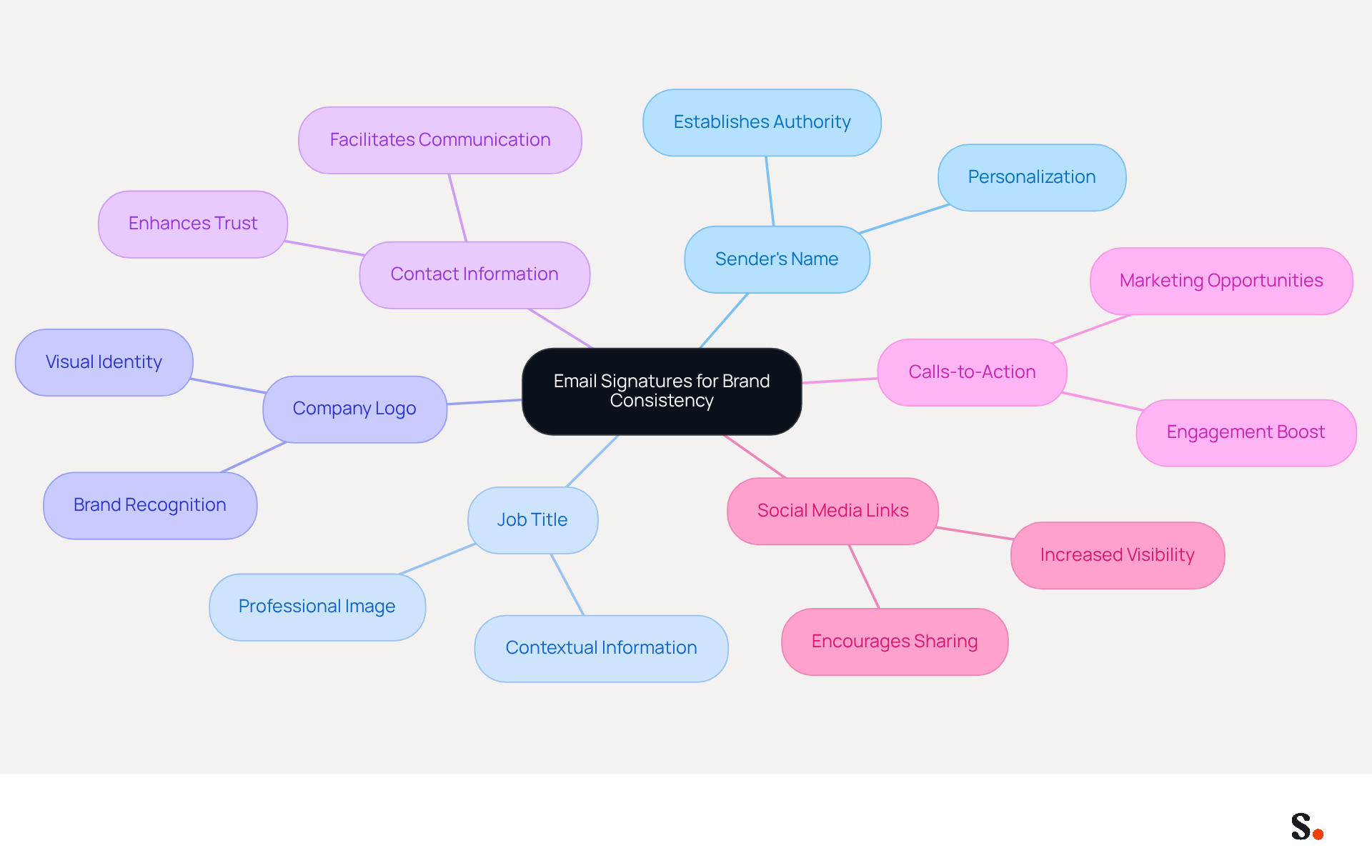
Many businesses fail to recognize the critical role that email ending lines play in their branding efforts. Email ending lines are often underestimated, yet they are essential for ensuring brand consistency across all communications. A well-crafted signature should include key elements such as:
- The sender's name
- Job title
- Company logo
- Contact information
All designed to reflect the brand's visual identity. Scribe's automated signature management guarantees consistent branding across all team communications, enhancing professionalism and fostering trust with contacts. Additionally, adding calls-to-action and social media links can engage recipients and boost brand visibility. By standardizing email ending lines, businesses can ensure that each message reinforces their brand image, transforming every communication into a powerful marketing opportunity.
Research indicates that companies utilizing centralized management solutions can achieve up to 85% enhanced brand consistency, making it clear that effective email signatures are not just a formality but a strategic asset in modern marketing. This oversight can lead to missed opportunities for brand reinforcement and customer engagement, highlighting the need for a strategic approach to managing email ending lines.
Conclusion
Effective email endings are crucial for impactful communication and audience engagement. By tailoring closing lines to fit the context and preferences of recipients, individuals can foster stronger connections and increase engagement. This approach enhances professionalism and increases the chances of a positive response.
Key strategies discussed include:
- Understanding the audience and context
- Selecting the appropriate tone and language
- Incorporating clear calls to action
- Leveraging email signatures for brand consistency
Each of these elements plays a crucial role in shaping how messages are perceived and can lead to improved engagement rates. For instance, utilizing personalized and action-oriented CTAs can dramatically enhance click-through rates, while consistent email signatures reinforce brand identity across all communications.
Without effective email endings, messages may fail to connect, leading to missed opportunities. By adopting these strategies, organizations can significantly improve their communication outcomes. In the end, effective email endings really matter. By mastering these techniques, businesses can ensure that every email serves as a strategic opportunity for engagement and growth.
Frequently Asked Questions
Why is it important to understand your audience when closing a message?
Understanding your audience is crucial because it allows you to use appropriate email ending lines that reflect the context of your communication, demonstrating respect and increasing the likelihood of a positive response.
What are some examples of email sign-offs for different audiences?
For formal messages directed at potential clients, appropriate sign-offs include 'Sincerely' or 'Best regards.' In contrast, a more casual note to a colleague might end with 'Cheers' or 'Talk soon.'
How does customizing email messages impact engagement rates?
Customizing email messages to the recipient's context can lead to significantly higher engagement rates, with segmentation strategies yielding up to 30% more opens and 50% more clicks.
What demographic trends should marketers consider when crafting messages?
Marketers should consider that 60% of young adults open and read less than half of the messages they receive, highlighting the importance of creating content that aligns with their preferences.
How does integrating Scribe with Google Workspace benefit users?
Integrating Scribe with Google Workspace streamlines signature management by allowing automatic updates, ensuring that any changes in Google Workspace are reflected in Scribe, which saves time and maintains brand consistency across correspondence.
List of Sources
- Understand Your Audience and Context
- Three audience analysis tips to improve employee engagement (https://gagenmacdonald.com/blog/three-audience-analysis-tips-to-improve-employee-engagement)
- Mastering Audience Analysis: The Key to Effective Communication (https://medium.com/nextgenleaders/mastering-audience-analysis-the-key-to-effective-communication-6c1f93209172)
- Investigating Email: Younger Audiences and Email (https://dma.org.uk/resources/report/investigating-email-younger-audiences-and-email)
- Email outperforms social media in engagement rates | Carlos Gil posted on the topic | LinkedIn (https://linkedin.com/posts/carlosgilonline_everyones-obsessed-with-social-media-engagement-activity-7405235722602950656-lP6k)
- emarsys.com (https://emarsys.com/learn/blog/improving-email-engagement-rates)
- Choose the Right Tone and Language
- How Your Email Tone Impacts Email Marketing Results (https://netatlantic.com/resources/articles/how-your-email-tone-impacts-email-marketing-results)
- Survey Reveals The Best Tone of Voice to Take with Customers (https://verticalresponse.com/blog/survey-reveals-the-best-tone-of-voice-to-take-with-customers)
- Trouver le ton d’e-mail adapté à votre audience | Mailchimp (https://mailchimp.com/resources/email-tone)
- CRM Article: Mastering Email Communication: The Power of Tone and Style - Smallbizcrm (https://smallbizcrm.com/blog/crm-article-mastering-email-communication-the-power-of-tone-and-style)
- Incorporate Clear Calls to Action
- The Art of Creating Effective Calls to Action - Invesp (https://invespcro.com/blog/calls-to-action)
- Mastering the art of email calls-to-action (https://smartbrief.com/original/mastering-the-art-of-email-calls-to-action)
- A Strategic Guide to Calls-to-Action (CTAs) in Email Marketing: Best Practices for Success (https://litmus.com/blog/click-tap-and-touch-a-guide-to-cta-best-practices)
- 10 Tips to Optimize Your Email CTAs (https://campaignmonitor.com/resources/guides/10-tips-to-optimize-your-calls-to-action-in-email-2)
- Mastering Calls To Action For Email Marketing Success (https://smartmessenger.co.uk/news-articles/what-makes-a-good-call-to-action-in-an-email-campaign)
- Leverage Email Signatures for Brand Consistency
- Using Email Signatures for Marketing | CloudM (https://cloudm.io/resources/blog/using-email-signatures-for-marketing-how-every-email-can-boost-your-brand)
- Best Practices for Email Signatures for Companies to Boost Branding (https://scribe-mail.com/en-US/blog/best-practices-for-email-signatures-for-companies-to-boost-branding)
- Research Recap: Branded Email Signatures Increase Company Recognition, Trust - Demand Gen Report (https://demandgenreport.com/industry-news/research-recap-branded-email-signatures-increase-company-recognition-trust/47252)
- Why is email signature marketing important? | Rocketseed (https://rocketseed.com/blog/why-is-email-signature-marketing-important-for-companies)
- The impact of email signatures on your branding (https://signitic.com/en/resources/the-impact-of-email-signatures-on-your-branding)
Get started with Scribe
Manage signatures across your whole team
Free 14-day trial — no credit card.