Master How to End Email with Sincerely for Professional Impact
Effective email communication hinges on the often-overlooked element of the closing sign-off, which can shape the recipient's perception significantly. By
Sophie Grant
Email Signature Specialist, Scribe
On this page
- Introduction
- Understand the Importance of a Professional Email Closing
- Identify Key Elements of a Professional Email Closing
- Explore Different Types of Email Sign-Offs
- Use Examples to Craft Effective Email Closings
- Avoid Common Mistakes in Email Closings
- Conclusion
- Frequently Asked Questions
- List of Sources
Introduction
Effective email communication hinges on the often-overlooked element of the closing sign-off, which can shape the recipient's perception significantly. By mastering the art of sign-offs, such as using "sincerely," individuals can enhance their professionalism and foster stronger relationships.
Choosing the right sign-off can be daunting, as it requires an understanding of the recipient's expectations and the context of the communication. In this guide, we will explore the essential components of effective email closings, providing insights and strategies to enhance workplace communication.
Ultimately, the right sign-off can transform a simple email into a powerful tool for professional engagement and relationship building.
Understand the Importance of a Professional Email Closing
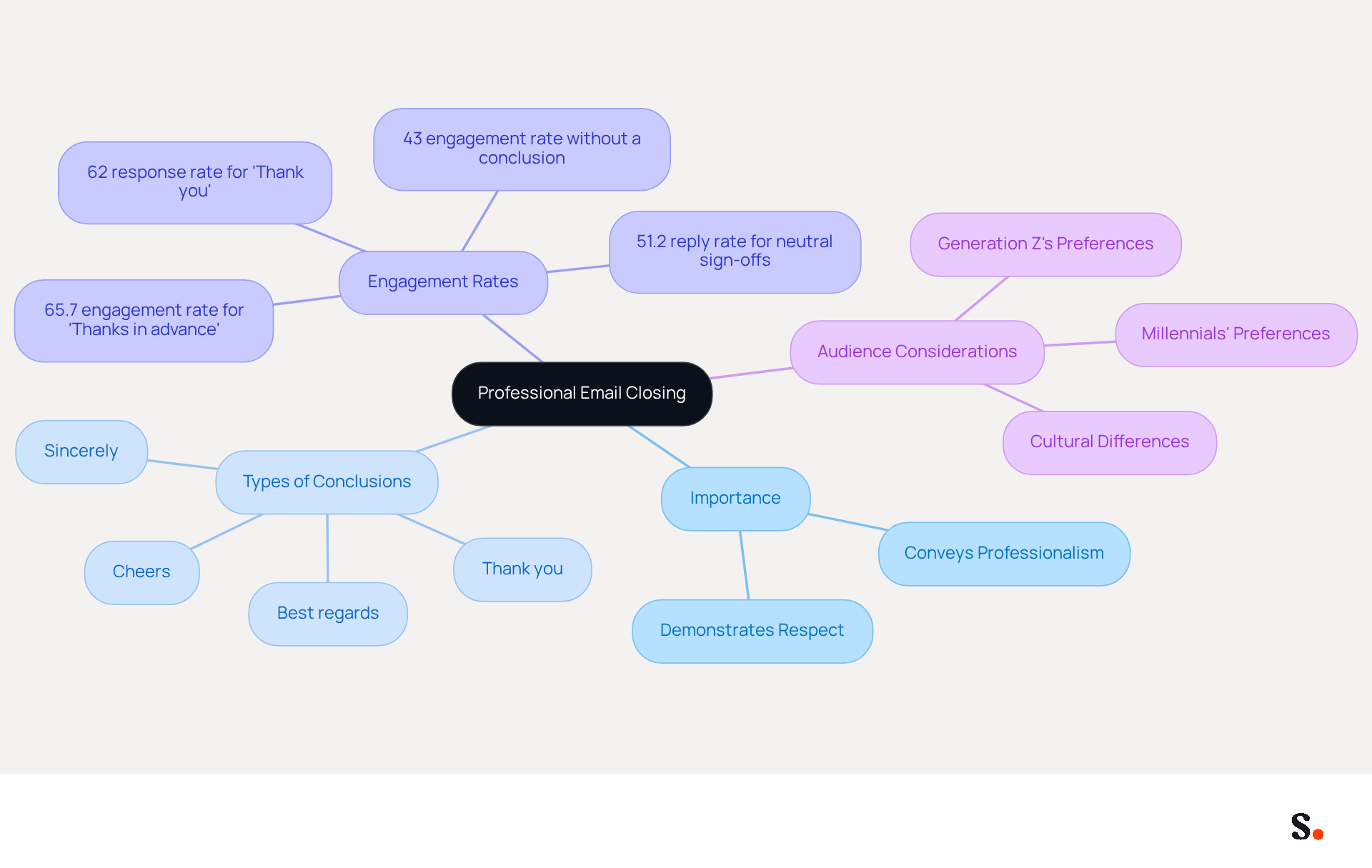
A well-crafted email conclusion is essential for effective communication, as it conveys professionalism and respect. A thoughtfully selected conclusion can reinforce your message and leave a lasting impression on the recipient. For instance, when you choose to end an email with sincerely or Best regards, it signals that you value the recipient's time and take the correspondence seriously. Conversely, a casual or inappropriate conclusion can lead to misunderstandings and diminish the perceived importance of your message.
Messages that conclude with gratitude, like Thank you, see higher engagement rates than neutral sign-offs, which yield only a 51.2% reply rate. Moreover, messages without a concluding statement average only a 43% engagement rate, underscoring the importance of including a conclusion in professional emails. Tailoring your conclusion to fit the recipient's style can strengthen relationships and boost interaction. Additionally, recognizing that Millennials and Generation Z often favor more casual sign-offs can assist in customizing your strategy for various audiences. Thus, acknowledging the impact of your email conclusion can transform your communication and strengthen your professional relationships.
Identify Key Elements of a Professional Email Closing
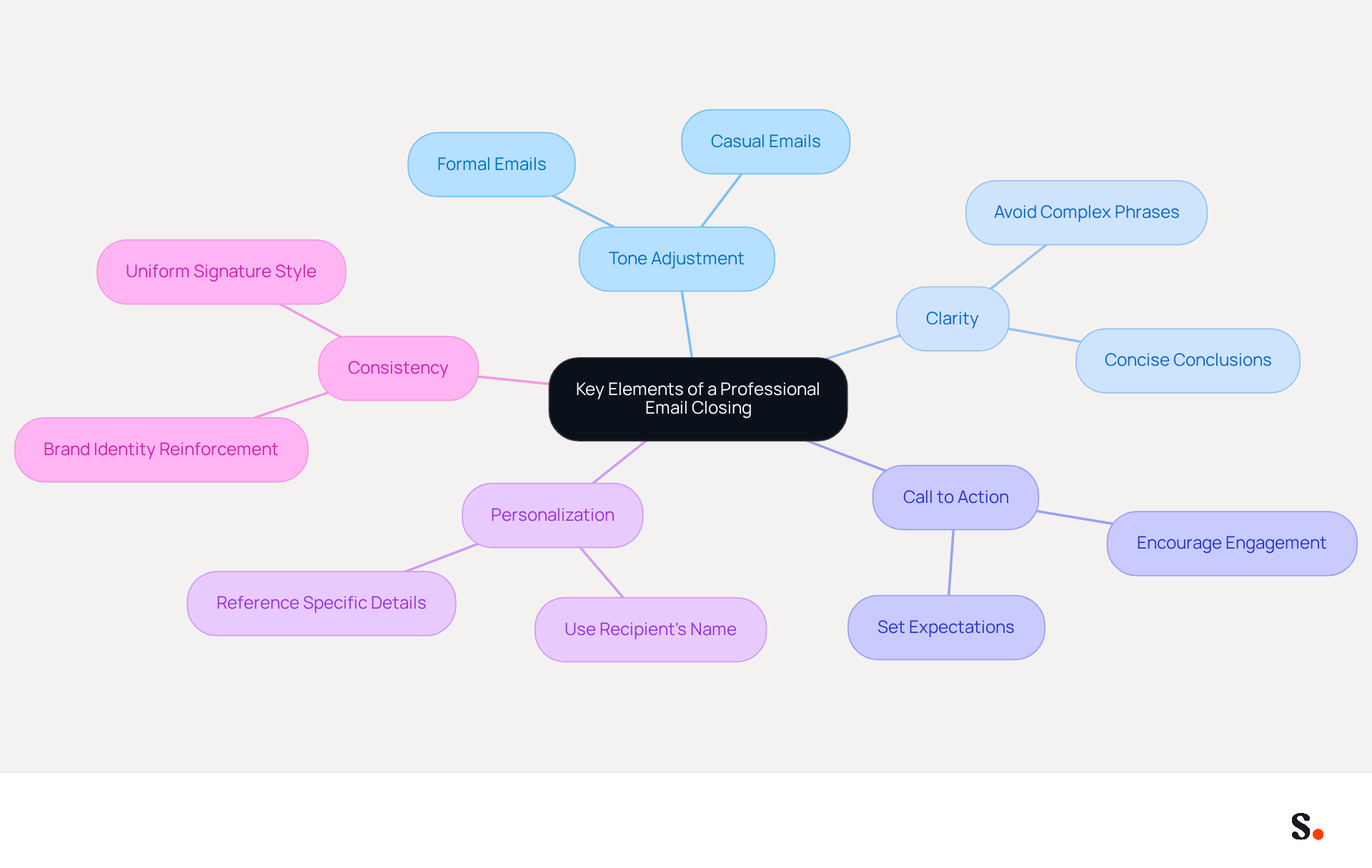
It is essential for effective communication and brand representation to end email with sincerely in a professional email closing. When crafting your email closing, keep these key elements in mind:
- Adjust the tone of your conclusion to match the overall tone of your message. Formal emails should end email with sincerely, whereas casual emails can adopt a more relaxed farewell.
- Clarity: Ensure your conclusion is clear and concise. Avoid complex phrases that may confuse the reader, as clarity is essential for effective communication.
- Call to Action: If applicable, include a call to action in your conclusion. Phrases like 'Looking forward to your response' can encourage engagement and prompt a reply.
- Personalization: Tailor your farewell to the recipient when possible. Using their name or referencing specific details can make your message feel more personal and engaging.
- Consistency: Maintain a uniform signature and closing style across all communications to reinforce your brand identity. With Scribe, each modification made in your Aircall configuration will automatically be reflected in your signatures, ensuring brand consistency. Furthermore, Scribe's SOC 2 Type II compliance ensures secure data management, facilitating marketing teams to handle signatures independently after the initial IT setup.
Without a consistent email signature management solution, your brand may struggle to maintain a professional image. By implementing these strategies, you not only enhance your professionalism but also foster stronger connections with your audience.
Explore Different Types of Email Sign-Offs
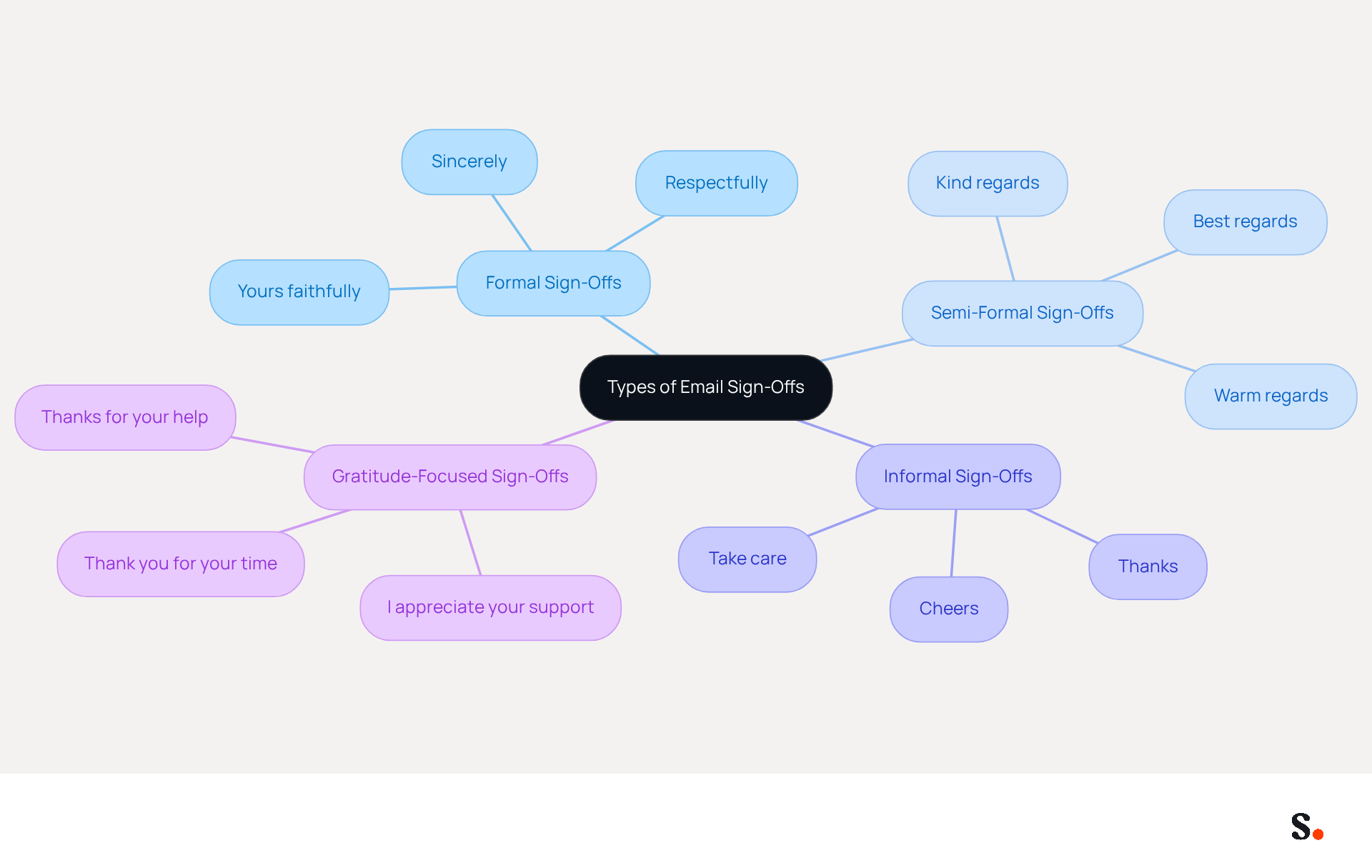
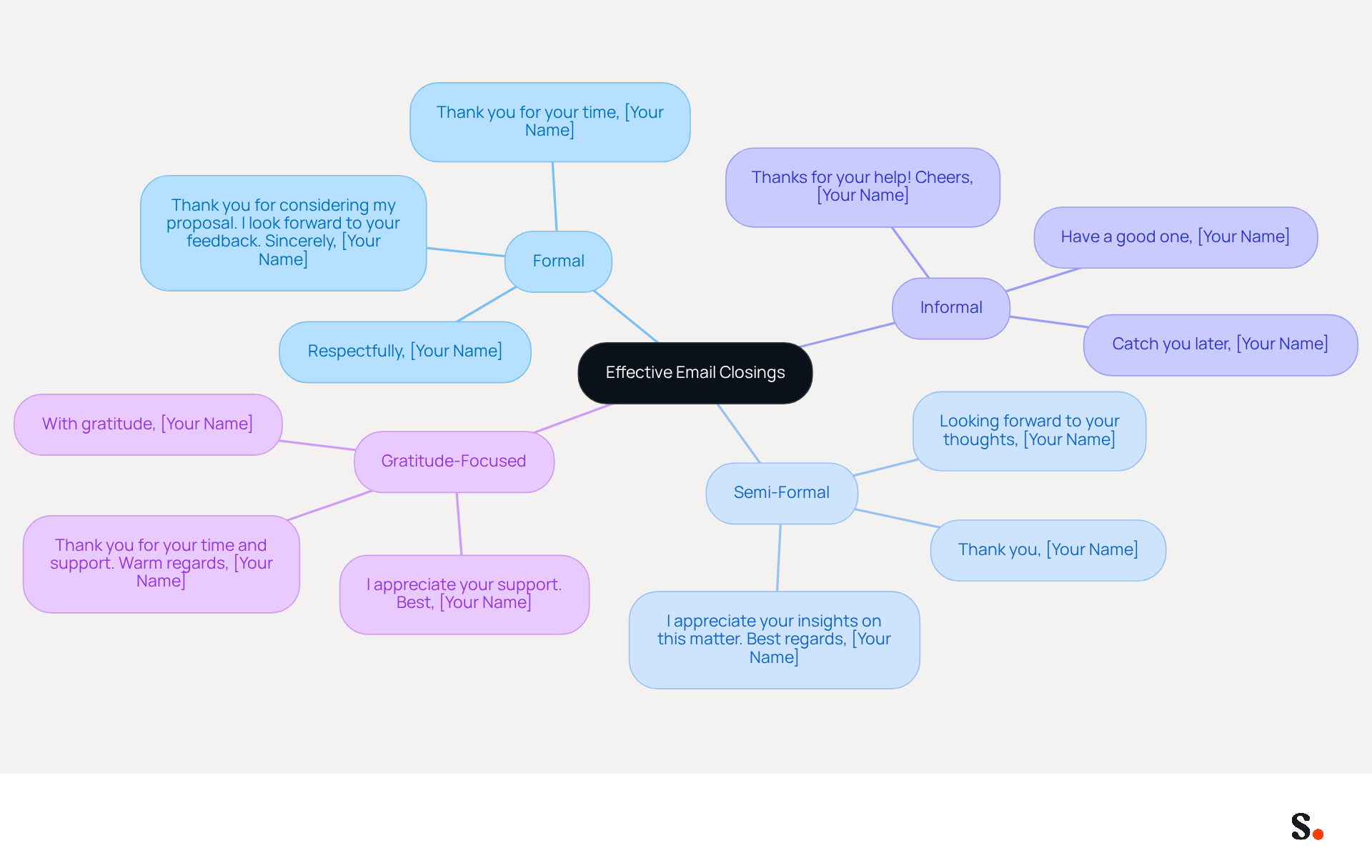
It is crucial for effective workplace communication to select the right email sign-off, and one way to end email with sincerely is to ensure each type serves a unique purpose. Here are some common types:
- Formal Sign-Offs: These are essential in professional or business contexts, conveying respect and professionalism. Examples include 'Sincerely,' 'Respectfully,' and 'Yours faithfully.' Such sign-offs are particularly suitable for high-stakes interactions like job applications or formal proposals.
- Semi-Formal Sign-Offs: Ideal for colleagues or clients with whom you have established rapport, these sign-offs maintain professionalism while adding a friendly touch. Examples include 'Best regards,' 'Kind regards,' and 'Warm regards.' They are often used in ongoing business relationships.
- Informal Sign-Offs: Suitable for casual messages or communications with friends, these sign-offs promote a relaxed tone. Examples include 'Cheers,' 'Thanks,' and 'Take care.' While they can enhance personal connections, they should be used cautiously in professional settings.
- Gratitude-Focused Sign-Offs: Expressing appreciation can significantly enhance relationships and encourage positive responses. Examples include 'Thank you for your time,' 'Thanks for your help,' and 'I appreciate your support.' These sign-offs are especially effective in follow-up messages or after meetings.
Choosing the right sign-off can be challenging, especially when deciding how to end email with sincerely, due to the nuances involved in workplace communication. Research indicates that 62% of marketers use signatures for marketing purposes, underscoring the importance of thoughtful sign-offs in driving engagement and nurturing professional relationships. Additionally, with Scribe's automated synchronization of signatures with Aircall, any changes made in your Aircall configuration will automatically be reflected in your Scribe signatures. This feature not only enhances brand consistency but also ensures that your organization maintains professionalism and reduces brand confusion across all communications. Moreover, Scribe's SOC 2 Type II certification and adherence to GDPR and CCPA highlight its dedication to secure data management, making it a trustworthy option for organizations aiming to handle their signatures effectively. Ultimately, the right sign-off can transform your correspondence, making it more impactful and fostering stronger professional relationships.
Use Examples to Craft Effective Email Closings
It is crucial for enhancing communication and fostering professional relationships to know how to end email with sincerely. Here are some examples of effective email closings:
- Formal Example: 'Thank you for considering my proposal. I look forward to your feedback. Sincerely, [Your Name]'
- Semi-Formal Example: 'I appreciate your insights on this matter. Best regards, [Your Name]'
- Informal Example: 'Thanks for your help! Cheers, [Your Name]'
- Gratitude-Focused Example: 'Thank you for your time and support. I look forward to hearing from you. Warm regards, [Your Name]'
Consider these examples as templates to guide your own email closings. Modify the phrasing to suit your style and the context of your message. Research shows that emails that end email with sincerely or expressions of gratitude often yield higher response rates, reinforcing the importance of considerate sign-offs in professional interactions. As Christina Marfice states, "The right sign-off can reinforce your message, build relationships, and prompt action." Additionally, consider avoiding automated sign-offs like 'Sent from my iPhone' to maintain professionalism. Effective email closings can clarify your message and help build stronger relationships.
Avoid Common Mistakes in Email Closings
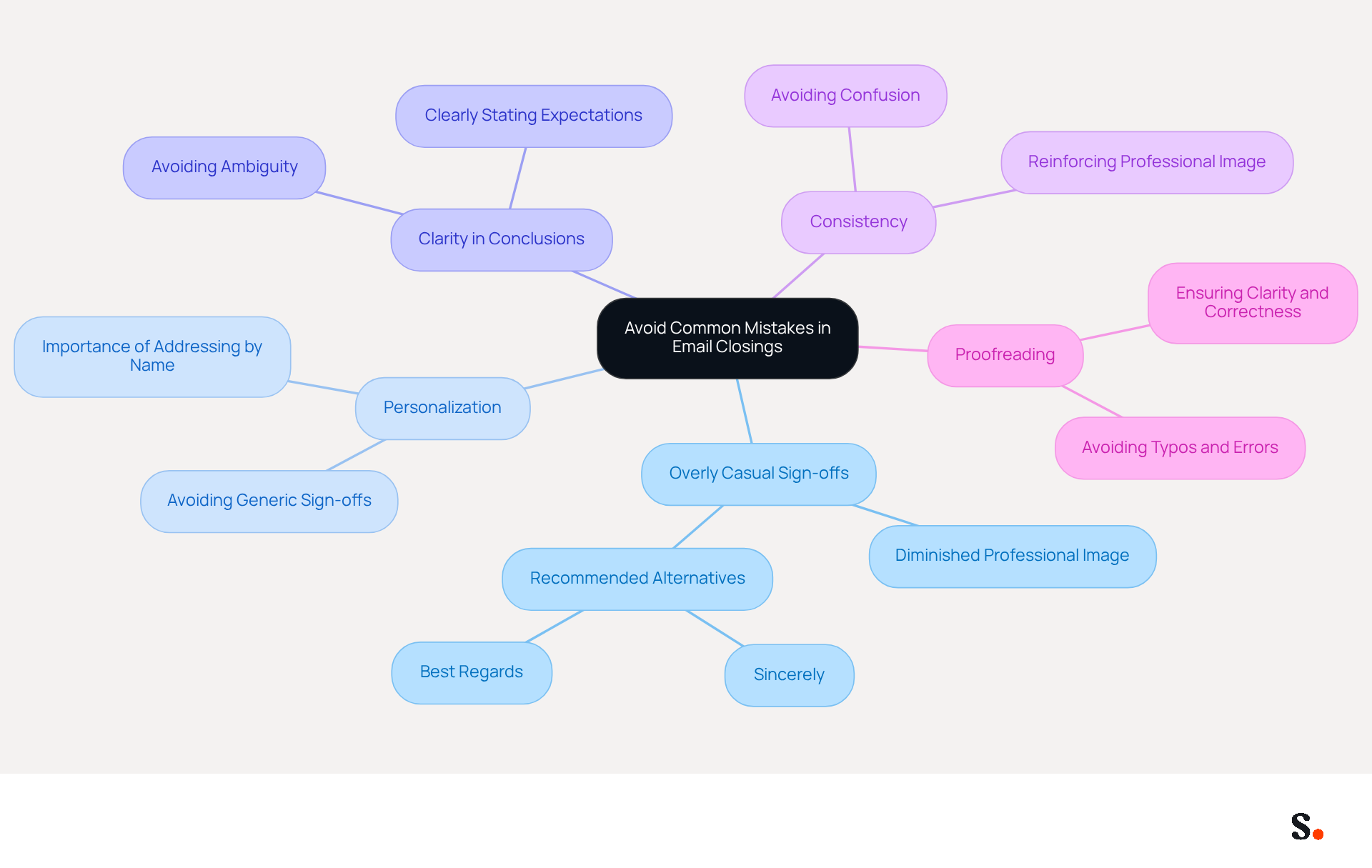
To maintain professionalism in your email closings, it is essential to avoid common pitfalls that can undermine your credibility:
- Avoiding overly casual sign-offs is crucial for maintaining professionalism: Sign-offs like 'Cheers' or 'Later' can diminish your professional image in formal communications. To convey respect, you should end email with sincerely or choose other suitable sign-offs like 'Best regards'.
- Personalizing your emails is essential for fostering connection: Failing to address the recipient by name or using a generic sign-off can make your email feel impersonal. Personalization shows attention to detail and strengthens your connection with the recipient.
- Clarity in your conclusions is vital for effective communication: Avoid ambiguous conclusions that do not convey your intent. Clearly state what you expect from the recipient, whether it’s a response or an action.
- To reinforce your professional image, it is important to maintain consistency in your sign-offs; for instance, you should end email with sincerely to avoid confusing recipients and diluting your brand identity. Consistency is key to maintaining professionalism.
- Proofreading your emails is essential to avoid errors that can undermine professionalism: Typos or grammatical mistakes in your closing can detract from your credibility. Always proofread your messages before sending to ensure clarity and correctness.
By being aware of these pitfalls, you can enhance the effectiveness of your communication. Recognizing and addressing these common mistakes can lead to more effective communication and a stronger professional image. Statistics show that 42% of consumers feel negatively toward businesses that lack a branded email signature, highlighting the importance of maintaining a professional image in all aspects of email correspondence.
Conclusion
A thoughtful email sign-off is more than just a courtesy; it plays a pivotal role in shaping professional communication. By choosing to conclude with "sincerely" or other appropriate phrases, you can significantly influence how your message is perceived and received.
Throughout the article, we have explored key elements of effective email closings, including the importance of tone, clarity, personalization, and consistency. We highlighted various types of sign-offs, from formal to informal, and emphasized the role of gratitude in fostering positive relationships. Additionally, we outlined common mistakes to avoid, underscoring the need for careful consideration in crafting email conclusions.
Ultimately, getting the hang of email sign-offs can really boost your communication and help build stronger professional relationships. By implementing the best practices discussed, you can ensure your emails not only convey the intended message but also reflect your professionalism and attention to detail. Embracing these strategies will lead to more effective interactions and a lasting positive impact in the business world.
Frequently Asked Questions
Why is a professional email closing important?
A well-crafted email conclusion conveys professionalism and respect, reinforces your message, and leaves a lasting impression on the recipient. It signals that you value the recipient's time and take the correspondence seriously.
What impact does the choice of email closing have on engagement rates?
Messages that conclude with gratitude, such as 'Thank you,' see higher engagement rates than neutral sign-offs, which yield only a 51.2% reply rate. Messages without a concluding statement average only a 43% engagement rate.
How can tailoring an email closing to the recipient's style benefit communication?
Tailoring your conclusion to fit the recipient's style can strengthen relationships and boost interaction, especially since Millennials and Generation Z often prefer more casual sign-offs.
What are the key elements to consider when crafting a professional email closing?
Key elements include adjusting the tone to match the message, ensuring clarity and conciseness, including a call to action if applicable, personalizing the farewell, and maintaining consistency in signature and closing style.
How should the tone of an email closing be adjusted?
Formal emails should end with 'sincerely,' while casual emails can adopt a more relaxed farewell to match the overall tone of the message.
What role does personalization play in email closings?
Personalizing your farewell by using the recipient's name or referencing specific details can make your message feel more engaging and personal.
Why is consistency important in email signatures?
Consistency in email signatures reinforces brand identity and helps maintain a professional image. Scribe ensures that modifications in configurations are automatically reflected in signatures for brand consistency.
How does Scribe support email signature management?
Scribe's SOC 2 Type II compliance ensures secure data management, allowing marketing teams to handle signatures independently after the initial IT setup, which helps maintain a professional image.
List of Sources
- Understand the Importance of a Professional Email Closing
- Is 'Best' a Good Way to End an Email? Compare Sign-Offs Here (https://scribe-mail.com/en-US/blog/is-best-a-good-way-to-end-an-email-compare-sign-offs-here)
- Email Etiquette: Dos and Don’ts of Professional Emails (https://businessnewsdaily.com/8262-email-etiquette-tips.html)
- 50 Best Email Sign-Offs to End an Email Properly in [year] (https://elementor.com/blog/best-email-sign-offs)
- How to End an Email: 43 Ways to Sign Off on an Email (2026) (https://respona.com/blog/how-to-end-an-email)
- Identify Key Elements of a Professional Email Closing
- Email Etiquette: Dos and Don’ts of Professional Emails (https://businessnewsdaily.com/8262-email-etiquette-tips.html)
- How to Sign Off on an Email Correctly | Rocketseed (https://rocketseed.com/blog/correct-way-to-sign-off-emails)
- The best ways to end an email professionally | Adobe Acrobat (https://adobe.com/acrobat/resources/how-to-end-an-email-professionally.html)
- 4 Best Practices for Effective Professional Email Closings (https://scribe-mail.com/en-US/blog/4-best-practices-for-effective-professional-email-closings)
- How to End Any Professional Email (Plus a List of Sign-Offs for When You’re Tired of Saying “Best”) (https://careerservices.upenn.edu/blog/2021/01/08/how-to-end-any-professional-email-plus-a-list-of-sign-offs-for-when-youre-tired-of-saying-best)
- Explore Different Types of Email Sign-Offs
- How to End an Email Professionally (With Examples) (https://iconnect.isenberg.umass.edu/blog/2024/07/10/how-to-end-an-email-professionally-with-examples)
- Mastering Professional Email Sign-Offs in 2026 (https://linkedin.com/pulse/mastering-professional-email-sign-offs-2026-bulksignature-qsr4e)
- Master Business Sign-Off Emails: Best Practices for Impactful Communication (https://scribe-mail.com/en-US/blog/master-business-sign-off-emails-best-practices-for-impactful-communication)
- 89 Ways To Sign Off On An Email (https://forbes.com/sites/susanadams/2014/10/08/89-ways-to-sign-off-on-an-email)
- Use Examples to Craft Effective Email Closings
- How to end an email: 70+ professional sign-offs & examples (https://blog.superhuman.com/how-to-end-an-email)
- 110 Best Ways to Sign Off an Email Correctly - Warmup Inbox (https://warmupinbox.com/blog/email-marketing/email-sign-offs)
- How to End an Email: 43 Ways to Sign Off on an Email (2026) (https://respona.com/blog/how-to-end-an-email)
- How to End an Email Professionally (With Examples) (https://iconnect.isenberg.umass.edu/blog/2024/07/10/how-to-end-an-email-professionally-with-examples)
- Email Sign Offs for Every Industry and Situation | Mailchimp (https://mailchimp.com/resources/email-sign-offs)
- Avoid Common Mistakes in Email Closings
- 10 Common Email Mistakes - Mindtools Membership (https://mindtools.com/at253lr/10-common-email-mistakes)
- 40+ Email Signature Statistics for 2026 (Data + Insights) (https://wavecnct.com/blogs/email-signature-statistics)
- 10 Email Etiquette Mistakes That Damage Your Reputation (https://simaraguard.com/blog/email-etiquette-mistakes)
- 5 Common Email Closing Mistakes and How to Avoid Them (https://intentamplify.com/blog/5-common-email-closing-mistakes-and-how-to-avoid-them)
Get started with Scribe
Manage signatures across your whole team
Free 14-day trial — no credit card.