What Does V/R Mean in Email Communication? Understanding Its Importance
As communication styles evolve, the appropriateness of traditional sign-offs like 'V/R' is increasingly scrutinized. Among these, "V/R," short for "Very
Sophie Grant
Email Signature Specialist, Scribe

On this page
- Introduction
- Define V/R: Understanding Its Meaning in Email Communication
- Contextualize V/R: Importance in Professional Email Sign-Offs
- Trace the Origins: Historical Background of V/R in Email Communication
- Explore Variations: Key Characteristics and Contexts of V/R Usage
- Conclusion
- Frequently Asked Questions
- List of Sources
Introduction
As communication styles evolve, the appropriateness of traditional sign-offs like 'V/R' is increasingly scrutinized. Among these, "V/R," short for "Very Respectfully," stands out as a formal closing that conveys deference and professionalism, especially in hierarchical contexts like military and corporate environments.
As communication styles shift, many professionals find themselves uncertain about the appropriateness of V/R in their emails. What does V/R truly signify in today's business landscape, and how can its proper application enhance the clarity and professionalism of your correspondence?
Misusing V/R may lead to misinterpretations of intent, potentially damaging professional relationships.
Define V/R: Understanding Its Meaning in Email Communication
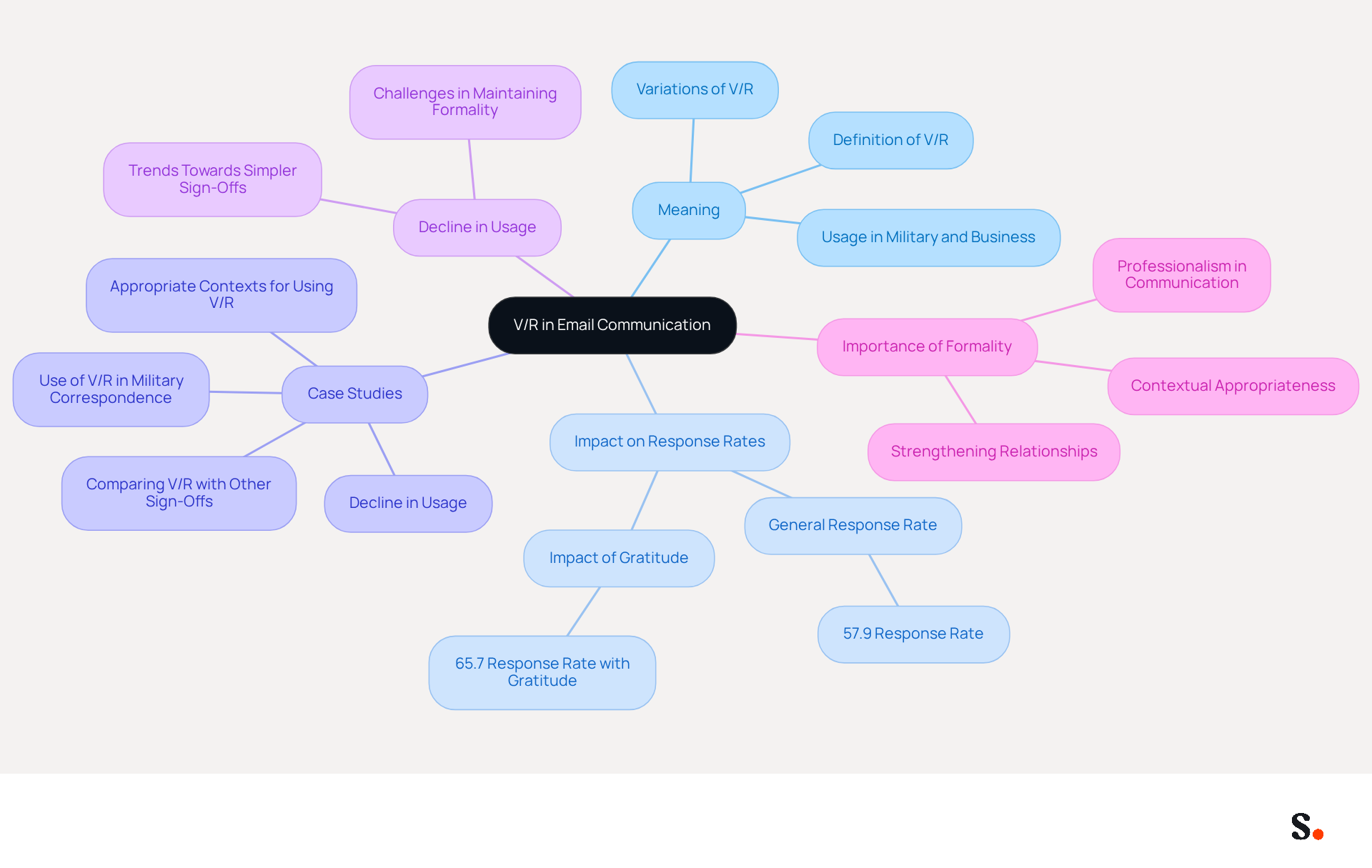
In formal communications, the choice of sign-off can significantly impact the perception of professionalism. V/R, an abbreviation for 'Very Respectfully,' is a formal email sign-off predominantly used in military and business interactions, which leads to the question of what does v/r mean. This sign-off conveys deference and respect, particularly in hierarchical settings where acknowledging the recipient's status is crucial. Using V/R in communication raises the question of what does v/r mean, as it shows professionalism and respect for established etiquette, making it a favored choice in formal correspondence.
The significance of V/R is underscored by its effectiveness in enhancing response rates; messages featuring respectful sign-offs achieve a response rate of 57.9%. Specifically, when gratitude is expressed in the sign-off, response rates can increase to 65.7%. This emphasizes the importance of maintaining a formal tone in official interactions, especially when addressing high-ranking individuals or government officials.
Case studies illustrate what does v/r mean in various professional scenarios. For instance, in military correspondence, junior members often use 'V/r' to show respect towards senior members, leading to the question of what does v/r mean, as outlined in the SECNAV Manual. This practice helps build a culture where respect and professionalism thrive. Additionally, businesses targeting government contracts may adopt V/R to align with the formal standards expected in those sectors, as highlighted in recent studies on professional communication.
However, the decline in V/R usage poses a challenge for professionals aiming to maintain formality in their communications. While V/R remains pertinent in formal interactions, its usage has decreased in everyday business correspondence, where simpler and more familiar sign-offs are favored. This shift towards simpler sign-offs may undermine the professionalism expected in formal communications. Grasping when to utilize V/R is crucial for ensuring that messages reflect professionalism and comply with industry-specific etiquette, especially in fields that prioritize respect-driven interactions. Understanding the nuances of sign-off choices is essential for maintaining the integrity of professional communication.
Contextualize V/R: Importance in Professional Email Sign-Offs
In professional email exchanges, the choice of sign-off significantly influences the tone and effectiveness of communication.
- 'V/R,' which stands for 'Very Respectfully,' is particularly important in contexts where respect and formality are paramount, such as military correspondence or interactions with senior executives, highlighting what does v/r mean.
- Using V/R, which is often questioned as what does v/r mean, shows respect for the recipient and meets the expectations of formal communication.
- In contrast to more casual sign-offs like 'Best' or 'Cheers,' V/R conveys a level of seriousness and professionalism that is often required in business interactions.
- This makes it an effective tool for establishing rapport and maintaining a respectful dialogue, especially in hierarchical relationships.
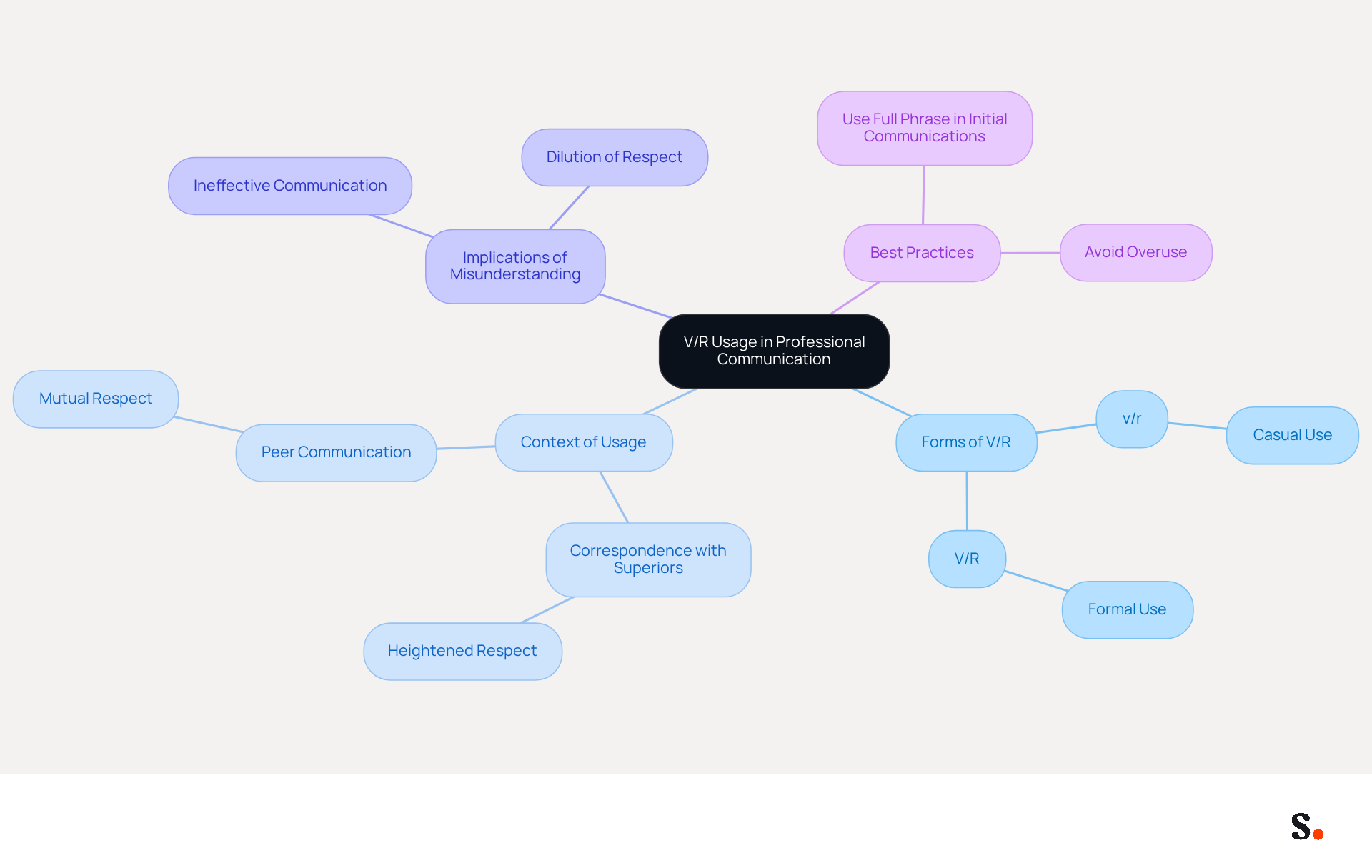
- Studies show that emails with respectful sign-offs, such as V/R, see a response rate of 57.9%, while emails with a V/R sign-off experience an even higher response rate of 65.7%.
- Moreover, formal approvals can increase response rates by 22%, highlighting their significance in improving interaction effectiveness.
- Additionally, maintaining consistency in using V/R across communications helps establish a professional identity and reinforces a respectful approach, ultimately contributing to stronger professional relationships.
- However, neglecting to proofread can lead to misunderstandings, undermining the professionalism of the communication.
- Using V/R too frequently can lessen its effectiveness, making it less impactful in critical communications.
- Ultimately, judicious use of V/R can enhance professional relationships and communication outcomes.
Trace the Origins: Historical Background of V/R in Email Communication
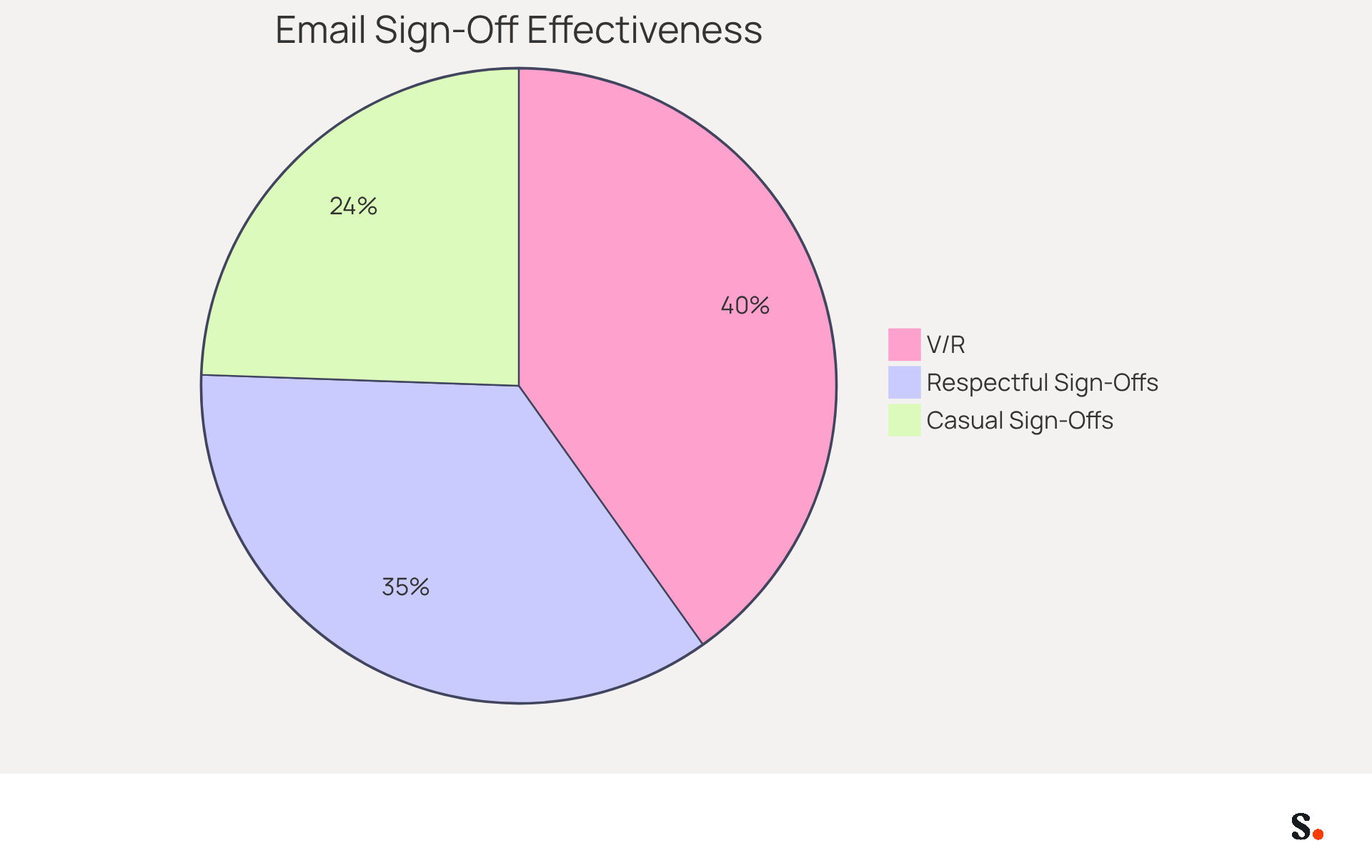
The term 'V/R,' or 'Very Respectfully,' embodies a tradition of formal communication that has evolved significantly over time, leading to the question of what does v/r mean. Its origins lie in U.S. military correspondence, where it has long served as a formal closing in letters and emails. This practice developed to ensure a respectful tone when communicating with superiors. Historically, 'V/R' has been a standard sign-off across all branches of the U.S. Armed Forces, leading to the inquiry of what does v/r mean in reflecting the hierarchical nature of military interactions. When a junior officer communicates with a senior officer, it is commonly used to reinforce respect and professionalism in these interactions, which raises the question of what does v/r mean.
As interactions progressed, the use of 'V/R' gradually expanded beyond military contexts into civilian business environments. Today, it is recognized as a formal sign-off in various sectors, including government and corporate settings, particularly where there are ties to military personnel, leading many to ask what does v/r mean. The adaptation of 'V/R' in these contexts highlights what does v/r mean in promoting respectful interactions, which are increasingly valued in workplace settings.
Research shows that using respectful sign-offs can boost response rates, with some studies reporting increases up to 57.9%. This highlights the significance of selecting suitable sign-offs in written correspondence, as they can greatly influence how recipients view the sender and the overall message. Expert Sophie Grant notes that 'V/R' conveys respect in professional communication, prompting the inquiry of what does v/r mean in this context.
Proper formatting of 'V/R' includes a comma following the sign-off, which contributes to a refined tone in messages. However, despite its historical significance, the relevance of 'V/R' is challenged by the evolving preferences in business communication, raising the question of what does v/r mean as simpler sign-offs become more favored. Additionally, for non-military audiences, it is important to clarify what does v/r mean, as it may cause confusion, making it essential to consider the context and audience when selecting an appropriate closing. This shift in preference underscores the necessity for professionals to tailor their communication style to their audience. Recognizing the historical context of 'V/R' can really help in using it effectively today, reminding us of the importance of respect in workplace communication.
Explore Variations: Key Characteristics and Contexts of V/R Usage
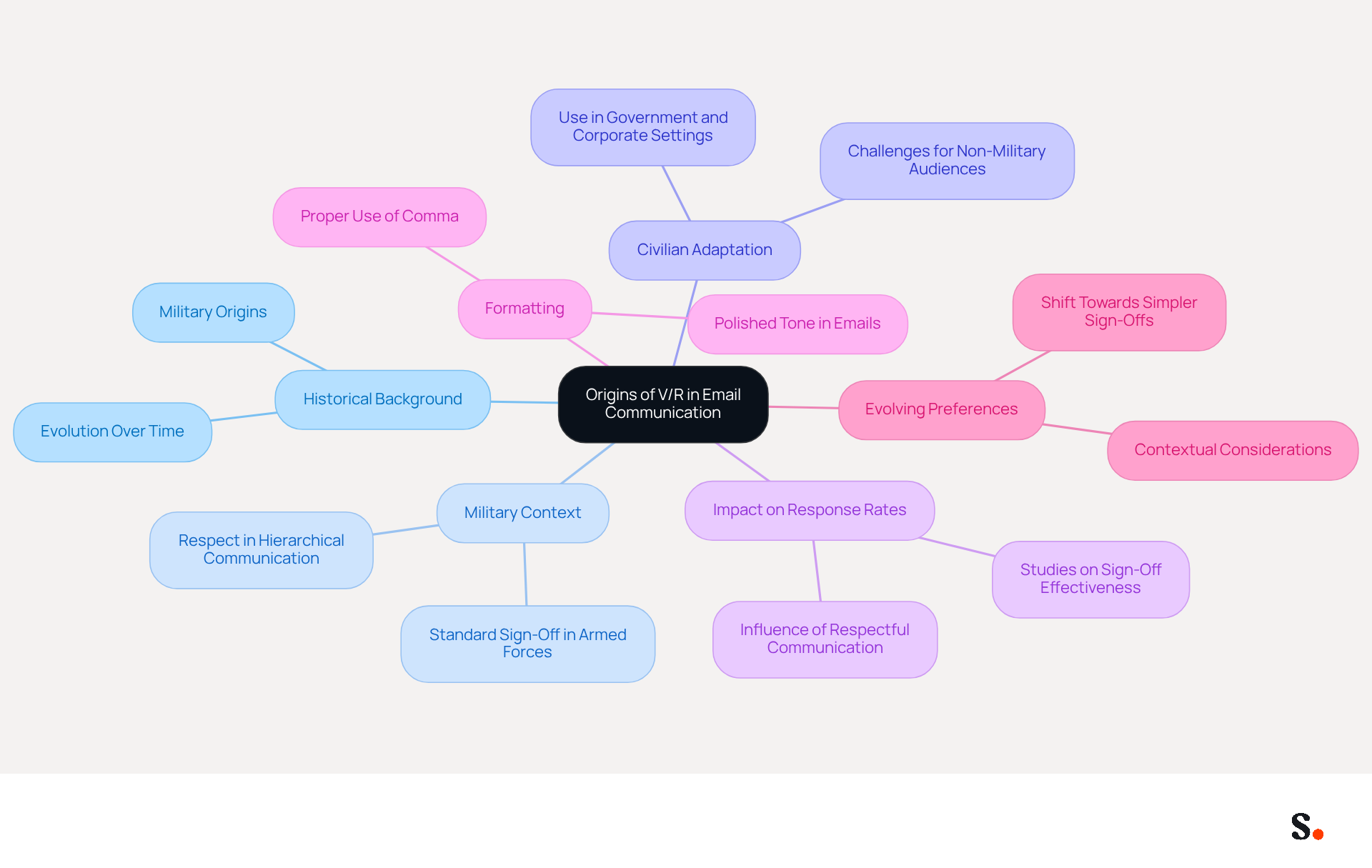
Understanding what does v/r mean is essential for effective electronic communication in professional settings. When discussing the variations of v/r, one might ask, what does v/r mean, as it can manifest in several forms, including 'v/r' and 'V/r,' each signifying different levels of formality and context. The lowercase 'v/r' is often seen as a more casual option, suitable for informal workplace communications, while 'V/R' follows formal etiquette closely.
V/R originated in the US military and government, emphasizing respectful interaction, particularly in hierarchical contexts. The context of usage significantly influences interpretation; for example, understanding what does v/r mean when used in correspondence with a superior conveys a heightened level of respect compared to its application among peers. Misunderstanding the nuances of V/R can lead to ineffective communication in professional settings.
By selecting the appropriate form of V/R, senders can tailor their messages to meet audience expectations, enhancing clarity and respect. Case studies indicate that emails utilizing the V/R sign-off experience a response rate of 57.9%, underscoring the significance of respectful interaction in professional settings. Additionally, the SECNAV Manual suggests using the full phrase 'Very Respectfully' in initial communications, reinforcing the need for clarity and professionalism in formal exchanges.
It is also important to avoid overusing the V/R sign-off, as this can dilute its impact and effectiveness. Ultimately, the thoughtful application of V/R can significantly enhance the quality of professional interactions.
Conclusion
The role of V/R, or 'Very Respectfully,' in email communication is pivotal for upholding professionalism across various contexts. This formal sign-off not only conveys respect but also enhances the likelihood of receiving a response, particularly in hierarchical settings such as military and corporate environments. By utilizing V/R appropriately, professionals can ensure their communications reflect the necessary decorum and respect expected in formal interactions.
Key insights include:
- The historical origins of V/R in military correspondence
- Its effectiveness in improving response rates
- The importance of context in its usage
The data shows that emails featuring respectful sign-offs like V/R can achieve response rates as high as 65.7%, underscoring the value of maintaining a formal tone in professional exchanges. Additionally, the article emphasizes the need for careful consideration of when and how to use V/R to avoid diminishing its impact.
Despite evolving communication styles, the relevance of V/R continues to hold strong. Professionals are encouraged to embrace this sign-off as a means of fostering respectful dialogue and enhancing their professional relationships. By mastering the use of V/R, professionals can elevate their communication and strengthen their professional networks in an increasingly complex business landscape.
Frequently Asked Questions
What does V/R stand for in email communication?
V/R stands for 'Very Respectfully,' and it is a formal email sign-off used predominantly in military and business interactions.
Why is the V/R sign-off important?
The V/R sign-off conveys deference and respect, particularly in hierarchical settings, and is favored for its professionalism and adherence to established etiquette.
How does using V/R affect response rates in emails?
Emails featuring respectful sign-offs like V/R achieve a response rate of 57.9%. When gratitude is expressed in the sign-off, response rates can increase to 65.7%.
In what contexts is V/R commonly used?
V/R is commonly used in military correspondence, where junior members show respect towards senior members, and in business communications targeting government contracts to align with formal standards.
What challenges are associated with the decline in V/R usage?
The decline in V/R usage poses a challenge for professionals aiming to maintain formality in communications, as simpler sign-offs are becoming more favored, potentially undermining professionalism.
When should V/R be used in professional communication?
V/R should be used in formal interactions, especially when addressing high-ranking individuals or in fields that prioritize respect-driven interactions, to ensure messages reflect professionalism and comply with industry-specific etiquette.
List of Sources
- Define V/R: Understanding Its Meaning in Email Communication
- What V/R Email Sign Off Means and When to Use It (https://designmodo.com/v-r-email-sign-off)
- What is V/R in email? — Stripo.email (https://stripo.email/glossary/what-is-v-r-in-email)
- What Does V/R Stand For in Email Communication? (https://scribe-mail.com/en-US/blog/what-does-v-r-stand-for-in-email-communication)
- Learn What V/r Means in an Email and How to Use It Properly (https://tabular.email/blog/what-does-vr-mean-in-email)
- What Does V/R Mean in an Email Signature? (https://bulksignature.com/blog/what-does-v-r-mean-in-an-email-signature)
- Contextualize V/R: Importance in Professional Email Sign-Offs
- The effectiveness of the email signature as a “point of contact” (https://signitic.com/en/resources/the-effectiveness-of-the-email-signature-as-a--point-of-contact)
- 10 Email Ending Examples to Enhance Your Professional Communication (https://scribe-mail.com/en-US/blog/10-email-ending-examples-to-enhance-your-professional-communication)
- Master the V/R Email Sign Off: Enhance Your Professional Communication (https://scribe-mail.com/en-US/blog/master-the-v-r-email-sign-off-enhance-your-professional-communication)
- What is V/R Meaning in Email Communication? (https://scribe-mail.com/en-US/blog/what-is-v-r-meaning-in-email-communication)
- What V/R Email Sign Off Means and When to Use It (https://designmodo.com/v-r-email-sign-off)
- Trace the Origins: Historical Background of V/R in Email Communication
- What Does V/R Mean in an Email Signature? (https://bulksignature.com/blog/what-does-v-r-mean-in-an-email-signature)
- What V/R Email Sign Off Means and When to Use It (https://designmodo.com/v-r-email-sign-off)
- What Does V/R Stand For in Email Communication? (https://scribe-mail.com/en-US/blog/what-does-v-r-stand-for-in-email-communication)
- What is V/R in email? — Stripo.email (https://stripo.email/glossary/what-is-v-r-in-email)
- Explore Variations: Key Characteristics and Contexts of V/R Usage
- What V/R Email Sign Off Means and When to Use It (https://designmodo.com/v-r-email-sign-off)
- Learn What V/r Means in an Email and How to Use It Properly (https://tabular.email/blog/what-does-vr-mean-in-email)
- Master the V/R Email Sign Off: Enhance Your Professional Communication (https://scribe-mail.com/en-US/blog/master-the-v-r-email-sign-off-enhance-your-professional-communication)
- What Does V/R Stand For in Email Communication? (https://scribe-mail.com/en-US/blog/what-does-v-r-stand-for-in-email-communication)
- What is V/R in email? — Stripo.email (https://stripo.email/glossary/what-is-v-r-in-email)
Get started with Scribe
Build a professional email signature
Free 14-day trial — no credit card.