4 Best Practices for Your Signature Block Template Strategy
In a marketplace saturated with competition, many organizations find it challenging to differentiate themselves, yet email signatures remain an underutilized
Sophie Grant
Email Signature Specialist, Scribe

Introduction
In a marketplace saturated with competition, many organizations find it challenging to differentiate themselves, yet email signatures remain an underutilized asset. Email signatures, often overlooked, serve as a powerful tool for reinforcing brand consistency and driving engagement. This discussion will outline four best practices for creating signature block templates that enhance brand recognition and drive marketing performance. By implementing these strategies, businesses can ensure their email signatures become powerful marketing tools that enhance brand visibility and engagement.
Establish Brand Consistency in Signature Design
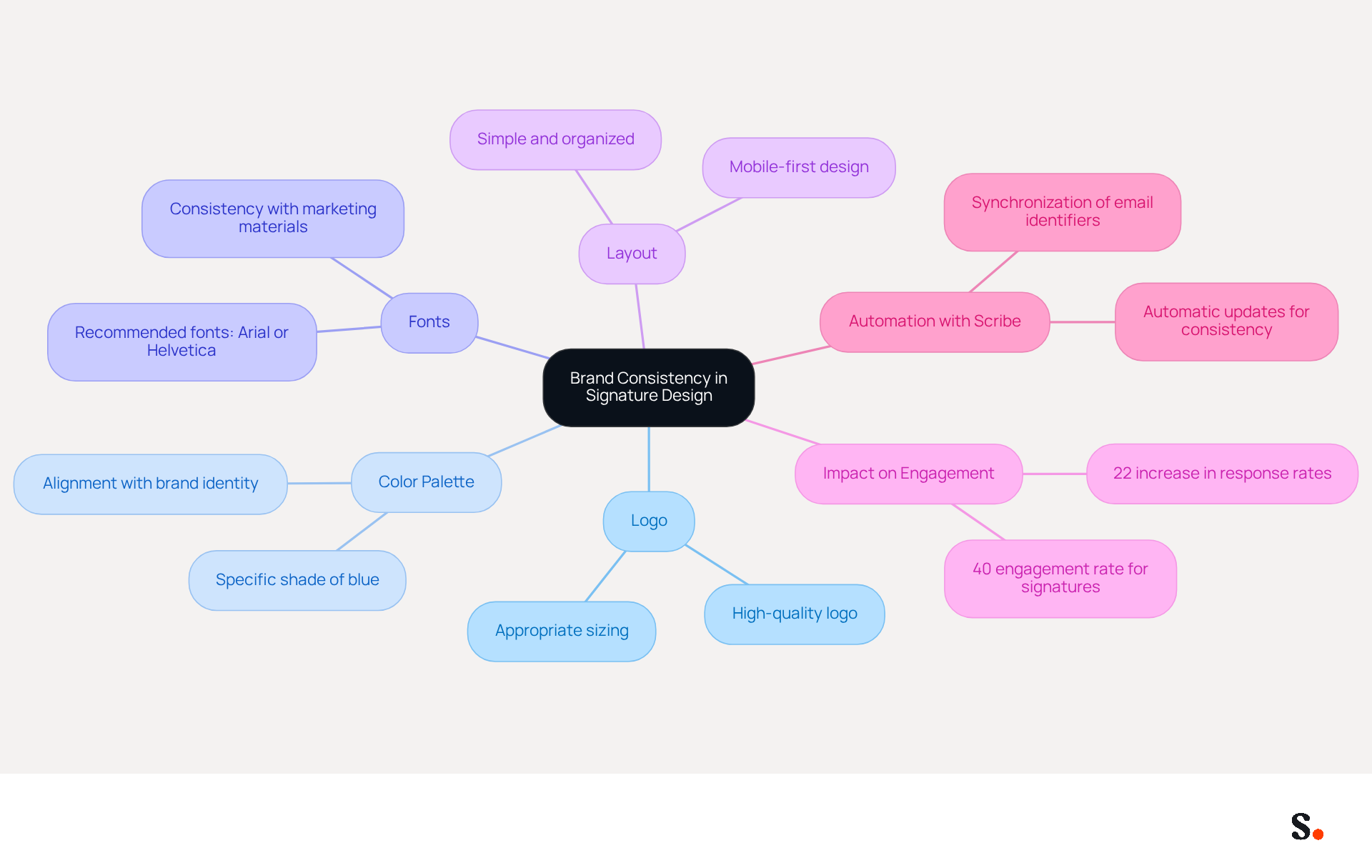
To ensure your communication design resonates, start with your company's logo, colors, and fonts. A high-quality logo, sized appropriately, ensures clarity across various email clients. Align your color palette with your identity; for instance, if your identity features a specific shade of blue, this should be reflected in your signature block template. Choosing fonts that align with your other marketing materials is essential for maintaining a cohesive image.
Keep the layout simple and organized to avoid clutter that can distract from essential information. This approach enhances brand identity and boosts professionalism in all communications. Research shows that companies with consistent messaging see a 22% increase in response rates, demonstrating how a well-crafted format can significantly boost engagement.
Recent trends suggest that by 2026, digital signatures are transforming into conversion tools, highlighting the necessity for mobile-first design and strategic calls to action. Research indicates that organizations adopting centralized management of digital identifiers experience an 85% boost in consistency and three times greater engagement in campaigns. By treating digital communication footers as a strategic resource instead of a secondary consideration, companies can greatly improve their marketing impact and perception.
With Scribe, you can automate the synchronization of email identifiers with your business phone system, ensuring that any changes made in your Aircall configuration are automatically reflected in your Scribe identifiers. This seamless integration not only saves time but also ensures that your teammates' identification information is always up-to-date, enhancing brand consistency across all communications. Additionally, Scribe's SOC 2 Type II compliance ensures that your data is secure, allowing you to focus on your marketing strategies with peace of mind.
Incorporate Effective Call-to-Action Elements
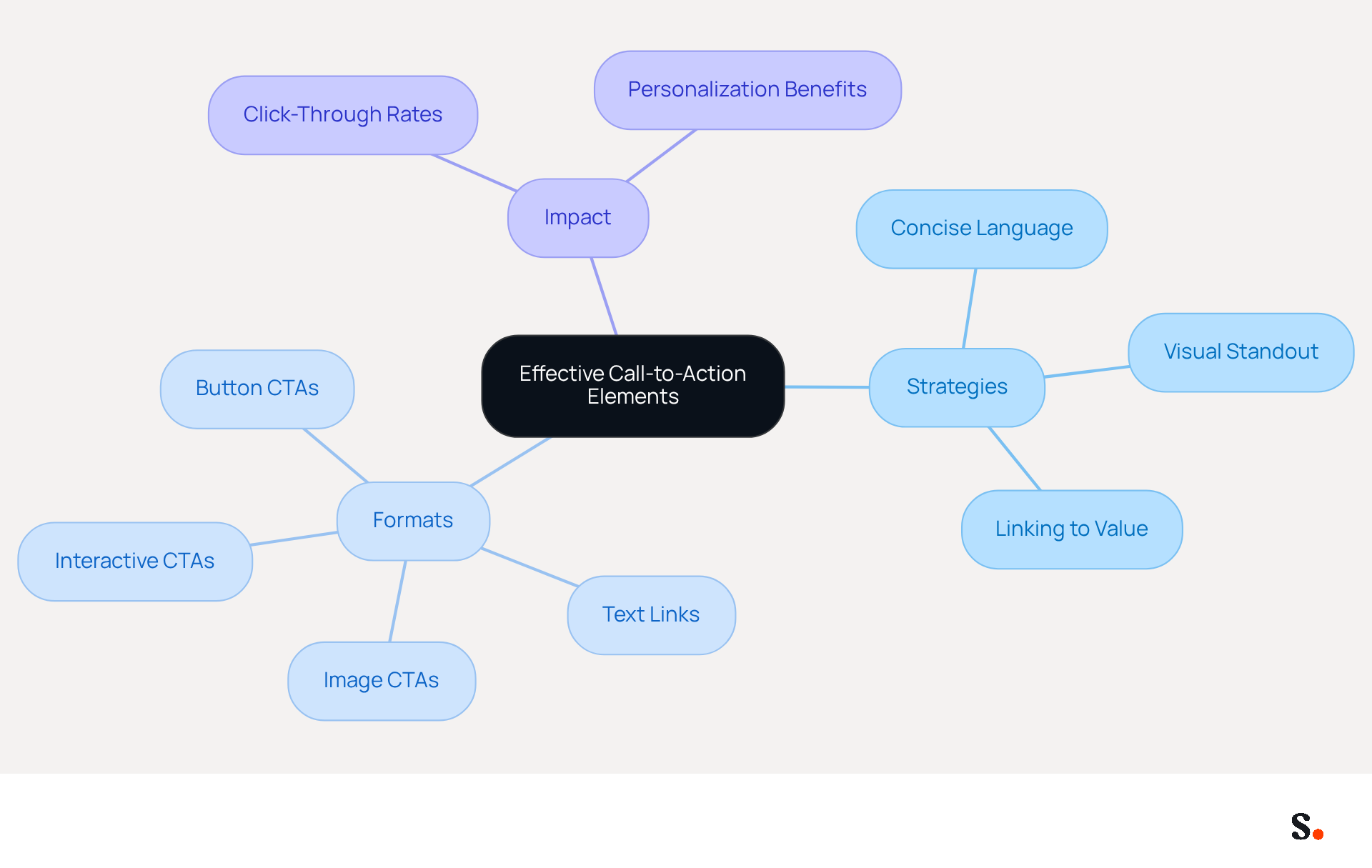
Incorporating effective call-to-action elements in your message footer is essential for maximizing engagement. Utilize concise and action-oriented language, such as:
- 'Schedule a Demo'
- 'Download Our Guide'
- 'Visit Our Website'
to prompt recipients to take immediate action. Ensure that the CTA stands out visually by using contrasting colors or buttons that capture attention. Linking the CTA to a specific landing page that offers value, like a promotional offer or informative resource, can further enhance engagement.
Internal analytics show that effective CTAs can lead to click-through rates as high as 7%, demonstrating their impact. Tracking the performance of these CTAs through analytics is crucial for refining your approach and improving engagement rates over time. For instance, organizations that have adopted personalized CTAs in their correspondence have experienced engagement boosts of up to 371%, highlighting the significance of customizing messages for the audience.
Furthermore, consider the four primary CTA formats:
- Button CTAs
- Text links
- Image CTAs
- Interactive CTAs
as each fulfills different roles and contexts within communication strategies. Focusing on these strategies and avoiding common pitfalls, like excessive CTAs or vague language, can help you make the most of your email signatures.
Utilize Automation for Efficient Signature Management
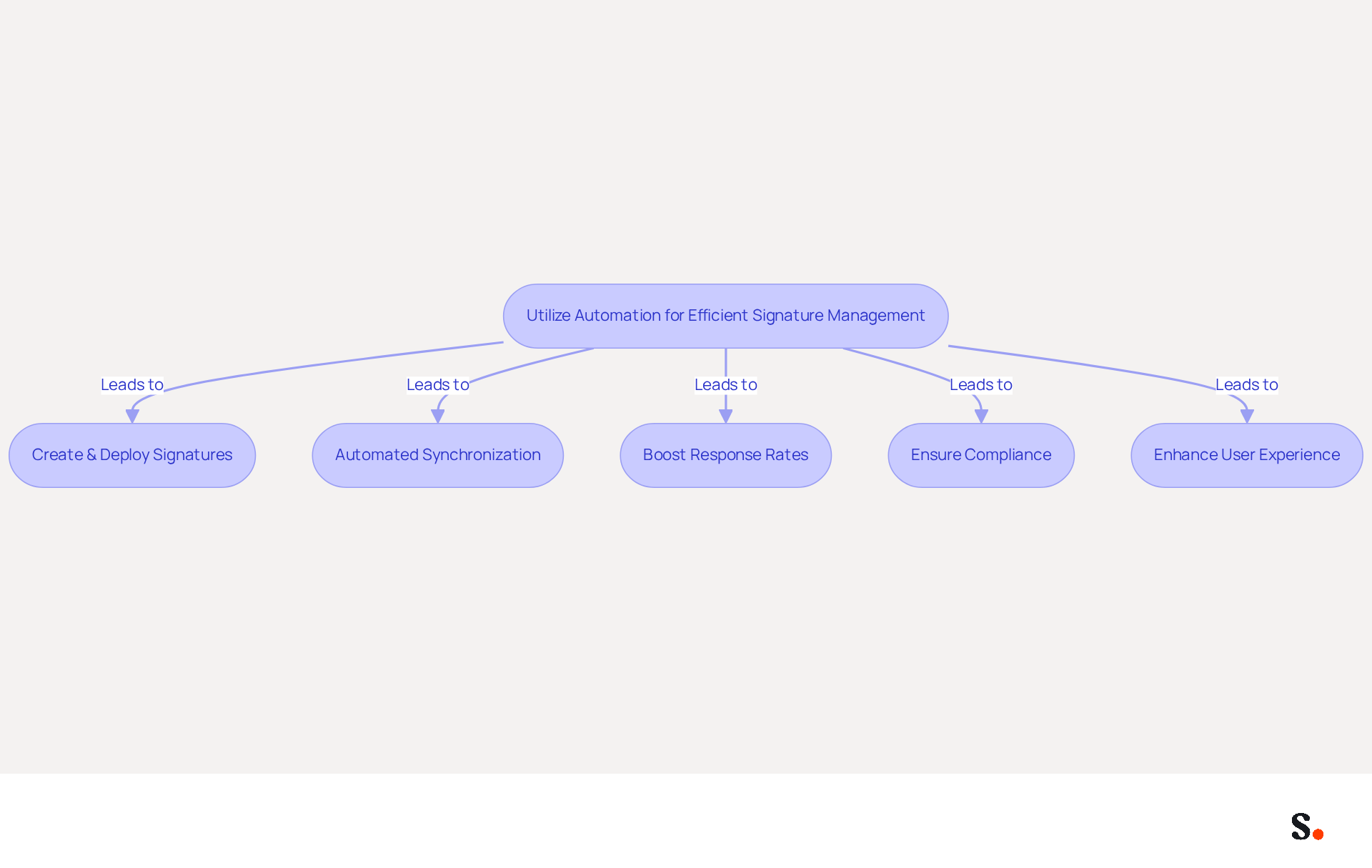
Managing email signatures manually can lead to inconsistencies and compliance risks, making a specialized tool like Scribe essential for effective management. Scribe allows organizations to create, deploy, and update electronic communications with just a few clicks, ensuring that every email reflects the brand's identity and adheres to compliance standards.
With automated synchronization from your business phone system, Scribe ensures that employee identification information is always current, minimizing the risk of outdated details without requiring action from your teammates. Research shows that using branded signatures can boost response rates by 22%, and adding dynamic banners to signatures can produce a 25% increase in click-through rates to specific landing pages.
Streamlining the management of email signatures allows teams to focus on strategic initiatives while ensuring a professional appearance in every email. Scribe's adherence to SOC 2 Type II and GDPR standards guarantees secure data management, reinforcing adherence to legal standards and enhancing corporate identity.
The integration of Scribe's SAML single sign-on enhances security and simplifies access for employees, further improving user experience. Case studies illustrate that organizations adopting automated systems, like Scribe, gain increased agility and responsiveness to market changes, enabling compliance teams to manage content independently.
By automating messaging, Scribe not only ensures compliance but also enhances engagement, making it an essential tool for organizations seeking 100% brand consistency and measurable marketing ROI from messaging.
Test and Optimize Signature Templates for Engagement
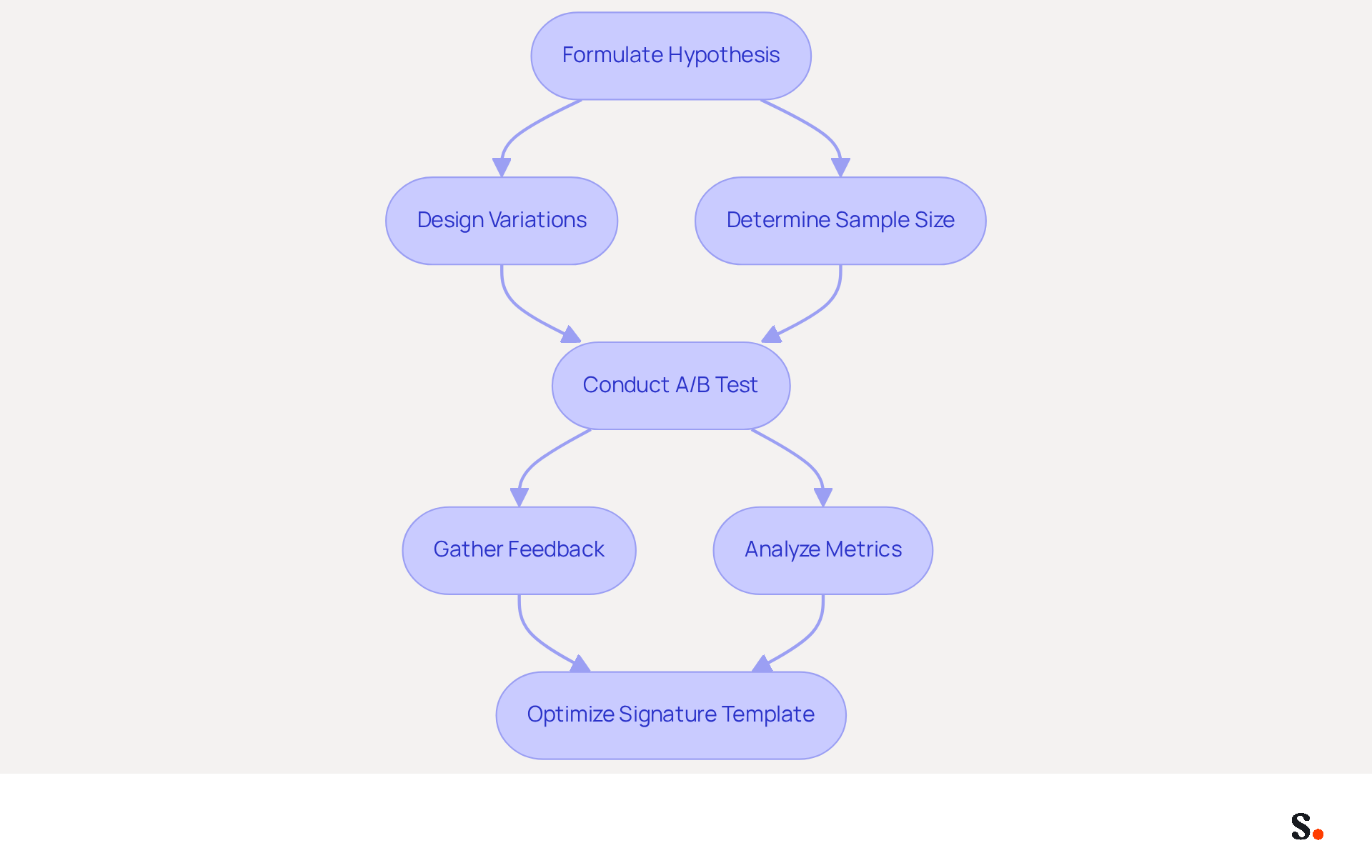
To maximize engagement, it is crucial to analyze key performance metrics such as click-through rates (CTR) and conversion rates associated with your calls to action (CTAs). Many businesses overlook the potential of A/B testing, missing out on significant engagement boosts. Implementing A/B testing on various design styles allows you to identify which elements resonate most with your audience. For instance, variations in color schemes, layouts, or the phrasing of your CTAs can reveal which version generates more clicks. Furthermore, gathering feedback from recipients can offer valuable insights that quantitative metrics might miss, aiding you in understanding their views of your mark. By implementing A/B testing, businesses can significantly enhance their email marketing effectiveness.
Moreover, it is essential to uphold brand consistency across your communication footers, particularly in the signature block template, as it strengthens recognition and trust among recipients. A structured approach to A/B testing, including formulating a testable hypothesis and estimating required sample sizes, is essential for effective testing. Be mindful of common pitfalls, such as stopping tests too soon or changing multiple elements at once, to avoid misapplication of the practice. Ultimately, a strategic approach to A/B testing can redefine your email signatures as essential tools for driving customer loyalty.
Conclusion
A well-crafted signature block template strategy is crucial for ensuring brand consistency and enhancing engagement in email communications. Focusing on cohesive design elements, effective calls to action, and automation tools allows organizations to turn their email signatures into impactful marketing assets that showcase their brand identity and deliver measurable results.
Key practices discussed include:
- The importance of maintaining a consistent visual identity through logos, colors, and fonts, which can lead to a notable increase in response rates, as evidenced by recent studies.
- Incorporating compelling CTAs not only encourages immediate action but also enhances engagement metrics, with personalized approaches yielding remarkable increases in interaction.
- Leveraging automation tools like Scribe streamlines signature management, ensuring compliance and up-to-date information while freeing teams to concentrate on strategic initiatives.
As digital communication becomes more essential, organizations must recognize the potential of their email signatures as strategic resources. By implementing these best practices, businesses can achieve 100% brand consistency and measurable marketing ROI, ultimately fostering stronger connections with their audience. Adopting these strategies not only solidifies brand identity but also empowers organizations to thrive in a competitive digital landscape.
Frequently Asked Questions
What is the importance of brand consistency in signature design?
Brand consistency in signature design enhances brand identity and professionalism in communications, leading to improved engagement and response rates.
How should a company's logo be used in email signatures?
A high-quality logo should be sized appropriately to ensure clarity across various email clients.
What elements should align with a company's identity in signature design?
The color palette and fonts used in the signature should reflect the company's identity, such as specific shades and styles found in other marketing materials.
What layout considerations should be made for email signatures?
The layout should be simple and organized to avoid clutter, which can distract from essential information.
What impact does consistent messaging have on response rates?
Research shows that companies with consistent messaging see a 22% increase in response rates.
How are digital signatures expected to evolve by 2026?
Digital signatures are transforming into conversion tools, emphasizing the need for mobile-first design and strategic calls to action.
What benefits do organizations experience by centralizing management of digital identifiers?
Organizations that centralize management of digital identifiers experience an 85% boost in consistency and three times greater engagement in campaigns.
How does Scribe enhance brand consistency in communications?
Scribe automates the synchronization of email identifiers with business phone systems, ensuring that any changes are automatically reflected in Scribe identifiers, keeping information up-to-date.
What compliance does Scribe offer to ensure data security?
Scribe is SOC 2 Type II compliant, ensuring that user data is secure while allowing companies to focus on their marketing strategies.
List of Sources
- Establish Brand Consistency in Signature Design
- Why Email Signatures Must Be In Your 2026 Marketing Plan | Rocketseed (https://rocketseed.com/blog/what-are-the-biggest-email-trends-for-2026)
- Email Signature Best Practices for 2026 (+ 15 Pro Examples) (https://wavecnct.com/blogs/email-signature-best-practices-2026)
- The impact of email signatures on your branding (https://signitic.com/en/resources/the-impact-of-email-signatures-on-your-branding)
- Incorporate Effective Call-to-Action Elements
- Email call to action best practices: The complete guide [2026] — Stripo.email (https://stripo.email/blog/email-call-action-best-practices-examples)
- The Ultimate Guide to Email Signature Call-to-Action - NEWOLDSTAMP (https://newoldstamp.com/blog/the-ultimate-guide-to-email-signature-call-to-action)
- 15 CTA Best Practices to Increase Conversions (2026) (https://ventureharbour.com/15-call-action-best-practices-increase-conversions)
- Call to Action in Emails: Examples, Templates, Tips [2026] (https://mailtrap.io/blog/call-to-action-in-emails)
- Do CTAs help to improve email response rates? (https://campaignmonitor.com/resources/knowledge-base/do-ctas-help-to-improve-email-response-rates)
- Utilize Automation for Efficient Signature Management
- 40+ Email Signature Statistics for 2026 (Data + Insights) (https://wavecnct.com/blogs/email-signature-statistics)
- Why Email Signatures Will Matter More in an AI-Driven Workplace | Crossware365 (https://crossware365.com/blog/why-email-signatures-will-matter-more-in-an-ai-driven-workplace)
- Automating Email Signatures: How IT Teams Streamline Processes & Reduce Risk (https://exclaimer.com/blog/streamlining-it-processes-automated-email-signatures)
- How to Automate Email Signatures for Effective Marketing Campaigns (https://scribe-mail.com/en-US/blog/how-to-automate-email-signatures-for-effective-marketing-campaigns)
- Email Signature Trends 2026: Centralized Control & Automation | SIGNandGO posted on the topic | LinkedIn (https://linkedin.com/posts/signngo_email-signature-trends-to-watch-in-2026-activity-7401523471786217473-zAVL)
- Test and Optimize Signature Templates for Engagement
- Email Signature A/B Testing: Methodology, UTM and GA4 Guide (https://signitic.com/en/resources/a-b-testing-your-email-signature-methodology-and-kpis)
- 12 A/B Testing Ideas for Email, SMS, & Web Forms - Klaviyo (https://klaviyo.com/blog/ab-testing-ideas)
- Maximize Engagement: Best Practices for Your Email Signature (https://scribe-mail.com/en-US/blog/maximize-engagement-best-practices-for-your-email-signature)
- Beyond the Sign-Off: Leveraging Email Signature Analytics for Strategic Insights (https://patronum.io/beyond-the-sign-off-leveraging-email-signature-analytics-for-strategic-insights)
- Retention Marketing with Email Signatures in 2026 | Rocketseed (https://rocketseed.com/blog/retention-marketing-with-email-signatures)
Get started with Scribe
Build a professional email signature
Free 14-day trial — no credit card.