Master Business Sign-Off Emails: Best Practices for Impactful Communication
Crafting effective email sign-offs is not merely a formality; it plays a pivotal role in shaping professional relationships. A well-crafted closing not only
Sophie Grant
Email Signature Specialist, Scribe

On this page
- Introduction
- Understand the Importance of Email Sign-Offs in Business Communication
- Follow Key Guidelines for Effective Email Sign-Offs
- Select Appropriate Sign-Offs for Different Contexts and Relationships
- Incorporate Branding and Marketing Strategies into Your Sign-Offs
- Conclusion
- Frequently Asked Questions
- List of Sources
Introduction
Crafting effective email sign-offs is not merely a formality; it plays a pivotal role in shaping professional relationships. A well-crafted closing not only reinforces the tone of the message but also enhances the likelihood of a positive response. Many professionals struggle to find the right tone in their email sign-offs, leading to missed opportunities for connection. In this article, we’ll explore best practices for crafting impactful email sign-offs that elevate communication and foster stronger connections in the professional realm.
Understand the Importance of Email Sign-Offs in Business Communication
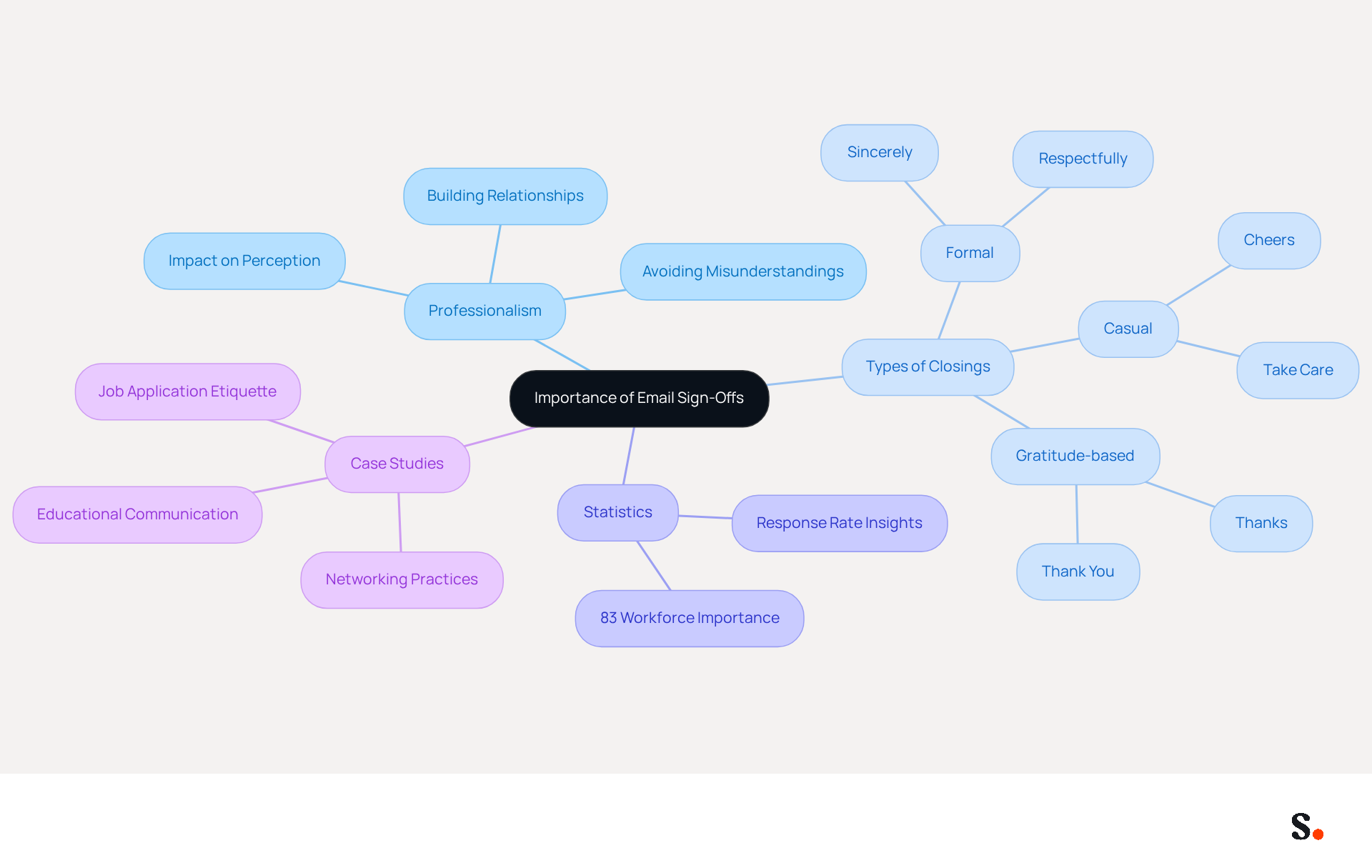
The way you conclude your emails can significantly shape the recipient's perception of your professionalism. A well-selected closing can reinforce your tone, convey professionalism, and even increase the chances of a response. In business interactions, a poorly chosen closing can lead to misunderstandings and weaken professional ties. For instance, using a formal sign-off like 'Sincerely' in a first-time interaction establishes respect, while a casual 'Cheers' may be more appropriate for colleagues with whom you have an established rapport. Understanding the nuances of email closings can significantly enhance your ability to convey messages and build stronger professional relationships.
Statistics indicate that 83% of the workforce sees email as crucial for their success, which underscores how important effective interaction strategies are. Research shows that gratitude-based closings, such as 'Thanks' or 'Thank you,' outperform neutral alternatives, yielding higher response rates. Specifically, gratitude-based closings have been shown to generate significantly higher engagement, making them a powerful tool in your messaging arsenal.
Case studies further demonstrate the effect of closings on business interactions. For example, in networking situations, warm and engaging farewells can promote ongoing communication and relationship building. Conversely, using overly casual closings in formal contexts can lead to misunderstandings and diminish professionalism. The considerate use of messages like 'Take Care' can transform professional relationships, fostering a more collaborative work environment.
In 2026, as businesses continue to navigate evolving communication landscapes, understanding the subtleties of electronic correspondence closings will be essential for enhancing communication effectiveness and building stronger professional relationships. Effective closings can significantly enhance your professional relationships and communication outcomes.
Follow Key Guidelines for Effective Email Sign-Offs
To craft effective email sign-offs, it is essential to consider several key guidelines that enhance professionalism and clarity:
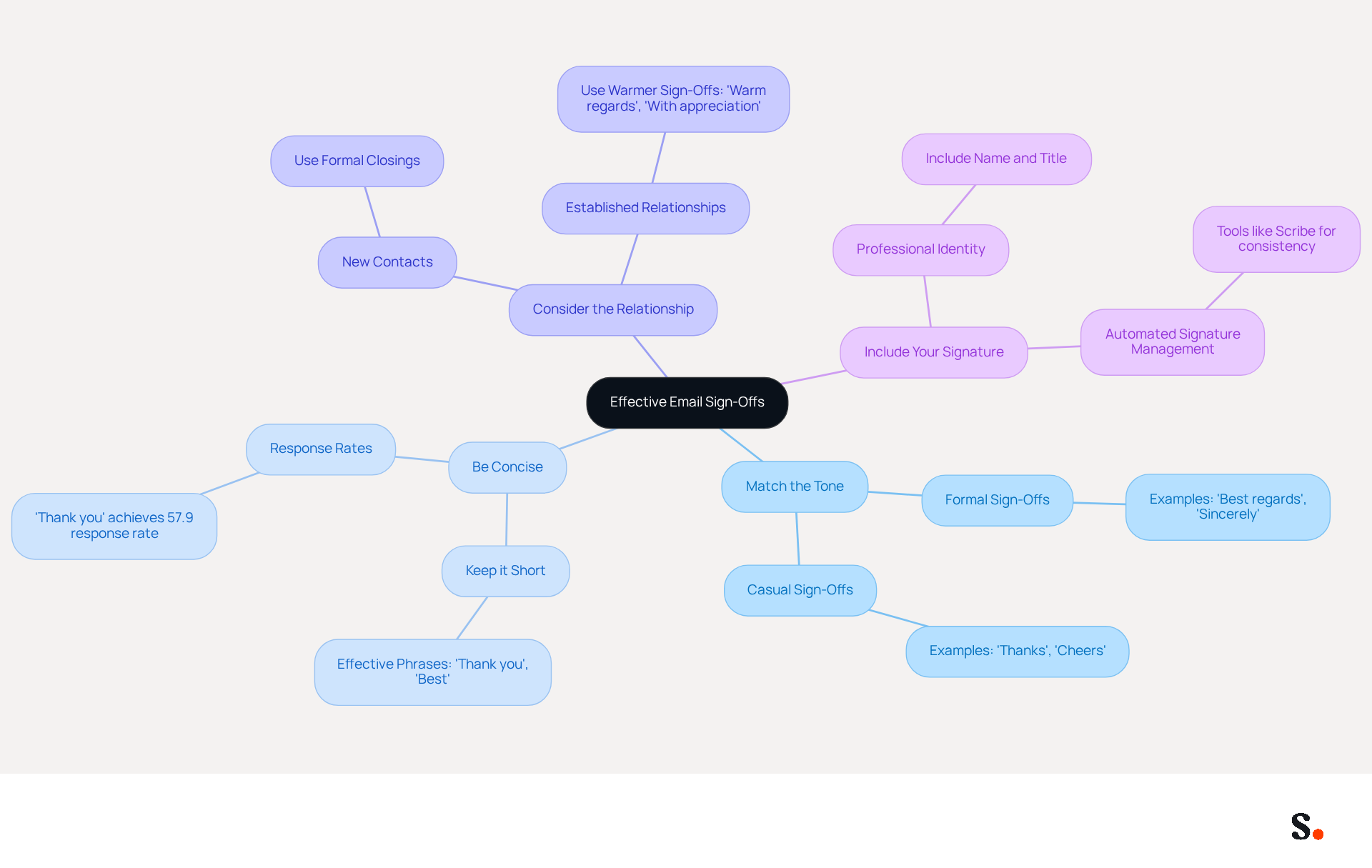
- Match the Tone: Align your sign-off with the overall tone of your message. For formal emails, use sign-offs like 'Best regards' or 'Sincerely.' In contrast, for more casual communications, 'Thanks' or 'Cheers' may be appropriate. This alignment can significantly enhance the recipient's perception of your professionalism.
- Be Concise: Keep your closing brief. A simple 'Thank you' or 'Best' is often sufficient. Research shows that concise conclusions boost response rates, with 'Thank you' achieving a 57.9% response rate, making it a solid professional choice.
- Consider the Relationship: Tailor your sign-off based on your relationship with the recipient. Use more formal closings for new contacts and casual ones for colleagues. For instance, established relationships can benefit from warmer sign-offs like 'Warm regards' or 'With appreciation.' This approach fosters goodwill and strengthens connections.
- Include Your Signature: Always follow your sign-off with your name and title to maintain professionalism. A well-crafted signature enhances your professional identity and provides recipients with necessary contact information, ensuring clarity and credibility in your communications. Scribe's automated signature management allows you to keep your signatures current without hassle, reflecting any changes in your Google Workspace without manual input. Additionally, Scribe's SAML single sign-on integration ensures secure access management, further enhancing the reliability of your signature. This approach saves you time and helps maintain compliance with GDPR and SOC 2 Type II standards, providing peace of mind regarding data security.
By implementing these strategies, you can significantly improve the effectiveness of your email communications and foster stronger professional relationships.
Select Appropriate Sign-Offs for Different Contexts and Relationships
Choosing the right email closing is crucial for effective communication, as it varies based on context and relationship with the recipient. Here are some examples:
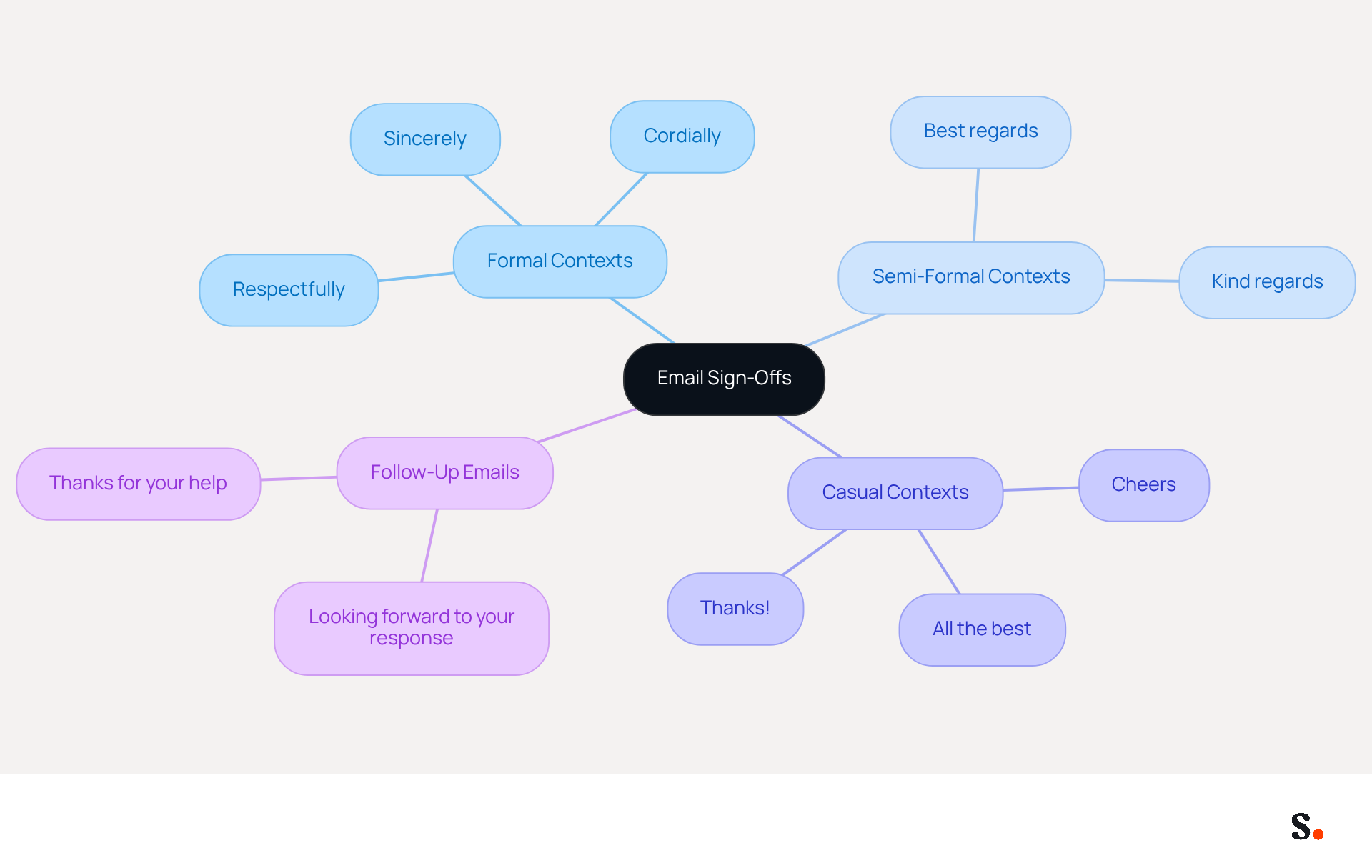
- Formal Contexts: For initial interactions or official requests, use closings like 'Sincerely' or 'Respectfully.'
- Semi-Formal Contexts: In situations where you have established a rapport, 'Best regards' or 'Kind regards' can be effective.
- Casual Contexts: For colleagues or friends, feel free to use 'Cheers' or 'Thanks!'
- Follow-Up Emails: When following up on a previous conversation, consider using 'Looking forward to your response' or 'Thanks for your help.'
Selecting the appropriate sign-off enhances the clarity and effectiveness of your communication. Ultimately, the right sign-off can leave a lasting impression and foster stronger connections in your professional interactions.
Incorporate Branding and Marketing Strategies into Your Sign-Offs
To maximize the effectiveness of your email sign-offs, integrating branding elements is crucial. Here are some effective strategies:
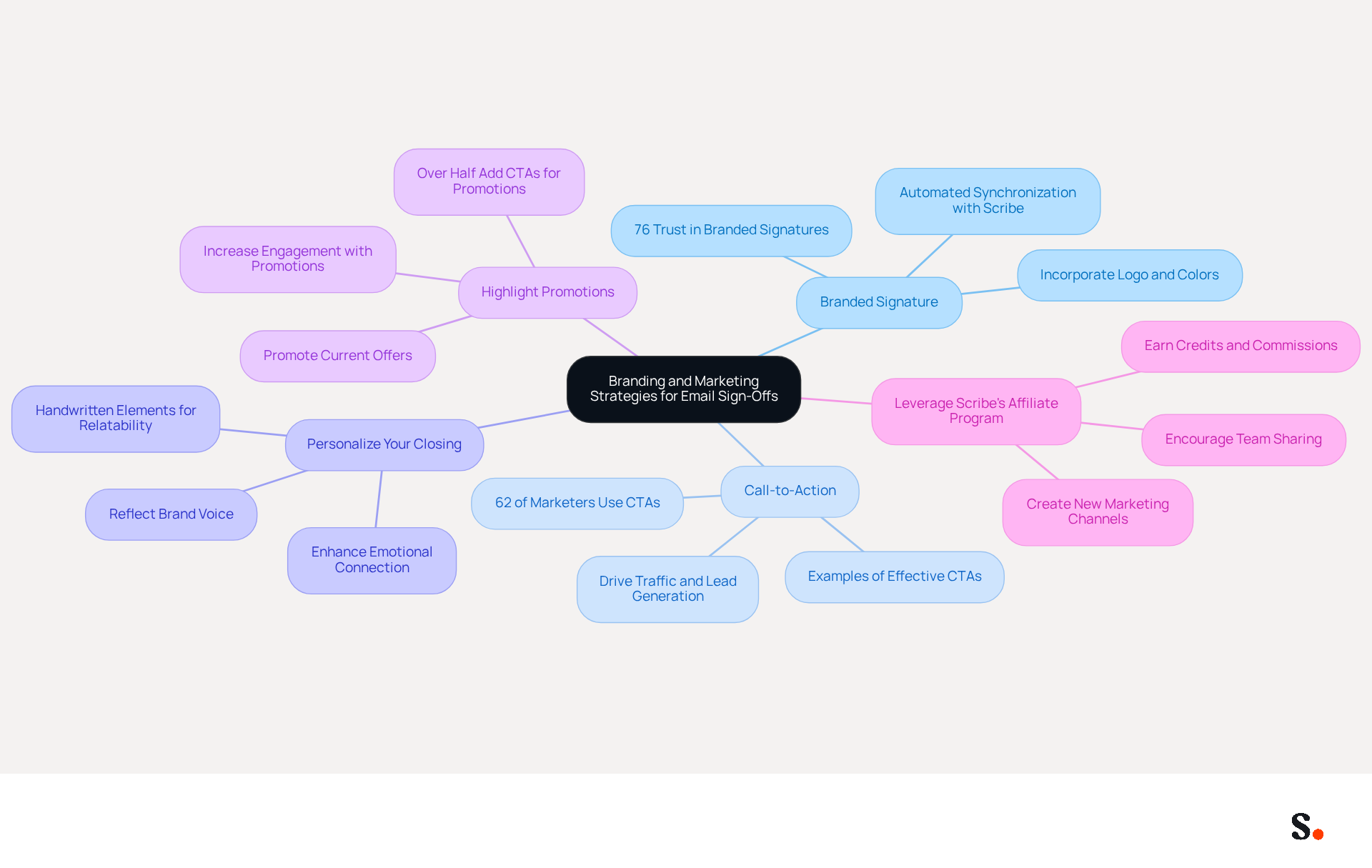
- Use a Branded Signature: Incorporate your company logo, colors, and fonts into your signature. This consistency strengthens brand identity and boosts recognition; 76% of people trust senders with branded email signatures. Additionally, with Scribe's automated synchronization with Aircall, any changes made in your configuration will be instantly reflected in your signatures, ensuring brand consistency across all communications.
- Add a Call-to-Action: Including a brief call-to-action (CTA) in your closing can greatly enhance engagement levels. For instance, phrases like 'Visit our website for more information' or 'Check out our latest offerings' can drive traffic and lead generation, with 62% of marketers using email signatures for marketing purposes.
- Personalize Your Closing: Tailor your closing to reflect your brand's voice. If your brand is recognized for being friendly and approachable, choose a casual closing that aligns with that image. Personal touches, such as handwritten elements, can enhance relatability and foster a stronger connection with recipients.
- Highlight Promotions: Use your sign-off to promote current offers or campaigns. For example, a message like 'Don't miss our summer sale!' can effectively capture attention and encourage action. Including promotional elements in signatures can increase engagement; over half of users add CTAs to their signatures.
- Leverage Scribe's Affiliate Program: Encourage your team to share Scribe with others. By doing so, they can earn a $30 credit on their subscription and a 50% commission for the first 12 months on any new sign-ups. This not only encourages brand consistency in signatures but also creates a new marketing channel for your organization.
By adopting these strategies, you can turn your email sign-offs into powerful marketing assets that enhance engagement and drive action, ultimately contributing to your brand's success.
Conclusion
Effective email sign-offs are crucial for shaping perceptions of professionalism in business communication. The way emails are concluded can significantly influence how recipients perceive professionalism and can either strengthen or weaken professional relationships. By understanding the nuances of sign-offs, individuals can enhance their communication strategies, ensuring that their messages resonate positively with recipients.
Aligning sign-offs with the tone of the email is essential for effective communication. Being concise and tailoring closings based on the relationship with the recipient can lead to higher engagement rates. Utilizing gratitude-based closings fosters a positive connection, while incorporating branding elements into signatures reinforces brand identity and recognition. Furthermore, the strategic use of calls-to-action in sign-offs can drive traffic and generate leads, making email signatures a valuable marketing tool.
When you apply these best practices in your daily communication, you'll notice a transformation in your email interactions, fostering stronger connections and enhancing overall effectiveness. As businesses continue to evolve, focusing on impactful email sign-offs can redefine your communication strategy and strengthen your professional presence. Embrace these strategies to elevate your email communication and make every sign-off count.
Frequently Asked Questions
Why are email sign-offs important in business communication?
Email sign-offs significantly shape the recipient's perception of professionalism, reinforce the tone of the message, and can increase the chances of a response.
How can a poorly chosen email closing affect professional relationships?
A poorly chosen closing can lead to misunderstandings and weaken professional ties, potentially damaging the relationship.
What is an example of a formal email sign-off?
A formal sign-off like 'Sincerely' is appropriate for first-time interactions and establishes respect.
When is it appropriate to use a casual email sign-off?
A casual sign-off like 'Cheers' may be more suitable for colleagues with whom you have an established rapport.
What impact do gratitude-based closings have on email responses?
Gratitude-based closings, such as 'Thanks' or 'Thank you,' outperform neutral alternatives and yield higher response rates, generating significantly higher engagement.
How do email closings affect networking situations?
Warm and engaging farewells in networking situations can promote ongoing communication and relationship building.
What can happen if overly casual closings are used in formal contexts?
Using overly casual closings in formal contexts can lead to misunderstandings and diminish professionalism.
What is the significance of understanding email closings in the future?
As businesses navigate evolving communication landscapes, understanding the subtleties of email closings will be essential for enhancing communication effectiveness and building stronger professional relationships.
List of Sources
- Understand the Importance of Email Sign-Offs in Business Communication
- 80+ Professional Email Sign-Offs for Every Situation, Role, and Industry (https://syncsignature.com/blog/email-sign-offs)
- Master the Take Care Email Sign-Off: Best Practices for Impact (https://scribe-mail.com/en-US/blog/master-the-take-care-email-sign-off-best-practices-for-impact)
- Email Sign Offs for Every Industry and Situation | Mailchimp (https://mailchimp.com/resources/email-sign-offs)
- Follow Key Guidelines for Effective Email Sign-Offs
- How to Sign Off on an Email Correctly | Rocketseed (https://rocketseed.com/blog/correct-way-to-sign-off-emails)
- Mastering Professional Email Sign-Offs in 2026 (https://linkedin.com/pulse/mastering-professional-email-sign-offs-2026-bulksignature-qsr4e)
- 12 Email Sign-Offs That Get Responses [2026 Data] (https://lagrowthmachine.com/email-sign-offs-get-responses)
- 50 Best Email Sign-Offs to End an Email Properly in [year] (https://elementor.com/blog/best-email-sign-offs)
- Email Sign Offs Professional: Best Practices for Business Emails (https://mailwarm.com/blog/professional-email-sign-offs-best-practices)
- Select Appropriate Sign-Offs for Different Contexts and Relationships
- Email Sign Offs for Every Industry and Situation | Mailchimp (https://mailchimp.com/resources/email-sign-offs)
- 110 Best Ways to Sign Off an Email Correctly - Warmup Inbox (https://warmupinbox.com/blog/email-marketing/email-sign-offs)
- How to Sign Off on an Email Correctly | Rocketseed (https://rocketseed.com/blog/correct-way-to-sign-off-emails)
- Best Email Sign-Offs for Any Correspondence (https://wisestamp.com/examples/email-sign-offs)
- Different Sign-offs & When You Should Use Them | Heinz Marketing (https://heinzmarketing.com/blog/different-sign-offs-when-you-should-use-them)
- Incorporate Branding and Marketing Strategies into Your Sign-Offs
- Brands Turn To Email Signatures For Marketing: Study (https://mediapost.com/publications/article/350372/brands-turn-to-email-signatures-for-marketing-stu.html?edition=118089)
- Why Email Signatures Must Be In Your 2026 Marketing Plan | Rocketseed (https://rocketseed.com/blog/what-are-the-biggest-email-trends-for-2026)
- 40+ Email Signature Statistics for 2026 (Data + Insights) (https://wavecnct.com/blogs/email-signature-statistics)
- How to Sign Off an Email to Engage Your Customers and Boost Sales (https://zerobounce.net/blog/email-resources/be-a-better-marketer/how-to-sign-off-email-signature)
- 12 email signature marketing examples that drive clicks (2026) (https://signitic.com/en/resources/12-email-signature-marketing-examples-that-actually-drive-clicks)
Get started with Scribe
Build a professional email signature
Free 14-day trial — no credit card.