Master Closers for Emails: Best Practices for Marketing Success
While email marketing offers substantial returns, many marketers fail to recognize the pivotal role of the email closer. These final lines not only wrap up the
Sophie Grant
Email Signature Specialist, Scribe
Introduction
While email marketing offers substantial returns, many marketers fail to recognize the pivotal role of the email closer. These final lines not only wrap up the message but also serve as strategic calls to action that can significantly influence a recipient's response. For organizations aiming for effective communication, grasping the nuances of email closers is crucial. By mastering email closers, marketers can significantly improve their campaign outcomes.
Understand the Role of Email Closers in Marketing
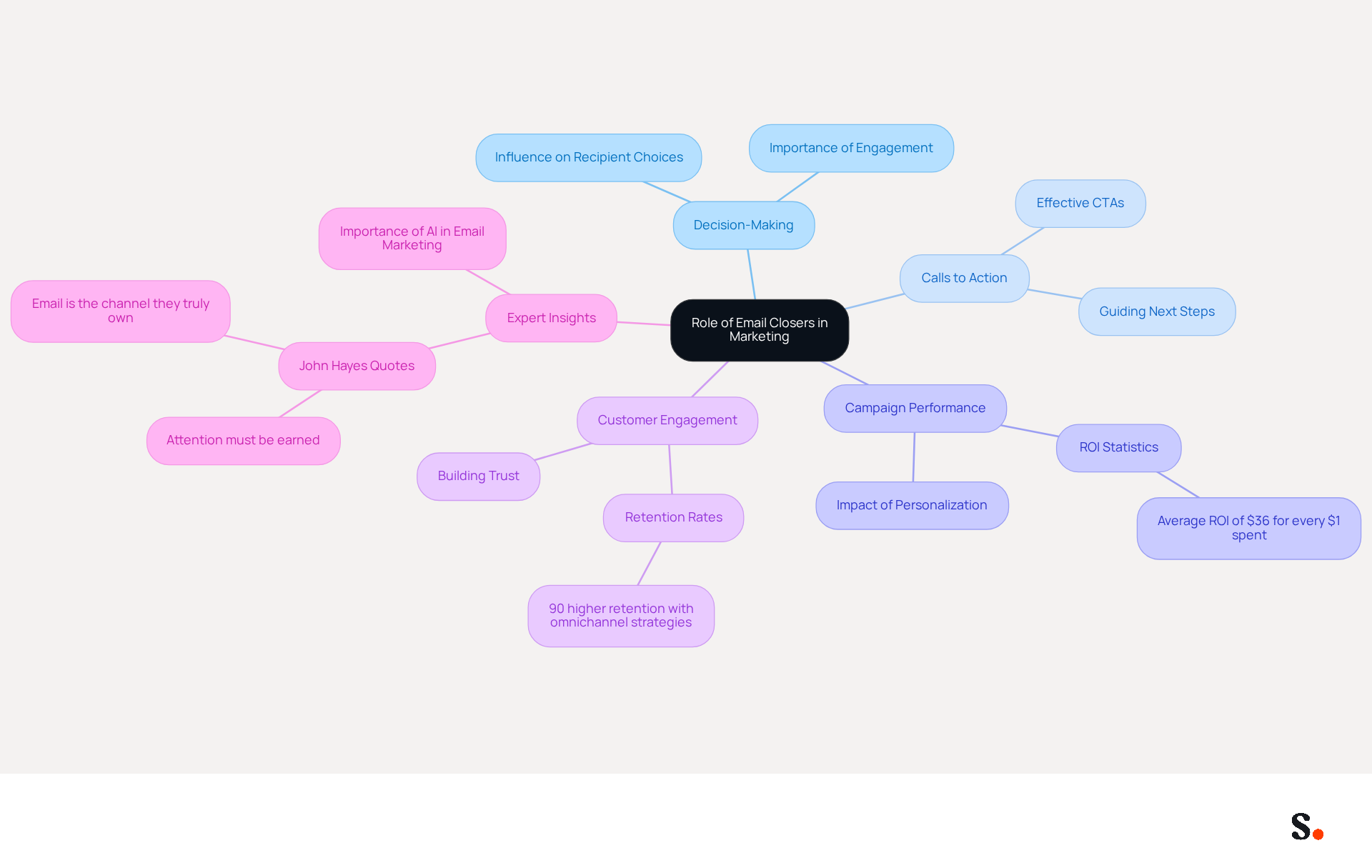
Closers for emails play a pivotal role in shaping the recipient's decision-making process, acting as both a courteous conclusion and a strategic call to action. A well-crafted closing line reinforces the main message, prompts a response, and directs the recipient toward the next steps. For instance, including a call-to-action (CTA) in the conclusion can effectively guide the reader to engage further - whether that involves clicking a link, responding to the message, or making a purchase.
Research shows that effective marketing through messages can yield an average ROI of $36 for every $1 invested, highlighting the significance of optimizing all elements of communication, including final touches. This highlights the critical role of effective closers in enhancing campaign performance.
Case studies show that brands utilizing strategic communication techniques have experienced significant enhancements in customer interactions. For example, brands employing omnichannel messaging strategies report 90% higher customer retention rates, illustrating how effective interaction, including personalized closing lines, can drive meaningful engagement and contribute to the success of marketing campaigns.
John Hayes, an Email Marketing Strategy Expert, emphasizes that marketers must earn attention with every email sent. This underscores the necessity for marketers to create engaging conclusions that resonate with their audience and build trust, which is vital for successful email marketing.
Ultimately, the effectiveness of email marketing hinges on the ability to create effective closers for emails that not only engage but also inspire action.
Explore Different Types of Email Closers
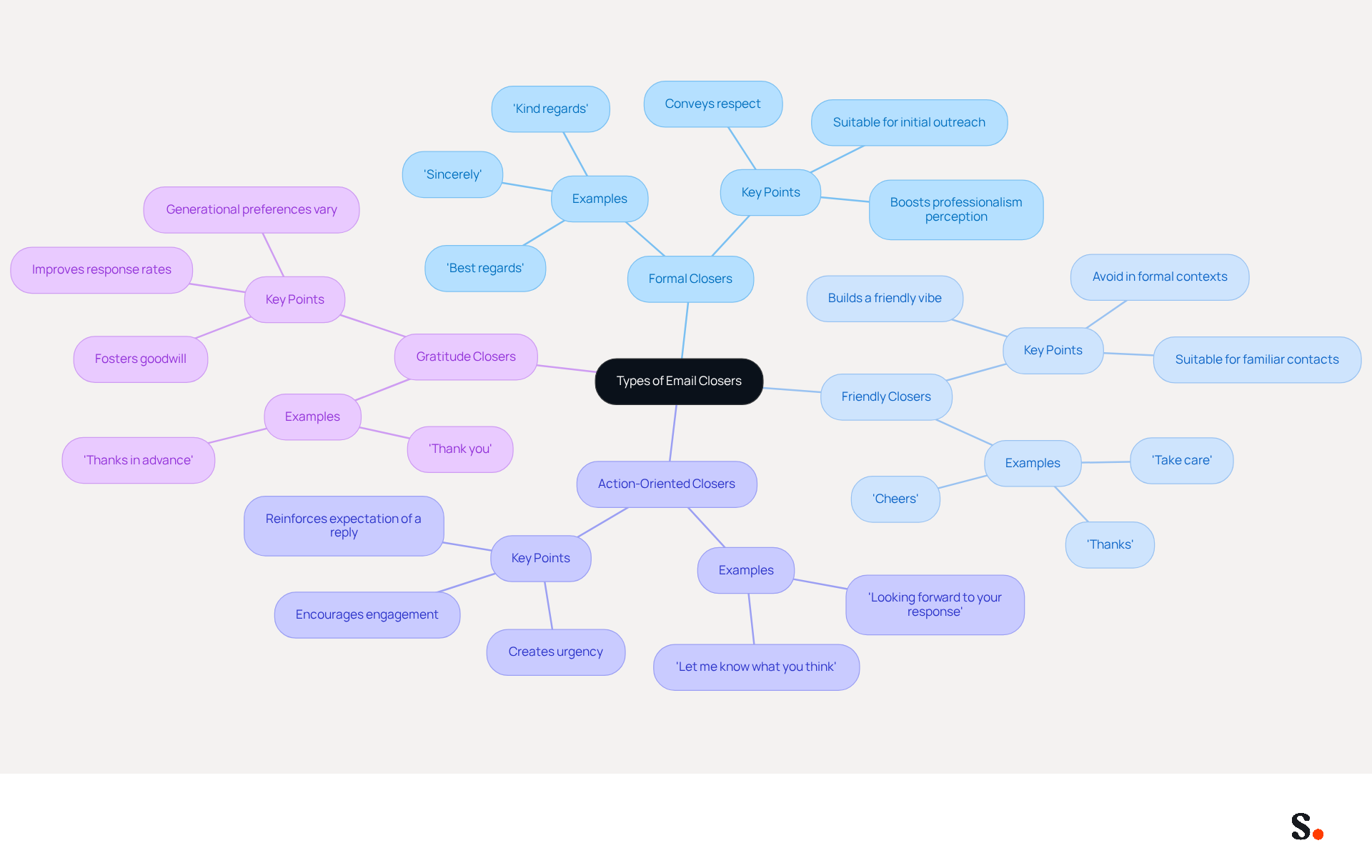
The choice of closers for emails can greatly influence the effectiveness of communication in professional settings. Email facilitators play an essential role in shaping the tone and effectiveness of interactions. Understanding the different types can help marketers tailor their messages for maximum impact. Here are the main categories:
- Formal Closers: Options like 'Sincerely' and 'Best regards' are crucial for professional correspondence, conveying respect and maintaining a formal tone. These sign-offs are particularly effective in initial outreach, interactions with senior management, and official announcements. Studies show that using formal sign-offs can really boost how professional the recipient thinks you are, which is key to building trust.
- Friendly Closers: Casual sign-offs such as 'Cheers' or 'Take care' help build a friendly vibe and make it easier to connect with others, making them suitable for familiar contacts and internal communications. However, it's important to avoid overly casual phrases in formal contexts, as this can lead to misunderstandings and diminish the sender's credibility.
- Action-Oriented Closers: Phrases like 'Looking forward to your response' or 'Let me know what you think' encourage engagement and prompt the individual to take action. This type of closing is particularly effective in follow-up emails, as it reinforces the expectation of a reply. The psychological effect of these conclusions can significantly influence how recipients perceive the urgency and importance of the communication.
- Gratitude Closers: Expressions of appreciation, such as 'Thank you' or 'Thanks in advance,' can significantly improve response rates and foster goodwill. Research indicates that a simple 'thank you' can transform a one-time client into a loyal partner, making expressions of gratitude a powerful tool in relationship-building. Furthermore, understanding generational preferences can influence the selection of sign-offs; for example, Millennials and Gen Z often favor casual expressions of gratitude, while Baby Boomers may prefer more traditional endings.
By strategically choosing closers for emails that align with the intended communication and audience, marketers can improve the chances of a favorable reply and strengthen professional relationships. Ultimately, the right sign-off can be the difference between a response and silence, making it a crucial element of effective communication.
Select Appropriate Closers for Different Situations
Choosing the right closers for emails is crucial for effective communication in professional settings. Selecting the appropriate sign-off relies on factors such as the relationship with the recipient, the message's purpose, and the overall tone of the interaction.
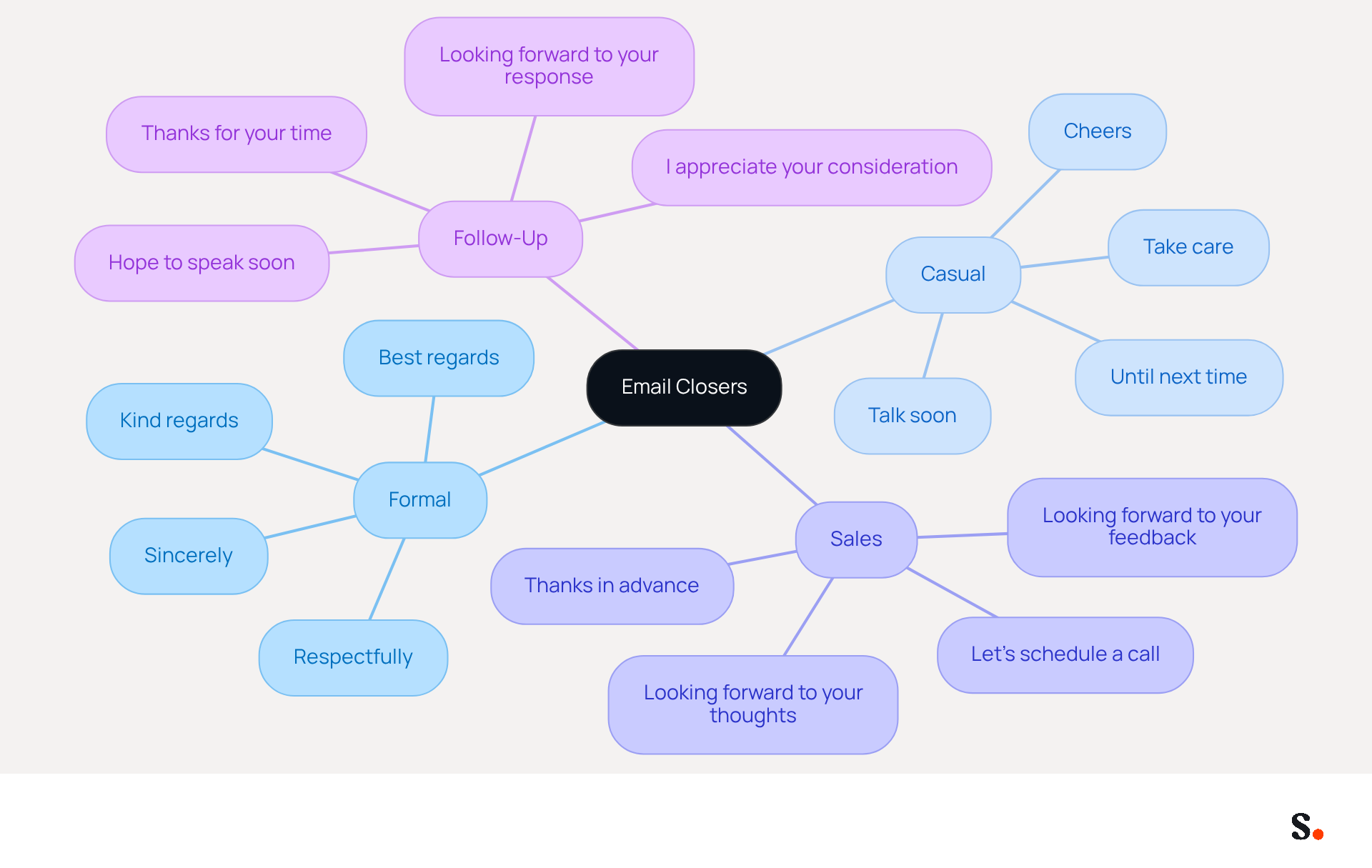
In formal business contexts, such as communications with clients or executives, it is best to choose appropriate closers for emails like 'Sincerely' or 'Best regards.' These sign-offs convey professionalism and respect, essential for maintaining a positive image. Without a proper sign-off, messages risk being perceived as abrupt, which can hinder effective communication, especially considering that professionals send and receive over 100 communications daily.
For emails directed at colleagues or familiar contacts, friendly sign-offs like 'Cheers' or 'Talk soon' can foster a relaxed atmosphere, encouraging open communication. Just be careful with overly casual sign-offs; they might not fit every professional situation.
In sales contexts, action-oriented phrases such as 'Looking forward to your feedback' or 'Let’s schedule a call' can encourage recipients to respond, increasing the chances of engagement. Personalization in message sign-offs has been shown to enhance response rates, with 59% of top-tier marketers ranking it as the most effective tool for engagement.
When following up, use phrases like 'Thanks for your time' or 'I appreciate your consideration' to reinforce a positive relationship and express gratitude. Ultimately, the right closers for emails can significantly influence the recipient's perception and response.
Implement Best Practices for Crafting Email Closers
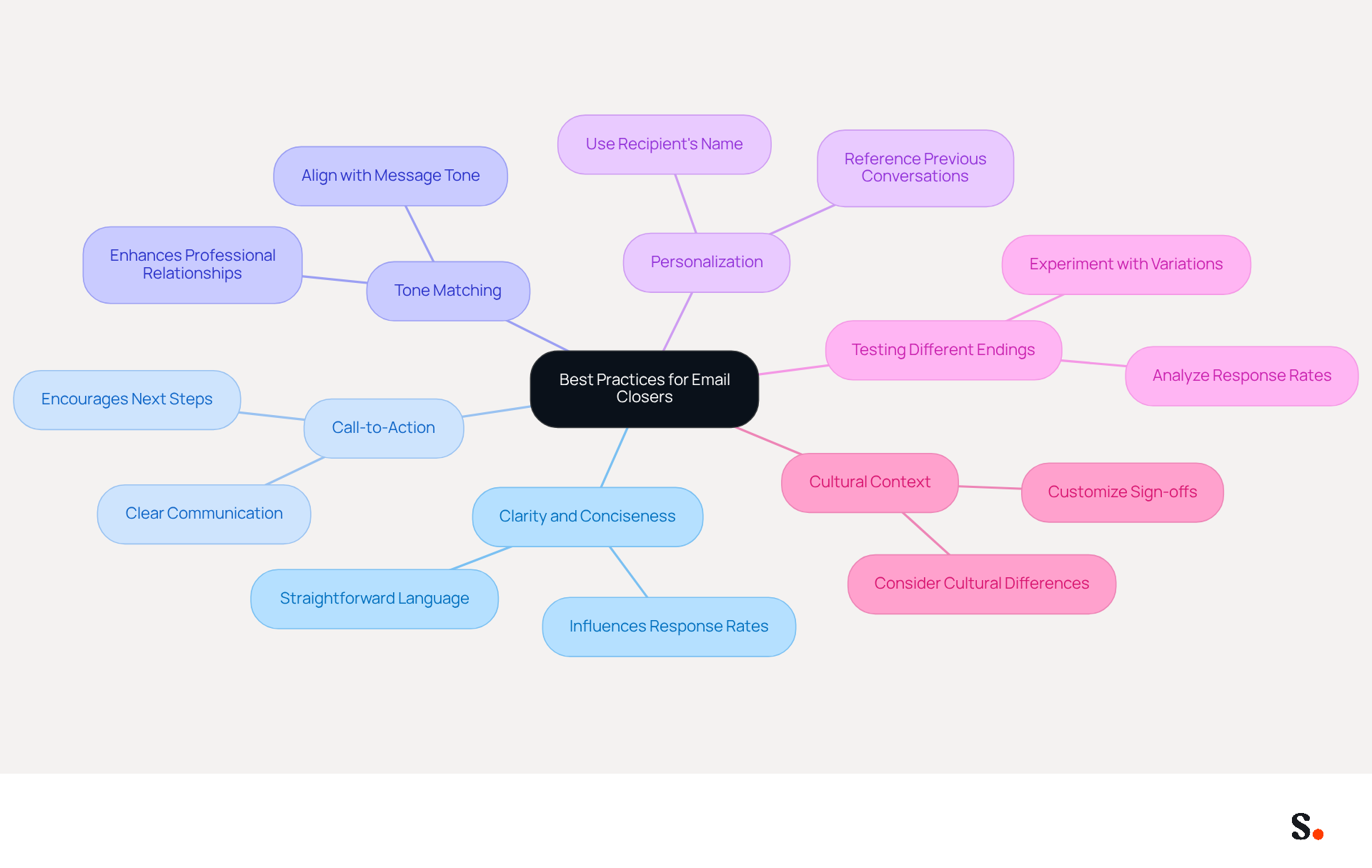
To craft effective email closers, marketers must adhere to best practices that ensure clarity and engagement:
- Be Clear and Concise: Ensure that your closing line is straightforward and easy to understand. Avoid overly complex language that may confuse the reader, as clarity is essential for effective communication. A clear and concise sign-off directly influences response rates and ensures messages are delivered effectively.
- Include a Call-to-Action: Whenever appropriate, incorporate a CTA that encourages the individual to take the next step, whether it’s replying, clicking a link, or scheduling a meeting. Clear communication in message conclusions can lead to better responses from recipients.
- Match the Tone: Align your closer with the overall tone of the message. If the message is formal, maintain that tone in your closing. If it’s casual, feel free to be more relaxed. As noted by industry experts, understanding the nuances of email etiquette can enhance professional relationships.
- Personalize When Possible: Tailor your closing to the recipient by using their name or referencing previous conversations. Using a personal touch can really make a difference in how engaged the recipient feels.
- Test Different Endings: Experiment with various endings to see which ones yield the best response rates. Analyze the results and adjust your strategy accordingly. Be cautious of common pitfalls, such as using sign-offs like "Thanks in advance" or "Cheers," which may detract from professionalism. A strong sign-off reduces uncertainty about identity and appropriate responses, enhancing brand recognition and response rates.
- Consider Cultural Context: Be mindful of cultural differences when choosing your sign-off. What may be acceptable in one culture could be seen as disrespectful in another. Customizing your message sign-offs to the recipient's background can improve communication effectiveness.
By following these best practices, marketers can create email closers that not only resonate with their audience but also drive desired actions, ultimately contributing to marketing success. Ultimately, a thoughtful approach to email closers can significantly impact engagement and response rates.
Conclusion
Crafting effective email closers is not just a skill; it's a necessity for marketers aiming to enhance engagement and drive action. Strategically using closing lines reinforces your main message and encourages action. They are vital to effective email communication. By understanding the nuances of different types of email closers and their appropriate contexts, marketers can significantly enhance their communication effectiveness.
Throughout the article, key insights have been shared regarding the importance of selecting the right closers based on the relationship with the recipient and the purpose of the message. From formal sign-offs that convey professionalism to friendly closers that foster connection, each type serves a unique role in shaping the recipient's perception. Additionally, incorporating clear calls-to-action and personal touches can further elevate the impact of email closers, driving higher engagement rates.
Many marketers struggle with engagement rates, often feeling frustrated when their emails go unanswered. By mastering email closers, marketers can turn missed opportunities into meaningful interactions. Ultimately, when you craft thoughtful and effective email closers, you can truly transform your marketing campaigns, leading to improved response rates and stronger relationships. Marketers are encouraged to implement these best practices and continuously refine their approach, ensuring that every email sent contributes to a cohesive and successful marketing strategy. Embracing the art of email closers not only enhances communication but also positions brands for greater success in their marketing endeavors.
Frequently Asked Questions
What is the role of email closers in marketing?
Email closers play a pivotal role in shaping the recipient's decision-making process by serving as a courteous conclusion and a strategic call to action. They reinforce the main message, prompt a response, and direct the recipient toward the next steps.
How can a well-crafted closing line impact email marketing?
A well-crafted closing line can effectively guide the reader to engage further, whether that involves clicking a link, responding to the message, or making a purchase.
What is the return on investment (ROI) for effective marketing through messages?
Research shows that effective marketing through messages can yield an average ROI of $36 for every $1 invested, highlighting the importance of optimizing all elements of communication, including email closers.
How do strategic communication techniques affect customer interactions?
Case studies indicate that brands utilizing strategic communication techniques, such as personalized closing lines, have experienced significant enhancements in customer interactions, including higher customer retention rates.
What does John Hayes emphasize about email marketing?
John Hayes, an Email Marketing Strategy Expert, emphasizes that marketers must earn attention with every email sent, highlighting the necessity for engaging conclusions that resonate with the audience and build trust.
Why are effective email closers important for marketing campaigns?
Effective email closers are crucial because they not only engage the recipient but also inspire action, which is essential for the overall success of email marketing campaigns.
List of Sources
- Understand the Role of Email Closers in Marketing
- Email Marketing in 2026: The Trends That Will Shape the Game (https://uplandsoftware.com/adestra/resources/blog/email-marketing-in-2026-the-trends-that-will-shape-the-game)
- Email Marketing in 2026: still an essential lever (https://r-advertising.com/en/blog/email-marketing-in-2026-still-an-essential-lever)
- The Top Email Marketing Trends for 2026 (https://litmus.com/blog/trends-in-email-marketing)
- Email marketing in 2026, what businesses need to know (https://redcmarketing.com/article/email-marketing-in-2026-what-businesses-need-to-know)
- Email Marketing Trends 2026: Here's What to Keep an Eye on (https://mailjet.com/blog/email-best-practices/email-marketing-trends-2026)
- Explore Different Types of Email Closers
- 50 Best Email Sign-Offs to End an Email Properly in [year] (https://elementor.com/blog/best-email-sign-offs)
- 20 email closings that reinforce your brand + cheat sheet (https://siteground.com/academy/email-closings)
- Mastering Professional Email Sign-Offs in 2026 (https://linkedin.com/pulse/mastering-professional-email-sign-offs-2026-bulksignature-qsr4e)
- Email Sign Offs for Every Industry and Situation | Mailchimp (https://mailchimp.com/resources/email-sign-offs)
- Best Email Closing Lines for Closing Deals (https://callboxinc.com/email-marketing/best-email-closing-lines-for-closing-deals)
- Select Appropriate Closers for Different Situations
- How to end an email: 70+ professional sign-offs & examples (https://blog.superhuman.com/how-to-end-an-email)
- 8 Email Marketing Statistics to Reinforce Your Strategy | Mailjet (https://mailjet.com/blog/email-best-practices/stats-email-marketing)
- Email Sign Offs for Every Industry and Situation | Mailchimp (https://mailchimp.com/resources/email-sign-offs)
- Implement Best Practices for Crafting Email Closers
- How to End an Email Professionally (With Examples) (https://iconnect.isenberg.umass.edu/blog/2024/07/10/how-to-end-an-email-professionally-with-examples)
- The Best (and Worst) Ways To Sign an Email | Robert H. Smith School of Business (https://rhsmith.umd.edu/research/best-and-worst-ways-sign-email)
- Best Email Closing Lines for Closing Deals (https://callboxinc.com/email-marketing/best-email-closing-lines-for-closing-deals)
- Email Sign Offs Professional: Best Practices for Business Emails (https://mailwarm.com/blog/professional-email-sign-offs-best-practices)
- How to Sign Off on an Email Correctly | Rocketseed (https://rocketseed.com/blog/correct-way-to-sign-off-emails)
Get started with Scribe
Signatures for every role on your team
Free 14-day trial — no credit card.