Master Email Endings: Professional Tips for Marketing Managers
Mastering the art of email endings is essential for marketing managers aiming to enhance their communication effectiveness. Many marketing managers find it
Sophie Grant
Email Signature Specialist, Scribe

Introduction
Mastering the art of email endings is essential for marketing managers aiming to enhance their communication effectiveness. Many marketing managers find it challenging to create email endings that are both professional and engaging. A well-crafted email conclusion reflects professionalism and acts as a powerful branding tool, capable of fostering stronger connections with recipients. Yet, how can marketing professionals balance professionalism with the need for their sign-offs to resonate with diverse audiences? This article delves into the critical components of impactful email endings, providing actionable strategies that turn routine emails into opportunities for engagement.
Define Essential Components of Email Endings
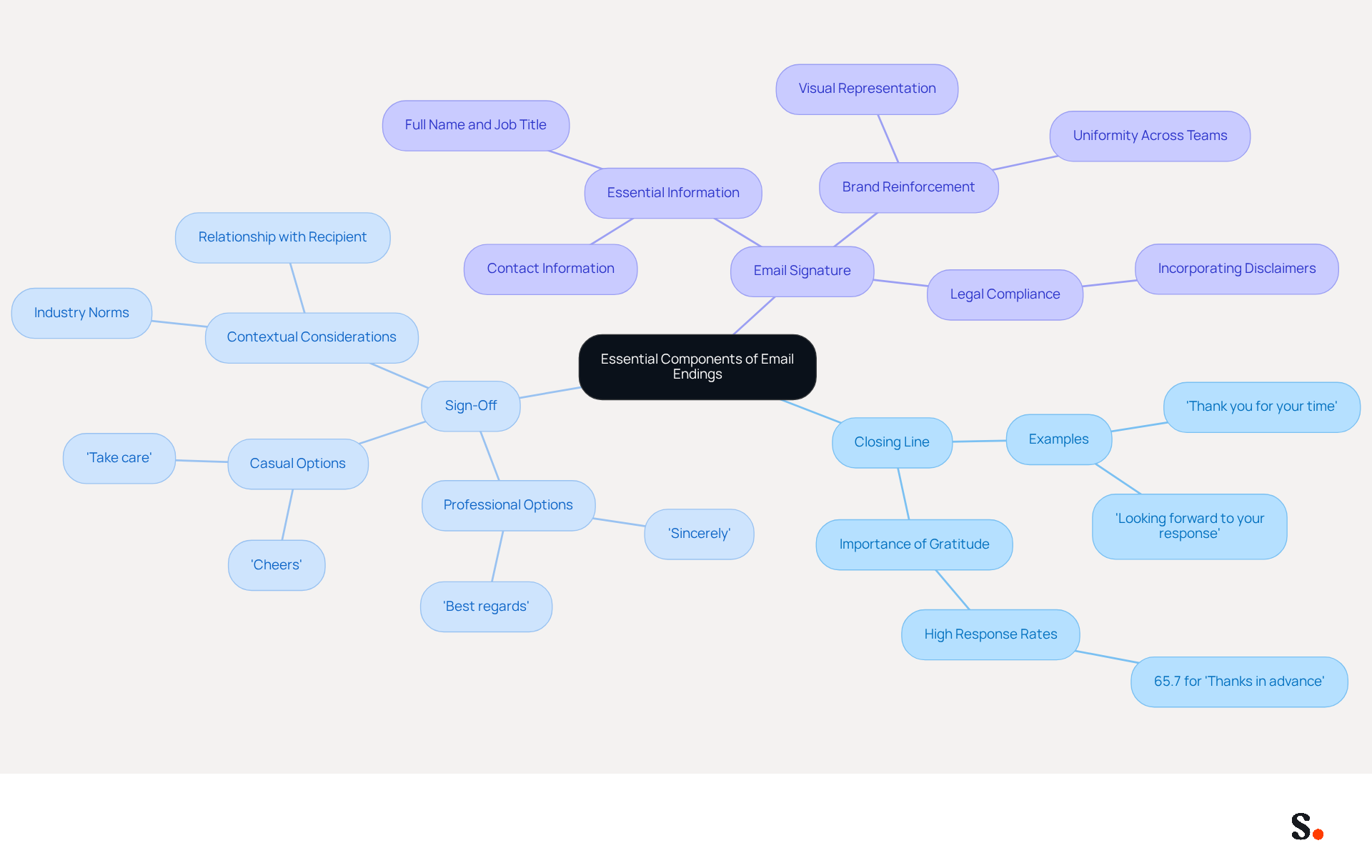
To create impactful email endings professional, marketing managers must master three essential components: the closing line, the sign-off, and the email signature.
- Closing Line: A strong closing line, such as 'Thank you for your time' or 'Looking forward to your response,' sets a positive tone and encourages engagement. Research shows that sign-offs expressing gratitude yield high response rates, with a study indicating a 65.7% response rate for the phrase 'Thanks in advance.'
- Sign-Off: The sign-off is crucial; it reflects your relationship with the recipient and the context of your email. Email endings professional, such as 'Sincerely', are suitable for professional interactions, while more casual options may be appropriate in relaxed settings. Understanding the norms of different industries can enhance professionalism and relatability in correspondence.
- Email Signature: An effective email signature reinforces your brand while providing essential information at a glance. For instance, Scribe's automated message templates ensure uniformity and professionalism across all interactions, transforming each correspondence into a branding opportunity. Standardizing signatures across teams can also enhance brand messaging and foster unity among team members.
By refining these elements, marketing managers can enhance their communication effectiveness and foster stronger connections with their audience.
Choose Contextual Sign-Offs for Impact
Choosing the appropriate email endings professional is crucial for enhancing the effectiveness of your communication. Here are some essential tips for choosing contextual sign-offs:
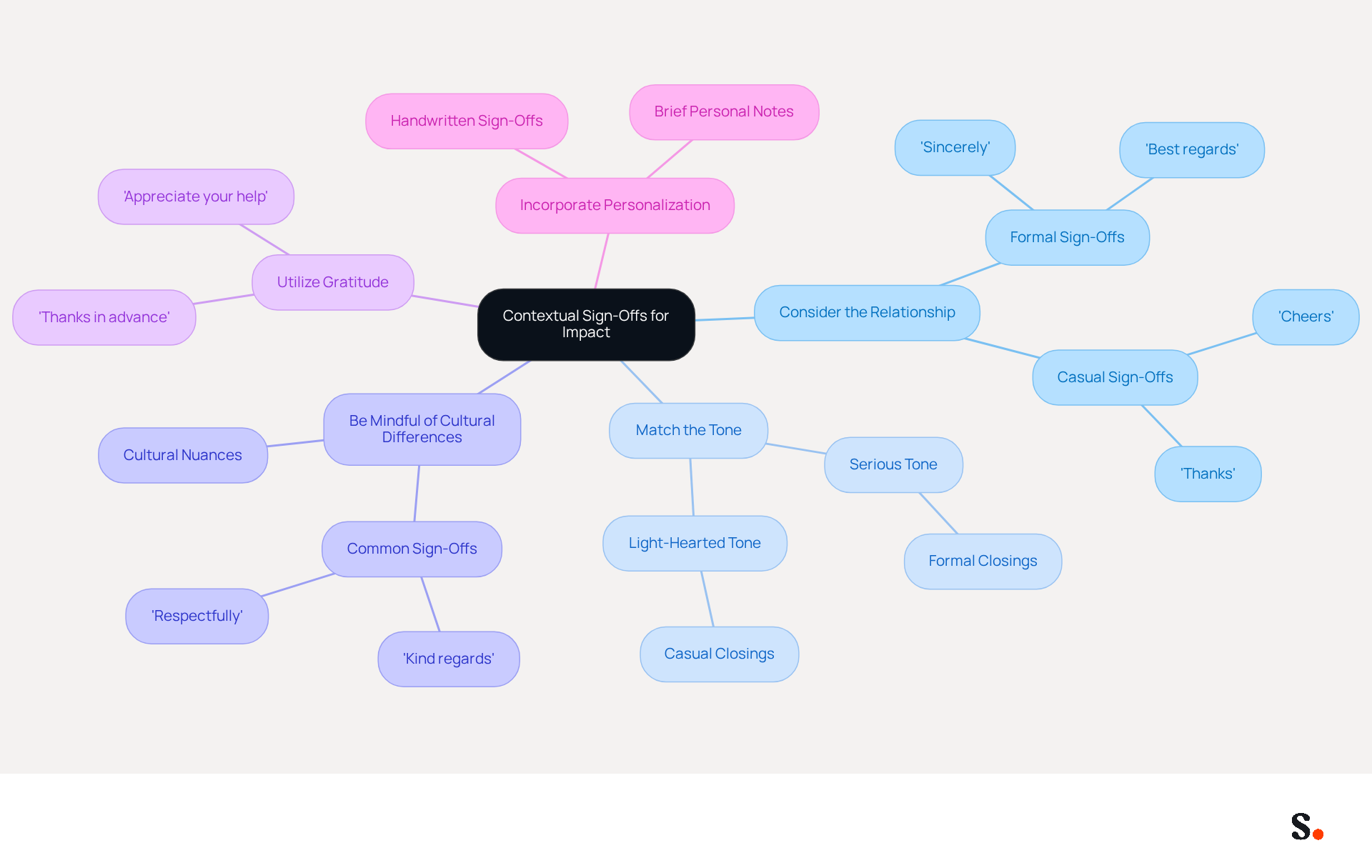
- Consider the Relationship: For formal communications, opt for sign-offs like 'Sincerely' or 'Best regards.' In contrast, for more casual interactions, 'Cheers' or 'Thanks' may be more appropriate. This distinction helps maintain professionalism while fostering a friendly rapport.
- Match the Tone: Align your sign-off with the overall tone of the message. If the content is serious, a formal sign-off is advisable. Conversely, if the message conveys a light-hearted tone, a casual sign-off can create a welcoming atmosphere, enhancing engagement.
- Be Mindful of Cultural Differences: Different cultures have varying expectations regarding sign-offs in correspondence. For example, 'Kind regards' is widely accepted in many English-speaking countries, while other cultures may favor more formal closings. Understanding these nuances can prevent miscommunication and foster respect.
- Utilize Gratitude: Sign-offs that express gratitude, such as 'Thanks in advance' or 'Appreciate your help,' have been shown to yield higher response rates. Emails that conclude with a form of thanks often encourage recipients to engage more positively. Daniela Camejo Sanchez emphasizes that showing gratitude in sign-offs is a smart move.
- Incorporate Personalization: Adding a personal touch, such as a handwritten sign-off or a brief note, can enhance relatability and strengthen connections. This method can make your messages feel more genuine and engaging.
Choosing the right email endings professional helps marketing managers connect better with their audience, which leads to improved engagement and response rates. For example, case studies have demonstrated that messages with sign-offs that include a form of 'thanks' achieve higher response rates, reinforcing the significance of gratitude in message exchanges. Ultimately, the right sign-off can be the difference between a response and silence.
Balance Professionalism and Tone in Closings
Striking the right balance between professionalism and tone in email endings is crucial for effective communication. Here are some strategies to consider:
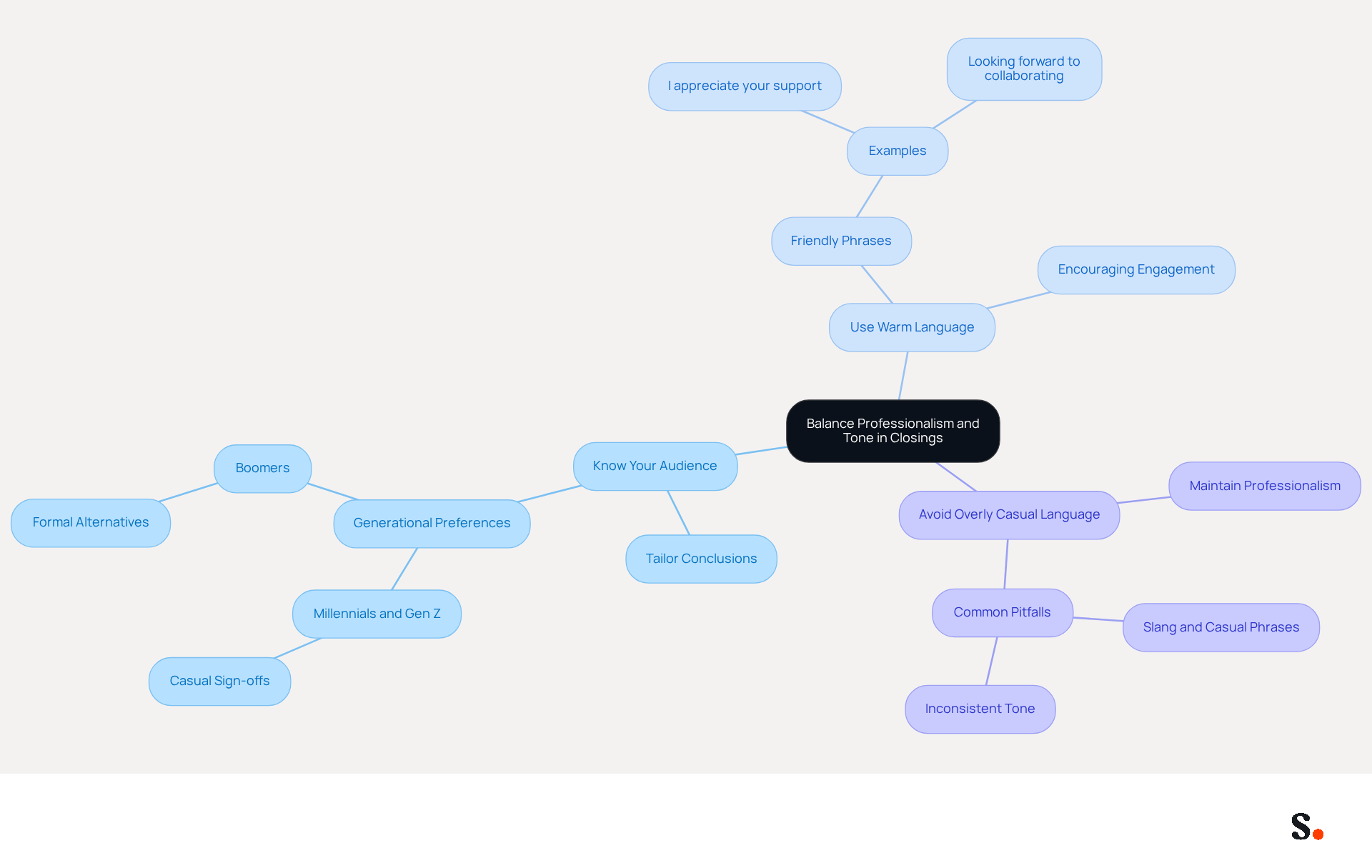
- Know Your Audience: Tailor your conclusion to the recipient's preferences and the nature of your relationship. For example, a conclusion for a client may differ from one for a colleague, reflecting the varying levels of formality required. Research indicates that Millennials and Gen Z tend to prefer casual sign-offs like 'Thanks,' while Boomers opt for more formal alternatives such as 'Sincerely.' This shows just how important it is to tailor your conclusion to what your audience expects.
- Use Warm Language: Incorporate friendly phrases that convey approachability while maintaining professionalism. Expressions like 'I appreciate your support' or 'Looking forward to collaborating' can foster a positive tone and encourage engagement. Hristina Tankovska, a digital marketing specialist, points out that your message conclusion is the last thing people read before deciding to respond, ignore, or discard your message. This highlights how important it is to have a considerate conclusion.
- Avoid Overly Casual Language: While friendliness is important, steer clear of slang or overly casual phrases that may undermine your professionalism. Stick to language that aligns with your brand's voice and values, ensuring that your message is taken seriously. Furthermore, be aware of common pitfalls, such as using overly casual language or failing to adapt to the recipient's preferences, which can diminish the effectiveness of your message.
However, achieving this balance can be challenging for many marketing managers. By effectively balancing professionalism and tone, marketing managers can create email endings that resonate with recipients, ultimately encouraging positive responses and fostering stronger relationships. Ultimately, a well-crafted conclusion can enhance your communication strategy and influence how recipients perceive your professionalism.
Leverage Email Signatures for Branding and Marketing
Email identifiers serve as critical tools for branding and marketing, not just formalities. Here’s how to leverage them effectively:
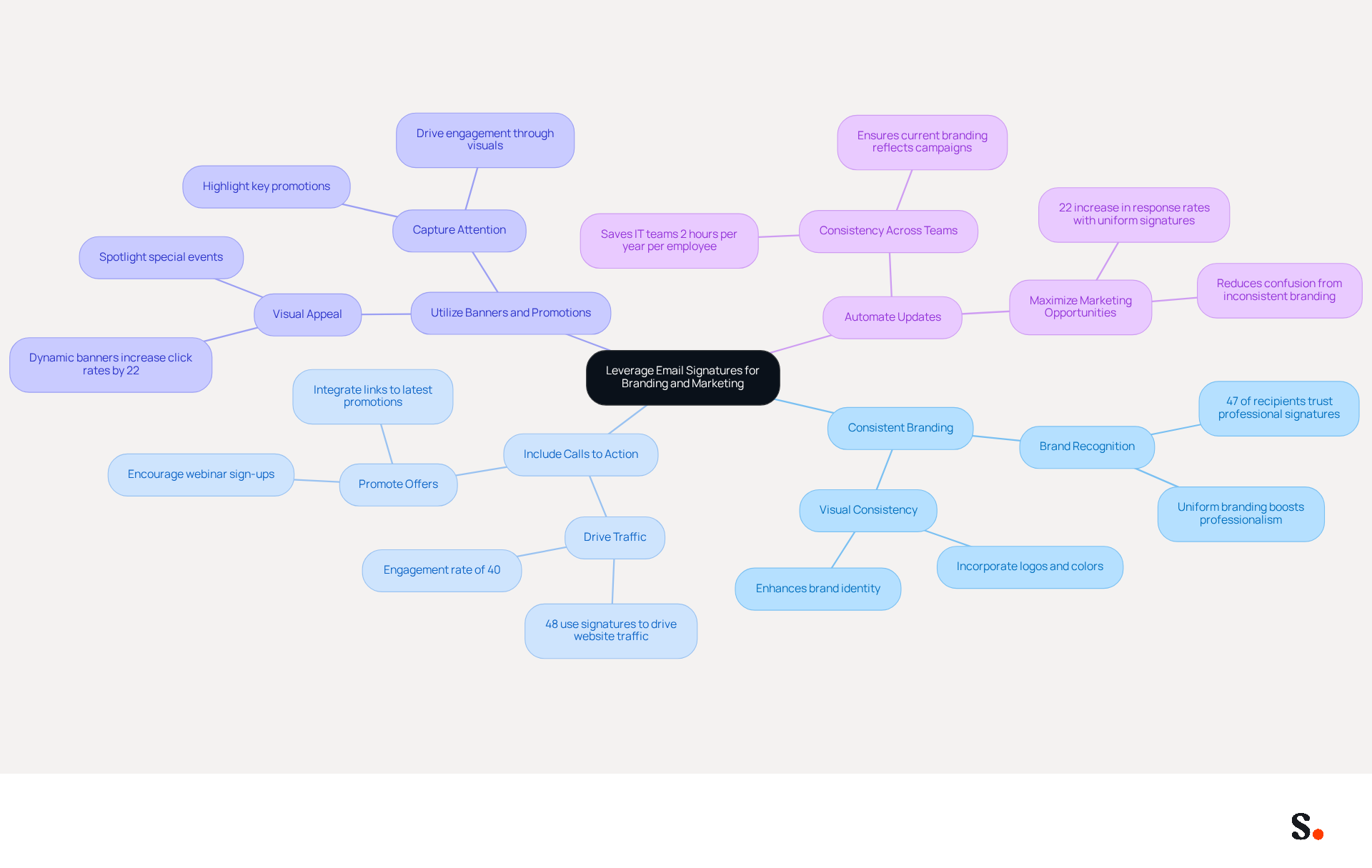
- Consistent Branding: Your correspondence footer should embody your brand's identity, incorporating elements like logos, colors, and fonts. This consistency strengthens brand recognition and enhances professionalism; studies show that uniform markings can boost trust among recipients by 47%.
- Include Calls to Action: Integrate calls to action (CTAs) within your correspondence footer, directing recipients to your latest blog post, upcoming webinar, or promotional offers. This approach is effective, as nearly half of marketers leverage digital identifiers to enhance website traffic.
- Utilize Banners and Promotions: Incorporate visually appealing banners in your correspondence to spotlight special promotions or events. Such visual elements can significantly capture attention and drive traffic, with dynamic banners reported to increase click rates by 22%.
- Automate Updates: With Scribe's automated management of digital signatures, you can ensure that all team members maintain current identifiers that reflect ongoing campaigns and branding efforts. Inconsistent email endings professional can lead to confusion and diminish brand integrity. This automation removes inconsistencies and maximizes marketing opportunities, as companies that implement uniform digital identifiers experience a 22% rise in response rates.
By adopting these strategies, marketing managers can elevate their email signatures from mere formalities to essential branding tools that enhance visibility and engagement.
Conclusion
For marketing managers, the way an email concludes can significantly influence communication outcomes. By focusing on the three critical components - closing lines, sign-offs, and email signatures - professionals can create impactful messages that resonate with their audience. Without mastering these components, marketing managers risk losing the opportunity to connect meaningfully with their audience. A strong email ending reflects professionalism and builds connections, which can boost engagement and response rates.
Throughout the article, key strategies have been outlined, such as:
- Choosing contextual sign-offs that align with the recipient's expectations
- Balancing professionalism with tone
- Leveraging email signatures as powerful branding tools
Incorporating gratitude in sign-offs and maintaining consistency in branding can significantly enhance the effectiveness of email communications. Additionally, utilizing Scribe's automated management features ensures that marketing teams can maintain brand integrity and capitalize on every correspondence as a marketing opportunity.
Ultimately, effective email endings play a crucial role in communication success. By adopting these practices, marketing managers can elevate their email communications to become pivotal in achieving their strategic objectives.
Frequently Asked Questions
What are the essential components of email endings?
The essential components of email endings are the closing line, the sign-off, and the email signature.
Why is a strong closing line important in emails?
A strong closing line, such as 'Thank you for your time' or 'Looking forward to your response,' sets a positive tone and encourages engagement. Research indicates that expressions of gratitude, like 'Thanks in advance,' can yield high response rates, with a study showing a 65.7% response rate for that phrase.
How does the sign-off affect email communication?
The sign-off reflects your relationship with the recipient and the context of your email. Professional sign-offs, like 'Sincerely', are suitable for formal interactions, while casual options may be appropriate in relaxed settings. Understanding industry norms can enhance professionalism and relatability.
What role does an email signature play in communication?
An effective email signature reinforces your brand and provides essential information at a glance. For example, Scribe's automated message templates ensure uniformity and professionalism, turning each correspondence into a branding opportunity. Standardizing signatures across teams can enhance brand messaging and foster unity.
How can marketing managers improve their email communication?
By refining the closing line, sign-off, and email signature, marketing managers can enhance their communication effectiveness and foster stronger connections with their audience.
List of Sources
- Define Essential Components of Email Endings
- Essential Parts of an Email: Converting Leads with LeadsPicker (https://leadspicker.com/articles/essential-parts-of-email)
- Email Sign Offs for Every Industry and Situation | Mailchimp (https://mailchimp.com/resources/email-sign-offs)
- How to End an Email: 43 Ways to Sign Off on an Email (2026) (https://respona.com/blog/how-to-end-an-email)
- The Importance Of Email Signatures | Email Marketing Blog | Mail Blaze (https://mailblaze.com/thinking/email-signatures-in-email-marketing)
- How to Sign Off on an Email Correctly | Rocketseed (https://rocketseed.com/blog/correct-way-to-sign-off-emails)
- Choose Contextual Sign-Offs for Impact
- email sign-offs (https://wisestamp.com/signature-examples/email-sign-offs)
- 100 Email Sign-Off Ideas (+10 Golden Rules for Marketing Pros) - MailerLite (https://mailerlite.com/blog/email-sign-offs)
- Memorable Email Sign-Offs: A Beginner's Guide (https://constantcontact.com/blog/email-sign-offs)
- How to End an Email Professionally (With Examples) (https://iconnect.isenberg.umass.edu/blog/2024/07/10/how-to-end-an-email-professionally-with-examples)
- Email Sign Offs Professional: Best Practices for Business Emails (https://mailwarm.com/blog/professional-email-sign-offs-best-practices)
- Balance Professionalism and Tone in Closings
- Email Etiquette: Best Practices for Professional Communication (https://memberportal.gfwc.org/news/communications-public-relations/111/111-Email-Etiquette-Best-Practices-for-Professional-Communication)
- Email Etiquette in the Workplace (https://adminvc.ucla.edu/news/email-etiquette-workplace)
- 20 email closings that reinforce your brand + cheat sheet (https://siteground.com/academy/email-closings)
- Mastering tone for business emails (https://dailybalance.com/mastering-tone-business-emails)
- How to End an Email Professionally (With Examples) (https://iconnect.isenberg.umass.edu/blog/2024/07/10/how-to-end-an-email-professionally-with-examples)
- Leverage Email Signatures for Branding and Marketing
- Brands Turn To Email Signatures For Marketing: Study (https://mediapost.com/publications/article/350372/brands-turn-to-email-signatures-for-marketing-stu.html?edition=118089)
- Why Are Email Signatures Key to Brand Awareness? | QuickMail (https://quickmail.com/role-of-email-signatures-in-brand-awareness)
- Email signature statistics: Why every business should optimize their email signatures — Stripo.email (https://stripo.email/blog/email-signature-statistics-why-every-business-should-optimize-their-email-signatures)
- The impact of email signatures on your branding (https://signitic.com/en/resources/the-impact-of-email-signatures-on-your-branding)
Get started with Scribe
Signatures for every role on your team
Free 14-day trial — no credit card.