Master the Take Care Email Sign-Off: Best Practices for Impact
In professional communication, the choice of email sign-offs plays a crucial role in shaping perceptions and fostering relationships. The phrase "Take Care"
Sophie Grant
Email Signature Specialist, Scribe
On this page
- Introduction
- Understand the Significance of 'Take Care' in Email Communication
- Identify Appropriate Contexts for 'Take Care' Sign-Offs
- Explore the Benefits of Using 'Take Care' in Professional Emails
- Implement Effective Strategies for 'Take Care' Sign-Offs
- Conclusion
- Frequently Asked Questions
- List of Sources
Introduction
In professional communication, the choice of email sign-offs plays a crucial role in shaping perceptions and fostering relationships. The phrase "Take Care" goes beyond simple politeness; it conveys warmth and connection, helping to build camaraderie in our digital interactions.
Professionals often face challenges in email interactions, and knowing when and how to use this sign-off can truly enhance rapport and lead to better responses.
What strategies can be employed to ensure that "Take Care" resonates effectively, and how does it impact the dynamics of professional relationships?
Understand the Significance of 'Take Care' in Email Communication
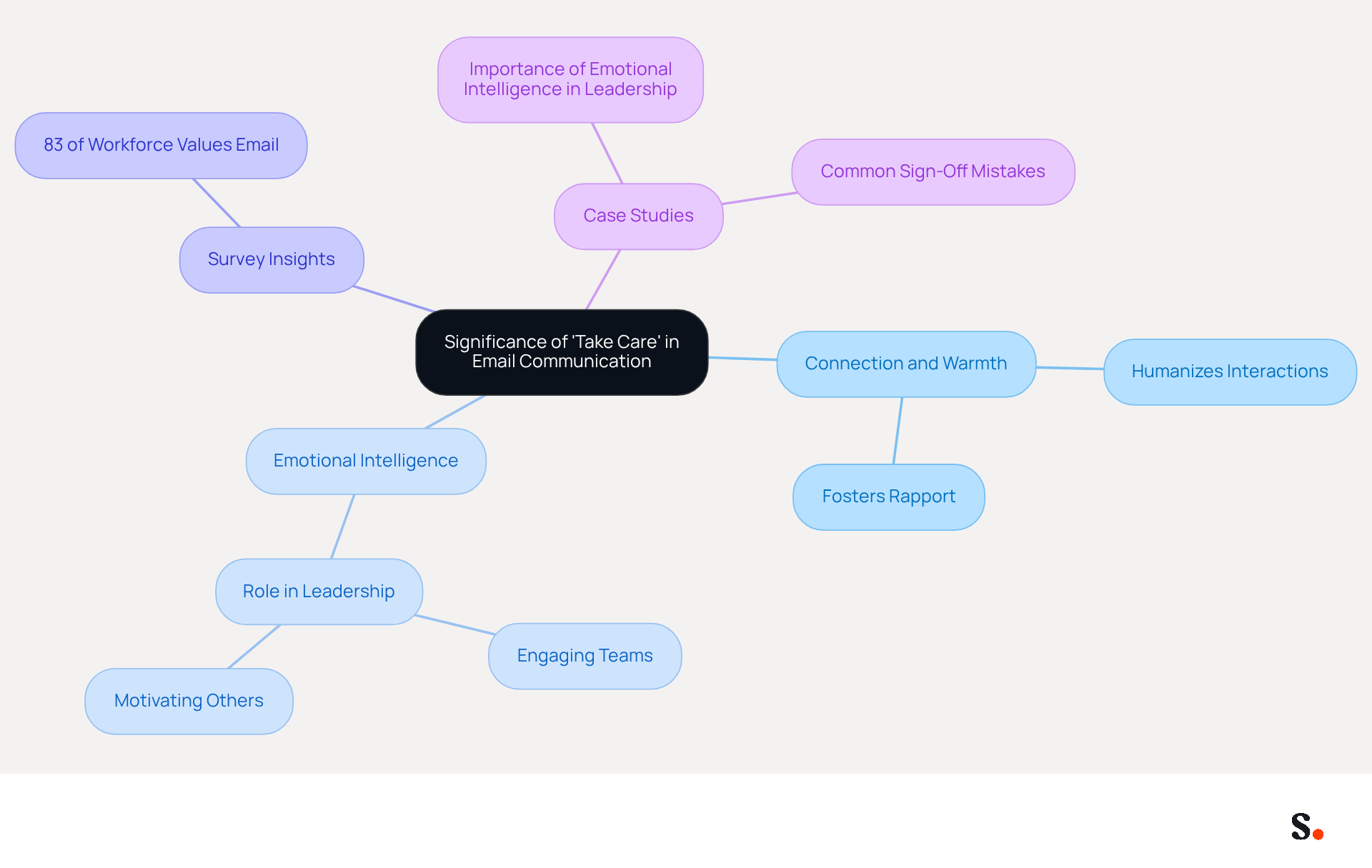
In professional correspondence, the take care email sign-off 'Look After' serves as more than just a casual farewell; it creates a sense of connection and warmth. This phrase fosters connection and rapport between sender and recipient, making it particularly effective in friendly messages. In an era where digital interactions often feel impersonal, incorporating a 'take care email sign-off' can humanize exchanges and leave a lasting positive impression.
A survey indicates that emotional intelligence in interactions can greatly enhance relationships, with 83% of the workforce considering email critical to their success. This highlights the importance of being thoughtful in our interactions.
Furthermore, case studies on 'The Importance of Emotional Intelligence in Leadership' reveal that leaders who develop emotional intelligence can significantly improve their ability to engage and motivate teams. This underscores the value of using compassionate sign-offs such as 'Be Well' to enhance professional relationships.
By using the take care email sign-off, professionals convey genuine concern for the recipient's well-being, fostering a more collaborative and supportive work environment.
Identify Appropriate Contexts for 'Take Care' Sign-Offs
The choice of sign-off in email communications can significantly impact the recipient's perception and response.
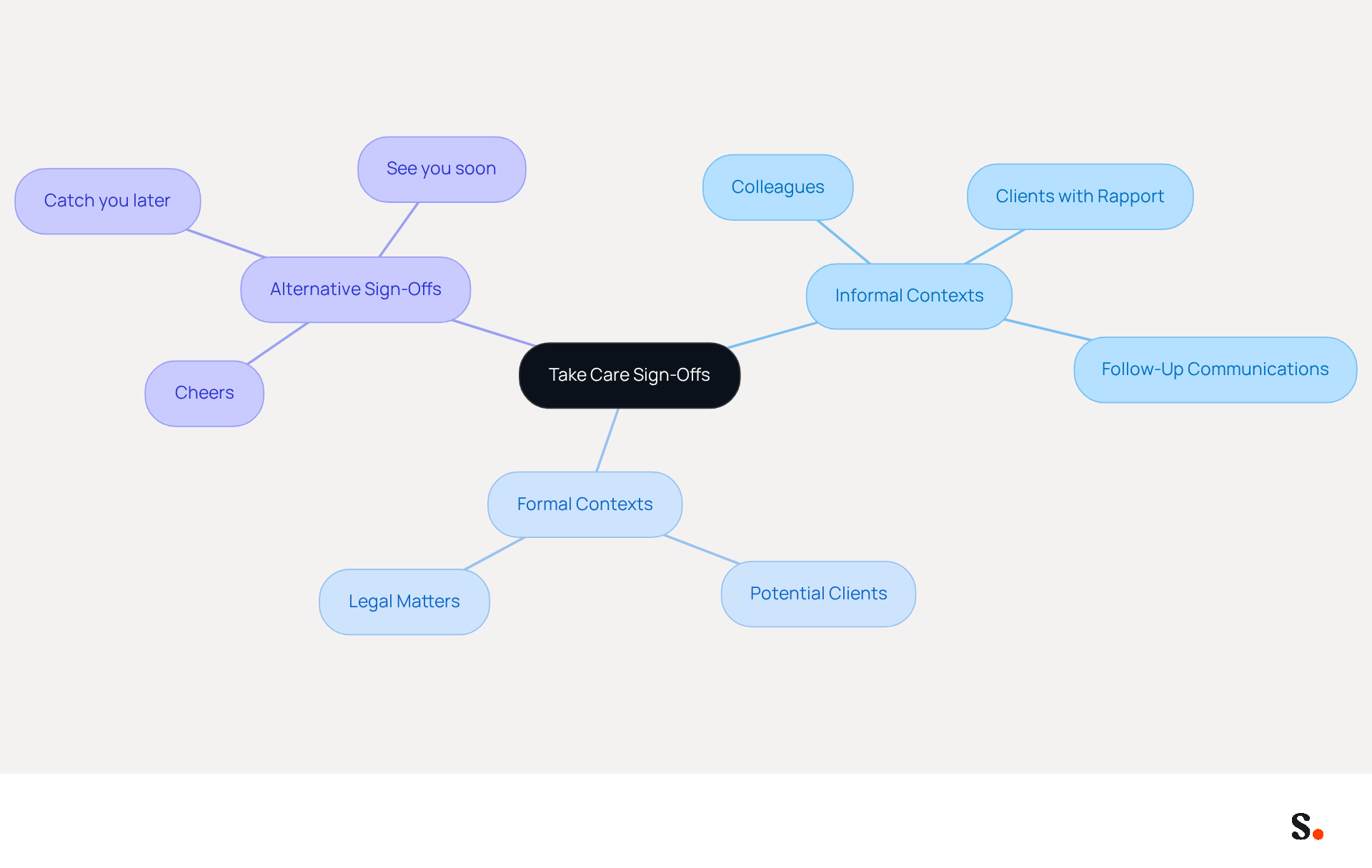
- 'Take care' email sign-off is ideally suited for semi-formal or informal communications, especially when the sender has established a rapport with the recipient.
- The 'take care' email sign-off is effective in messages directed to colleagues or clients with whom a relationship has been nurtured, or in follow-up communications after meetings.
- Yet, in formal situations - like reaching out to potential clients or handling legal matters - it's better to stick with traditional sign-offs like 'Sincerely' or 'Best regards.'
- It's essential to understand the context to ensure the sign-off supports the message instead of undermining it.
- Furthermore, statistics show that messages concluding with expressions of gratitude, such as 'Thank you,' attain higher response rates, emphasizing the significance of selecting the appropriate sign-off to encourage positive engagement.
- Other informal sign-offs, such as 'Cheers,' 'Catch you later,' and 'See you soon,' can also be used in appropriate contexts, but caution is advised to avoid being perceived as unprofessional.
- Selecting the right sign-off not only reflects professionalism but also fosters stronger connections in communication.
Explore the Benefits of Using 'Take Care' in Professional Emails
In professional correspondence, the choice of sign-off can significantly impact the recipient's perception and response. Utilizing a thoughtful sign-off can lead to several advantages, including:
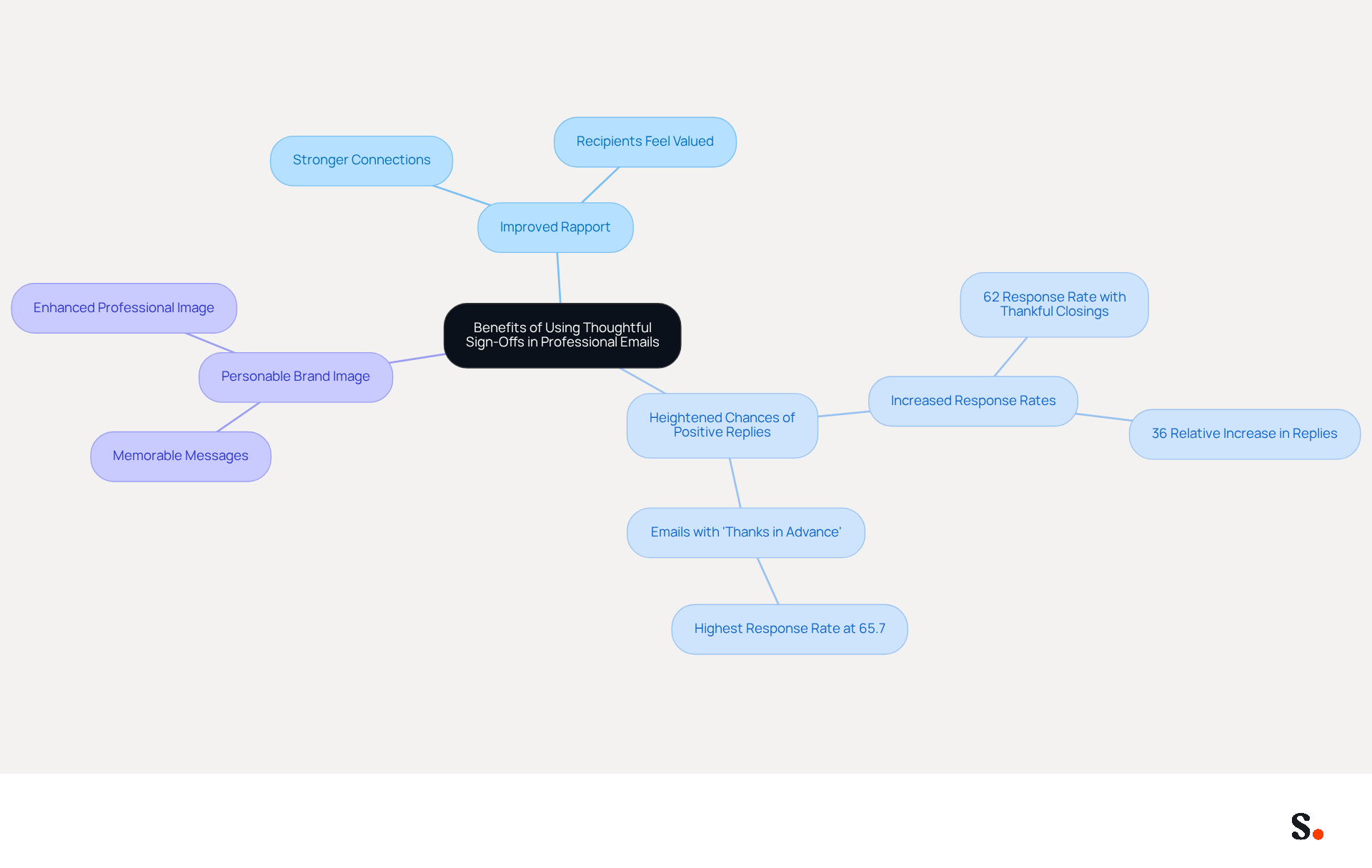
- Improved rapport with recipients
- Heightened chances of positive replies
- A more personable brand image
This approach can enhance the sender's professional image and foster stronger connections, making recipients feel valued and appreciated, which is crucial in maintaining long-term professional relationships. Additionally, it can distinguish the sender in a crowded inbox, making their messages more memorable. Research indicates that tailored communication can enhance engagement rates, making thoughtful sign-offs a strategic option for those aiming to enhance their email effectiveness.
Implement Effective Strategies for 'Take Care' Sign-Offs
To effectively implement the take care email sign-off, it is essential to consider your audience and the context of your communication.
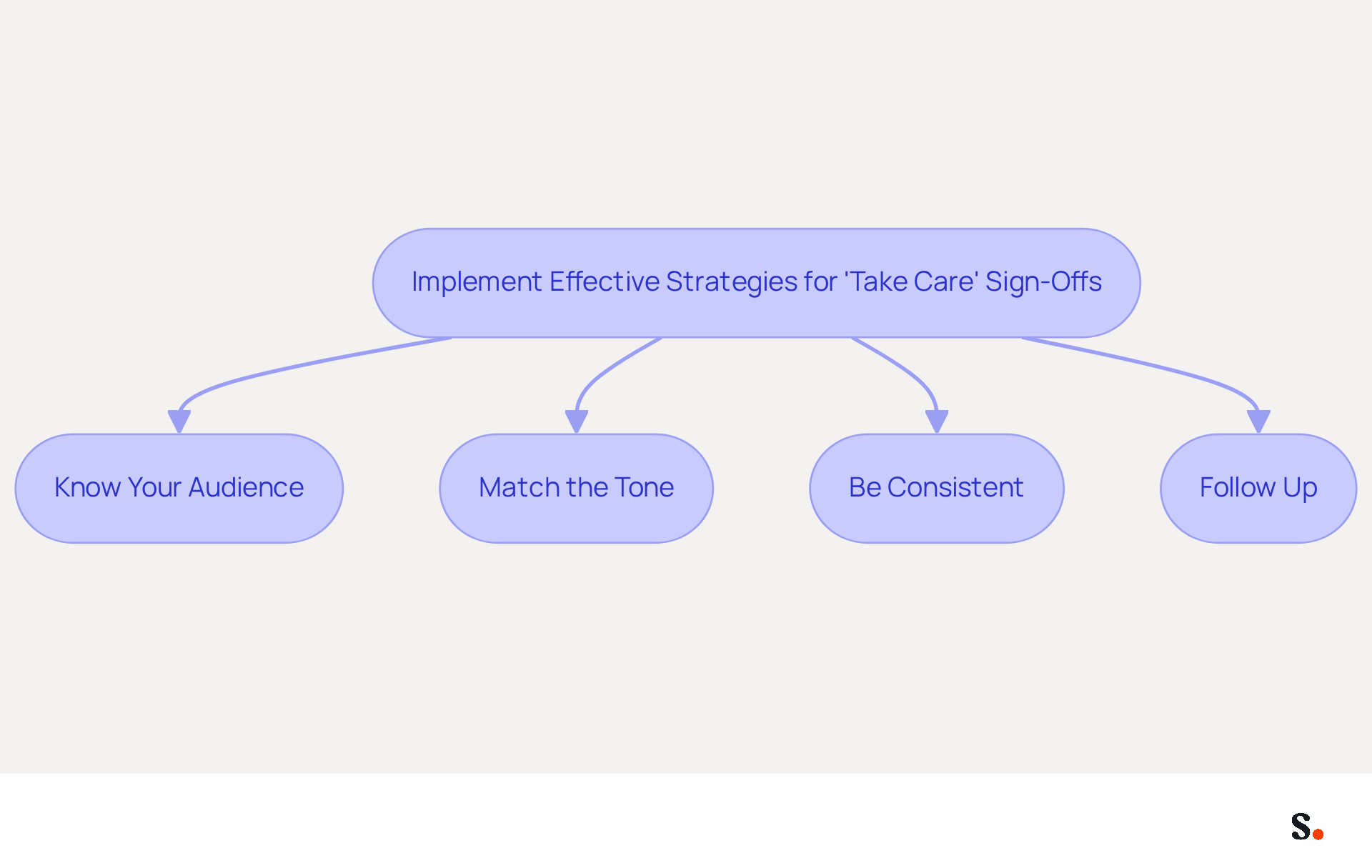
- Know Your Audience: Use 'Take Care' primarily with colleagues or clients you have a rapport with; reserve formal sign-offs for new contacts.
- Match the Tone: Ensure that the tone of your message aligns with the warmth of 'Take Care.' If the message content is light-hearted or friendly, a take care email sign-off will resonate well, enhancing the overall message.
- Be Consistent: If you choose to use 'Take Care,' incorporate it consistently in your signature. Consistently using a take care email sign-off helps create a recognizable style that reflects your personal brand. Scribe assists you in maintaining this consistency across all interactions, ensuring your brand identity is reflected in every message.
- Follow Up: Incorporate the 'take care email sign-off' in follow-up messages to maintain a friendly tone and encourage ongoing interaction. This strategy can significantly strengthen your professional relationships, as it conveys a sense of care and attentiveness.
Additionally, consider joining Scribe's Affiliate Program to enhance your signature strategy and unlock a new marketing channel. By promoting Scribe, you can earn a 50% commission on subscriptions and offer a $30 credit to new users, benefiting both you and your contacts.
Integrating these approaches can improve your messaging and foster more significant relationships. Notably, personalized emails can increase open rates by 26%, making the take care email sign-off a valuable tool in your communication arsenal.
Conclusion
Incorporating the 'Take Care' email sign-off into professional communication can significantly enhance interpersonal connections. This impactful phrase humanizes digital interactions and builds rapport, making it a valuable part of any email strategy.
The context in which 'Take Care' is used is crucial for effective communication, particularly in semi-formal or informal settings where relationships have been established. The benefits of this sign-off include:
- Improved rapport
- Increased chances of positive responses
- A more personable brand image
Knowing when and how to use 'Take Care' helps professionals communicate more effectively and leave a lasting impression.
Ultimately, the thoughtful use of email sign-offs like 'Take Care' can transform professional relationships and communication dynamics. By implementing the strategies outlined, individuals can refine their communication and foster a more engaged and collaborative workplace. By adopting this approach, professionals can not only refine their communication but also foster a more engaged and collaborative workplace.
Frequently Asked Questions
What is the significance of the 'Take Care' email sign-off in professional communication?
The 'Take Care' email sign-off, such as 'Look After', serves to create a sense of connection and warmth, fostering rapport between the sender and recipient, especially in friendly messages.
How does the 'Take Care' sign-off impact digital interactions?
Incorporating a 'Take Care' sign-off can humanize digital exchanges, making them feel less impersonal and leaving a lasting positive impression.
What does the survey mentioned in the article indicate about email communication?
The survey indicates that 83% of the workforce considers email critical to their success, highlighting the importance of being thoughtful in email interactions.
How does emotional intelligence relate to email communication?
Emotional intelligence in interactions can greatly enhance relationships, making it important for professionals to be considerate in their email communications.
What do case studies reveal about emotional intelligence in leadership?
Case studies show that leaders who develop emotional intelligence can significantly improve their ability to engage and motivate teams, emphasizing the value of compassionate sign-offs like 'Be Well'.
What is the overall benefit of using a 'Take Care' email sign-off?
Using a 'Take Care' email sign-off conveys genuine concern for the recipient's well-being, fostering a more collaborative and supportive work environment.
List of Sources
- Understand the Significance of 'Take Care' in Email Communication
- The EQ Effect: Leveraging Emotional Intelligence in Communication (https://er.educause.edu/blogs/2019/3/the-eq-effect-leveraging-emotional-intelligence-in-communication)
- Email Sign Offs for Every Industry and Situation | Mailchimp (https://mailchimp.com/resources/email-sign-offs)
- Best Email Sign-Offs: 15 Examples for Every Situation (https://beanstalkconsulting.co/blogs/best-email-sign-offs)
- Emotionally Intelligent Emailing (https://forbes.com/sites/travisbradberry/2013/01/11/emotionally-intelligent-emailing)
- Identify Appropriate Contexts for 'Take Care' Sign-Offs
- Best Email Sign-Offs for Any Correspondence (https://wisestamp.com/examples/email-sign-offs)
- The 37 best ways to close emails (https://signitic.com/en/resources/email-sign-offs)
- 12 Email Sign-Offs That Get Responses [2026 Data] (https://lagrowthmachine.com/email-sign-offs-get-responses)
- Explore the Benefits of Using 'Take Care' in Professional Emails
- Your Emails Are 36 Percent More Likely to Get a Reply If You End Them This Way (https://inc.com/jessica-stillman/your-emails-are-36-percent-more-likely-to-get-a-reply-if-you-close-them-this-way.html)
- Are your email sign-offs sabotaging your outreach? - Moving Targets (https://movingtargets.com/blog/business-marketing/email-sign-offs-sabotaging-outreach)
- Ending Your Emails With this One Word Vastly Improves the Response Rate | Team Referral Network (https://teamreferralnetwork.com/news/2017/03/ending-your-emails-with-this-one-word-vastly-improves-the-response-rate)
- Forget “Best” or “Sincerely,” This Email Closing Gets the Most Replies – The Boomerang Blog (https://blog.boomerangapp.com/2017/01/how-to-end-an-email-email-sign-offs)
- End your emails with this sign off and you’re almost guaranteed a response - National | Globalnews.ca (https://globalnews.ca/news/3254593/end-your-emails-with-this-sign-off-and-youre-almost-guaranteed-a-response)
- Implement Effective Strategies for 'Take Care' Sign-Offs
- 100 Email Sign-Off Ideas (+10 Golden Rules for Marketing Pros) - MailerLite (https://mailerlite.com/blog/email-sign-offs)
- 33+ email marketing stats you need to know in 2026 (https://wix.com/blog/email-marketing-statistics)
- 49 Top Email Marketing Statistics (https://forbes.com/advisor/business/software/email-marketing-statistics)
- 8 Email Marketing Statistics to Reinforce Your Strategy | Mailjet (https://mailjet.com/blog/email-best-practices/stats-email-marketing)
- Email Etiquette in the Workplace (https://adminvc.ucla.edu/news/email-etiquette-workplace)
Get started with Scribe
Build a professional email signature
Free 14-day trial — no credit card.