Master Email Closing Words for Maximum Engagement and Impact
Effective email closings are essential for enhancing professional communication. The right closing words convey respect and professionalism while significantly
Sophie Grant
Email Signature Specialist, Scribe

Introduction
Effective email closings are essential for enhancing professional communication. The right closing words convey respect and professionalism while significantly impacting engagement and response rates. Organizations face the challenge of tailoring sign-offs to resonate with diverse audiences while ensuring brand consistency and effective messaging. Achieving the right balance between formality and approachability is crucial for ensuring that every email leaves a lasting impression. Failure to do so may result in missed opportunities for engagement and connection.
Establish a Professional Tone with Email Closings
To establish a professional tone in your email closing words, it is essential to follow best practices that reinforce your credibility and effectiveness.
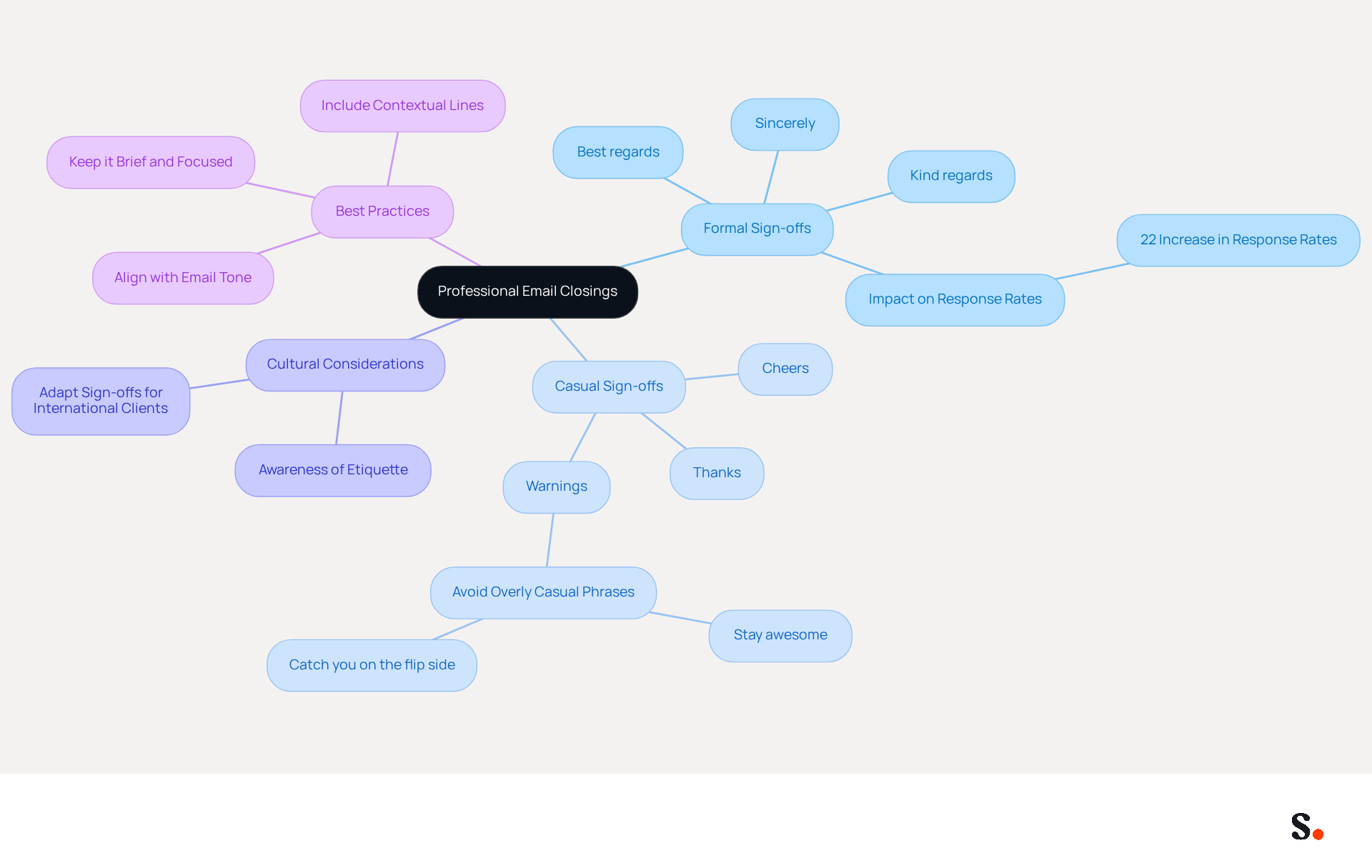
Consider using traditional sign-offs such as 'Sincerely,' 'Best regards,' or 'Kind regards' in formal communications. These expressions convey respect and professionalism. Studies indicate that using formal identifiers in message sign-offs can lead to a 22% increase in response rates.
It's important that your conclusion aligns with the tone of your correspondence. If your email is more casual, consider lighter sign-offs like 'Cheers' or 'Thanks.' However, be cautious; overly casual phrases such as 'Stay awesome' or 'Catch you on the flip side' can undermine professionalism.
Aim to keep your closing brief and focused. A simple 'Thank you' or 'Looking forward to your response' can be effective. Keeping it concise reinforces clarity in communication.
Using overly casual language can lead to misunderstandings and diminish your professional image. Stick to language that reflects professionalism to maintain your credibility.
When communicating with international clients or colleagues, it's crucial to be aware of cultural nuances in correspondence etiquette. Some cultures may prefer more formal closings. Adapting your sign-off can enhance rapport with international clients.
It's essential that your sign-offs align with your voice and identity. This strengthens professionalism and aligns with Scribe's mission to enhance brand visibility through effective communication.
By adhering to these practices, you can ensure that your email closing words reinforce a professional image, thereby enhancing your overall communication effectiveness. Ultimately, a thoughtful sign-off can significantly influence the recipient's perception and response, making it a crucial element of professional communication.
Choose Effective Closing Phrases for Maximum Impact
Choosing the right email closing words can significantly enhance your communication effectiveness. Consider the following strategies to maximize impact:
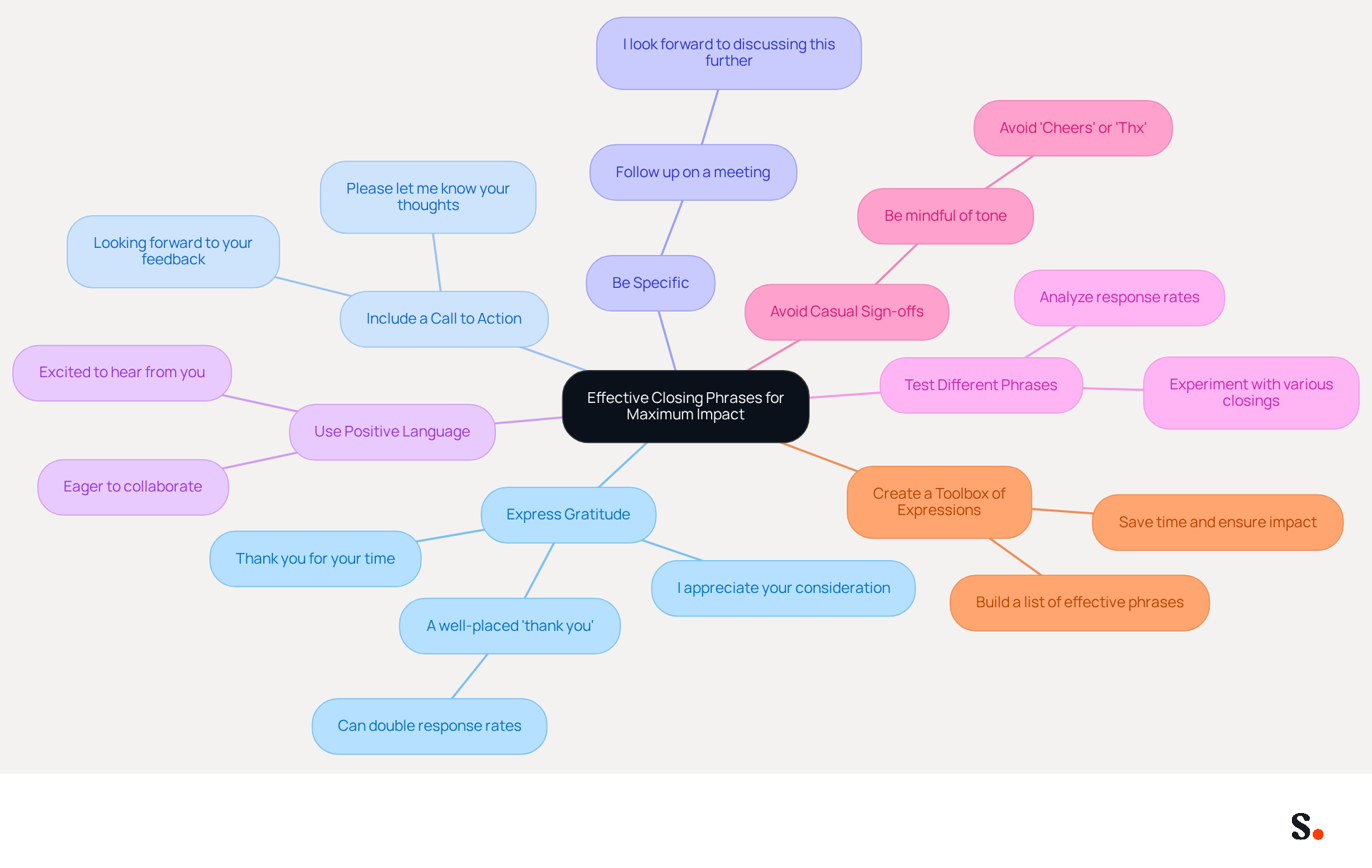
- Express Gratitude: Phrases like 'Thank you for your time' or 'I appreciate your consideration' can significantly foster goodwill. Studies show that a well-placed 'thank you' can double response rates for requests. Saying thank you can really boost your relationships and encourage positive responses.
- Include a Call to Action: Encourage the recipient to take the next step with phrases such as 'Looking forward to your feedback' or 'Please let me know your thoughts.' This approach invites engagement and shows that you value their input, which can lead to quicker decision-making.
- Be Specific: Customize your conclusion to the context of the message. For instance, if you are following up on a meeting, you might say, 'I look forward to discussing this further in our meeting next week.' Specificity helps clarify expectations and reinforces the purpose of your communication.
- Use Positive Language: Positive phrases like 'Excited to hear from you' or 'Eager to collaborate' can create a sense of enthusiasm and encourage prompt replies. Research indicates that positive language enhances the recipient's perception of the opportunity, making them more likely to respond.
- Test Different Phrases: Experiment with various concluding phrases in your emails to identify which resonate best with your audience. Analyzing response rates can help determine effectiveness, allowing you to refine your approach for maximum engagement.
- Avoid Casual Sign-offs in Formal Contexts: Be mindful of the tone of your conclusion. Using overly casual phrases like 'Cheers' or 'Thx' in formal communications can undermine your professionalism. Instead, opt for more appropriate sign-offs that reflect the context of your message.
- Create a Toolbox of Expressions: Consider building a 'toolbox' of effective concluding phrases that you can easily reference. This can save time and ensure that your message sign-offs are consistently impactful.
By implementing these strategies, you can significantly improve your response rates and strengthen professional relationships by using appropriate email closing words. Ultimately, the right closing phrases can transform your interactions, leading to stronger connections and better outcomes.
Tailor Closings to Context and Audience for Better Engagement
To enhance the effectiveness of your email closings, it is essential to tailor them to your audience and context:
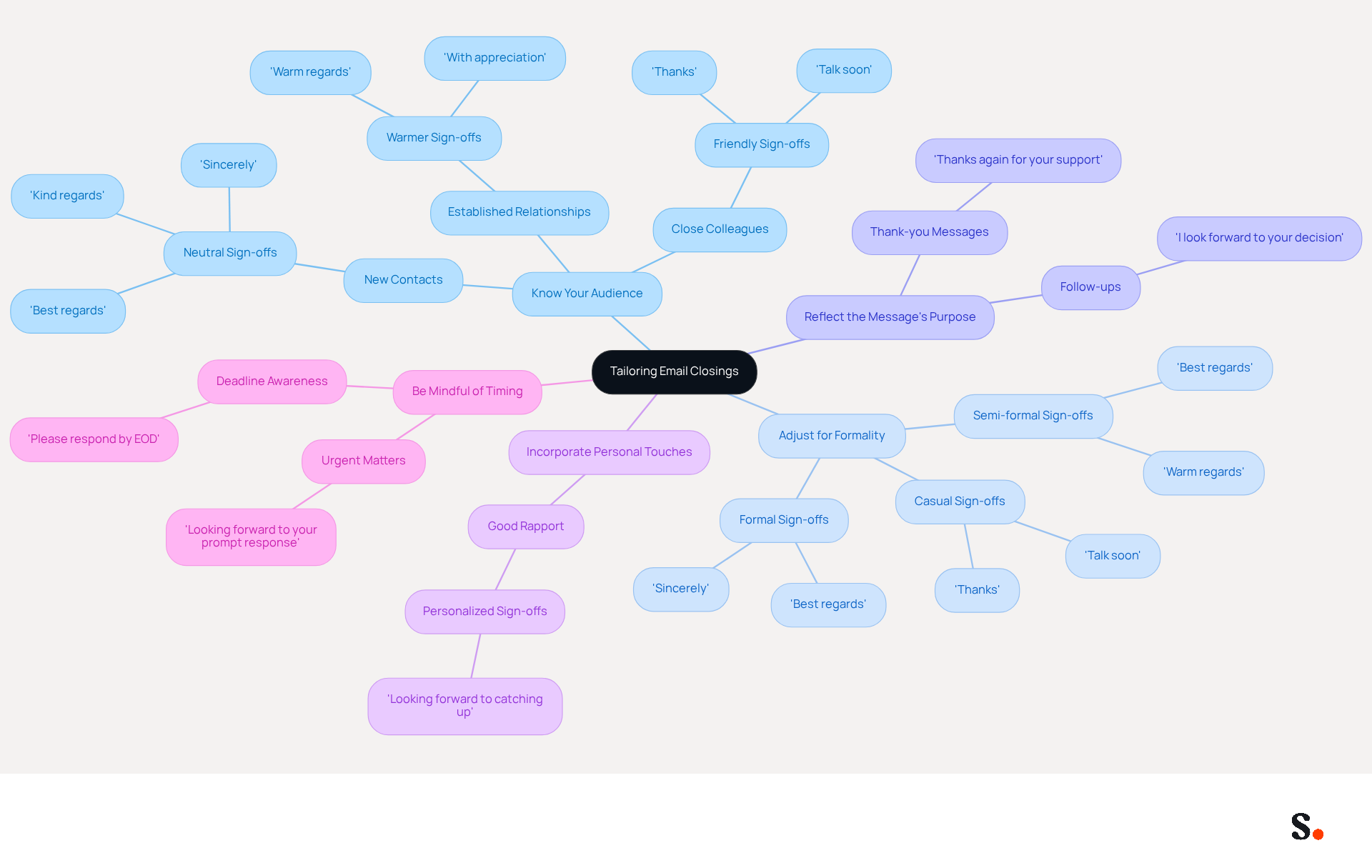
- Know Your Audience: Understand the preferences and expectations of your recipient. For instance, a farewell for a colleague may differ significantly from one intended for a client or a superior. Statistics suggest that new contacts should opt for neutral sign-offs like 'Best regards' or 'Kind regards' to uphold professionalism.
- Adjust for Formality: Match the level of formality in your conclusion to your relationship with the recipient. Utilize more formal sign-offs such as 'Sincerely' or 'Best regards' for clients or executives, while choosing casual sign-offs like 'Thanks' or 'Talk soon' with peers. Semi-formal correspondence can effectively utilize sign-offs such as 'Warm regards' to strike a balance.
- Reflect the Message's Purpose: Adapt your conclusion to the message's intent. For follow-ups on proposals, a closing like 'I look forward to your decision' is appropriate. In contrast, a thank-you message might conclude with 'Thanks again for your support.' Thus, a well-crafted use of email closing words can leave a lasting impression on the recipient, as they often remember the final tone of a message long after forgetting the specifics due to the psychological recency effect.
- Incorporate Personal Touches: When you have a good rapport with the recipient, adding a personal touch to your farewell can really enhance the warmth of your message. TrainSmart, INC. emphasizes that effective communication etiquette can solidify your reputation as a reliable and trustworthy professional.
- Be Mindful of Timing: If your message is sent close to a deadline, reflect that urgency in your conclusion, such as 'Looking forward to your prompt response.' This approach conveys the importance of the matter and encourages timely engagement. Additionally, be cautious of common pitfalls, such as being overly casual or using the same sign-off repeatedly, which can undermine your professionalism.
By thoughtfully customizing your email closing words, you can foster stronger professional relationships and enhance your communication effectiveness.
Leverage Email Signatures to Reinforce Brand Messaging
To maximize the impact of your email signatures, implementing best practices is crucial:
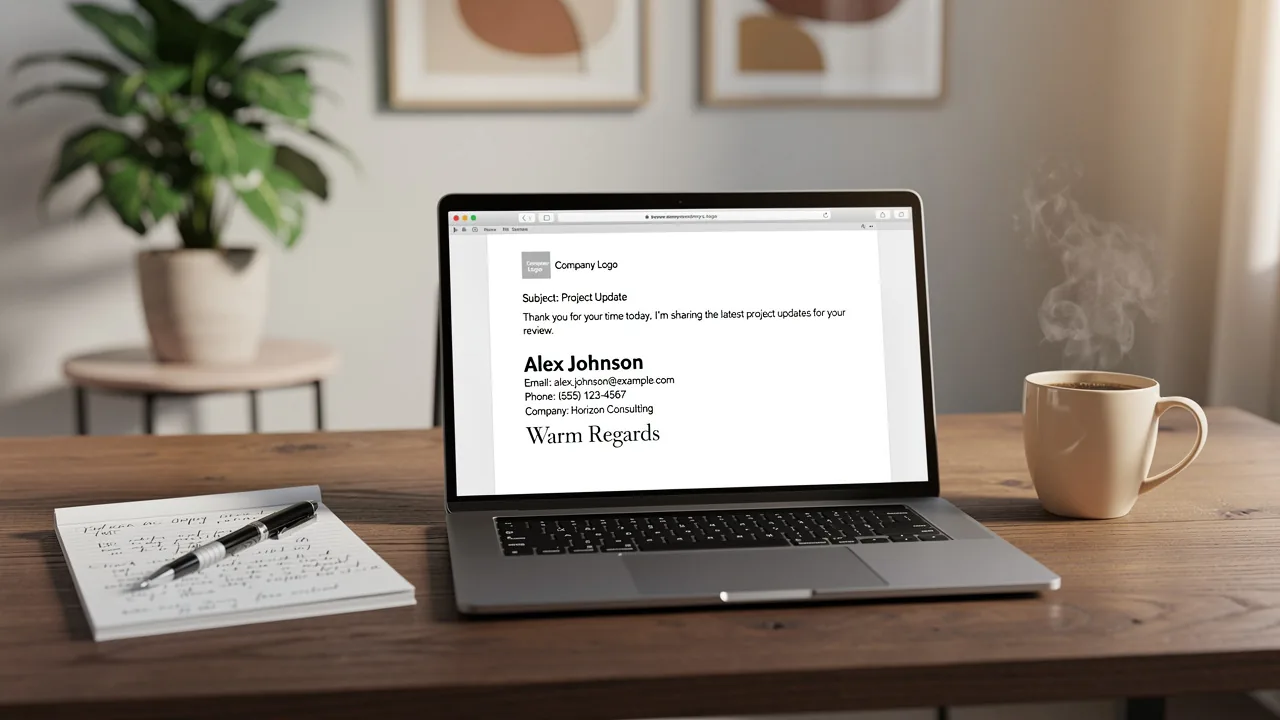
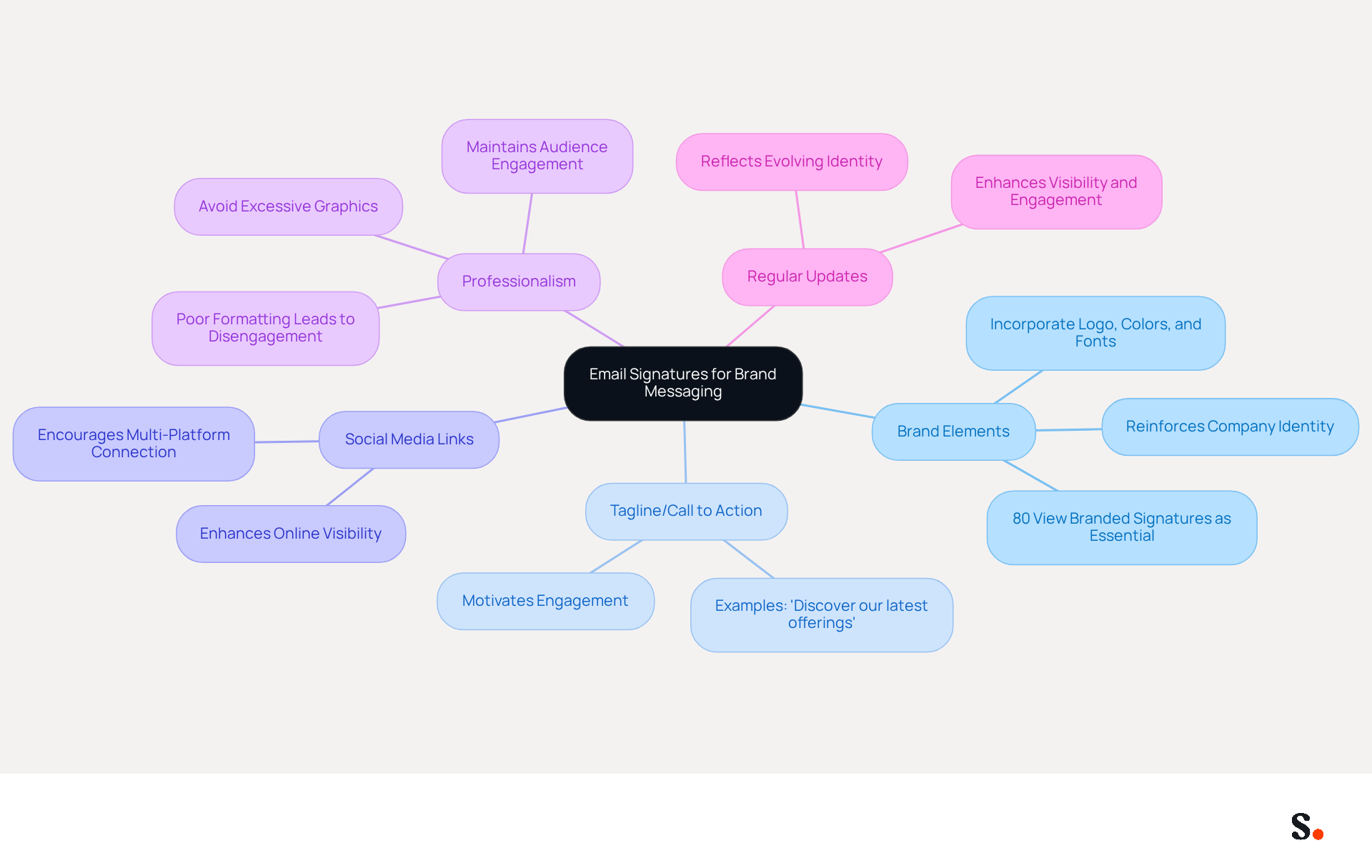
- Include Brand Elements: Incorporate your company logo, colors, and fonts in your signature to maintain consistency. This visual representation reinforces your identity in every email; 80% of respondents view branded email signatures as essential to a company's identity.
- Add a Tagline or Call to Action: Integrate a brief tagline or a call to action in your signature, such as 'Discover our latest offerings' or 'Schedule a demo today.' This motivates recipients to engage further with your organization, increasing the chances of interaction.
- Utilize Social Media Links: Include links to your company's social media profiles in your signature. This not only enhances your online visibility but also encourages recipients to connect with your identity on multiple platforms, driving traffic and engagement.
- Maintain Professionalism: While creativity is essential, ensure that your signature remains professional. Excessive graphics or distracting fonts can lead to disengagement from your audience, as poor formatting is a leading reason for consumer disengagement.
- Regularly Update Your Signature: As your identity evolves, so should your signature. Timely updates can significantly enhance visibility and drive traffic, supported by case studies that demonstrate improved engagement with timely updates.
By using your email signatures effectively, you can really boost your messaging and turn every email into a marketing opportunity. Ultimately, a well-crafted email signature can be a powerful tool in fostering trust and recognition among your audience.
Conclusion
Effective email closings are crucial for fostering professional relationships and enhancing communication. Selecting appropriate sign-offs that match your message's tone and context can significantly impact how recipients perceive your communication. A thoughtful conclusion not only enhances professionalism but also fosters deeper engagement with recipients, making it essential for successful email correspondence.
Consider expressing gratitude, incorporating calls to action, and tailoring your closings to fit your audience and context. Utilizing effective phrases can significantly boost response rates and strengthen connections. Additionally, leveraging email signatures as a branding tool reinforces your organization's identity and messaging, transforming every email into an opportunity for engagement.
Integrating these best practices into your daily communication can enhance your interactions and lead to more favorable outcomes. As organizations strive for brand consistency and measurable marketing ROI, the importance of effective email closings and signatures cannot be overstated. Adopting these strategies can redefine your email communication, ensuring every interaction leaves a lasting impression.
Frequently Asked Questions
What are some recommended sign-offs for professional emails?
Recommended sign-offs for professional emails include traditional expressions such as 'Sincerely,' 'Best regards,' and 'Kind regards,' as they convey respect and professionalism.
How can using formal sign-offs impact response rates?
Studies indicate that using formal identifiers in message sign-offs can lead to a 22% increase in response rates.
What should I consider when choosing a closing for my email?
Your email closing should align with the tone of your correspondence. For casual emails, lighter sign-offs like 'Cheers' or 'Thanks' may be appropriate, but overly casual phrases can undermine professionalism.
How important is brevity in email closings?
Keeping your closing brief and focused is important. Simple phrases like 'Thank you' or 'Looking forward to your response' can be effective and reinforce clarity in communication.
What are the risks of using overly casual language in email sign-offs?
Using overly casual language can lead to misunderstandings and diminish your professional image, so it's important to stick to language that reflects professionalism.
Why is it important to consider cultural nuances in email sign-offs?
When communicating with international clients or colleagues, being aware of cultural nuances in correspondence etiquette is crucial, as some cultures may prefer more formal closings. Adapting your sign-off can enhance rapport.
How does aligning sign-offs with my voice and identity affect professionalism?
Ensuring that your sign-offs align with your voice and identity strengthens professionalism and aligns with Scribe's mission to enhance brand visibility through effective communication.
What is the overall significance of thoughtful email sign-offs?
Thoughtful sign-offs can significantly influence the recipient's perception and response, making them a crucial element of professional communication.
List of Sources
- Establish a Professional Tone with Email Closings
- Mastering Professional Email Sign-Offs in 2026 (https://linkedin.com/pulse/mastering-professional-email-sign-offs-2026-bulksignature-qsr4e)
- Email Sign Offs Professional: Best Practices for Business Emails (https://mailwarm.com/blog/professional-email-sign-offs-best-practices)
- 50 Best Email Sign-Offs to End an Email Properly in [year] (https://elementor.com/blog/best-email-sign-offs)
- How to End an Email Professionally (With Examples) (https://iconnect.isenberg.umass.edu/blog/2024/07/10/how-to-end-an-email-professionally-with-examples)
- 4 Best Practices for Effective Professional Email Closings (https://scribe-mail.com/en-US/blog/4-best-practices-for-effective-professional-email-closings)
- Choose Effective Closing Phrases for Maximum Impact
- 50 Best Email Sign-Offs to End an Email Properly in [year] (https://elementor.com/blog/best-email-sign-offs)
- Best Email Closing Lines for Closing Deals (https://callboxinc.com/email-marketing/best-email-closing-lines-for-closing-deals)
- Phrases for closing an email - Target Training GmbH (https://targettraining.eu/20-phrases-closing-email)
- How to End an Email Professionally (With Examples) (https://iconnect.isenberg.umass.edu/blog/2024/07/10/how-to-end-an-email-professionally-with-examples)
- Tailor Closings to Context and Audience for Better Engagement
- The importance of good email etiquette (https://studyworkgrow.com/email-etiquette-why-is-it-important)
- Mastering Professional Email Sign-Offs in 2026 (https://linkedin.com/pulse/mastering-professional-email-sign-offs-2026-bulksignature-qsr4e)
- Email Etiquette in the Workplace (https://adminvc.ucla.edu/news/email-etiquette-workplace)
- Why Email Etiquette Is Important In The Workplace (https://trainsmartinc.com/why-email-etiquette-matters-more-than-ever)
- 50 Best Email Sign-Offs to End an Email Properly in [year] (https://elementor.com/blog/best-email-sign-offs)
- Leverage Email Signatures to Reinforce Brand Messaging
- Research Recap: Branded Email Signatures Increase Company Recognition, Trust - Demand Gen Report (https://demandgenreport.com/industry-news/research-recap-branded-email-signatures-increase-company-recognition-trust/47252)
- Exclaimer Research: 67% of Marketers Expect Email Signatures to Support With Lead Gen In 2023 (https://businesswire.com/news/home/20230612141095/en/Exclaimer-Research-67-of-Marketers-Expect-Email-Signatures-to-Support-With-Lead-Gen-In-2023)
- Why Are Email Signatures Key to Brand Awareness? | QuickMail (https://quickmail.com/role-of-email-signatures-in-brand-awareness)
- Email Signature Trends 2026: Centralized Control & Automation | SIGNandGO posted on the topic | LinkedIn (https://linkedin.com/posts/signngo_email-signature-trends-to-watch-in-2026-activity-7401523471786217473-zAVL)
- Why Email Signatures Must Be In Your 2026 Marketing Plan | Rocketseed (https://rocketseed.com/blog/what-are-the-biggest-email-trends-for-2026)
Get started with Scribe
Build a professional email signature
Free 14-day trial — no credit card.