Signatures for Regulated Industries: A Validation and Governance Framework
Learn how regulated organizations validate email signature content, review personal data, approve changes, and maintain governance.
Sophie Grant
Email Signature Specialist, Scribe

On this page
- Open a change record before editing a signature
- Separate an email signature from a formal electronic signature
- Define the change test and release criteria
- Assess the information impact of a change
- Test whether a change affects required information
- Screen privacy and personal-data effects
- Approve the proposed version
- Release with observable controls
- Audit the change and its trigger
- Close with the questions stakeholders must answer
- What should each stakeholder verify before approval?
- What are the key considerations for privacy in email signatures?
- What is the difference between an email signature and a formal electronic signature?
- What actions should organizations take when conditions change regarding email signatures?
- How can organizations manage the approval process for email signature content?
- Sources
Open a change record before editing a signature
Treat each signature update as a controlled change to an approved communication. Open a record that identifies the current version, the proposed change, its intended scope, and the owner of the decision. Review the proposed result against the approved version before deciding whether it can be released.
Your first question should be: which signature elements must this organization validate for this role and communication context? That question prevents a common mistake—turning a useful disclosure in one setting into a supposedly universal requirement. A healthcare provider, investment adviser, insurer, and law firm may face different obligations, and the answer can also vary by employee role, audience, and message type. The fact that an item appears in another organization’s footer does not establish that it applies to yours.
Use the following sequence before drafting language:
- Define the business activity and regulated status involved.
- Identify the jurisdictions that govern the sender and the communication.
- Separate role-specific information from organization-wide information.
- Identify the audience and communication channel.
- Record which stakeholder has authority to approve each element.
- Note the event or change that would require the decision to be reopened.
The result should be a validation record, not a collection of copied disclaimer examples. Your goal is to show why each approved element applies, who approved it, where it may be used, and when the decision must be revisited.
Separate an email signature from a formal electronic signature
The two mechanisms can appear in the same communication, but they answer different questions. A signature block helps identify who sent the message and what information accompanies it. Formal execution involves a separate legal or operational process.
Your review should therefore ask what the email signature is intended to communicate, not whether the block itself completes a transaction or creates formal assent. Do not describe a standard footer as an electronic signature, digital signature, approval, consent, or execution mechanism unless a qualified stakeholder has specifically established that role for your process.
This distinction changes the approval path. The team reviewing sender identity, professional information, disclosures, privacy wording, and contact details is not automatically approving a contract-signing method. Keep signature content governance separate from any workflow that authorizes, signs, accepts, or executes a formal record.
Record the boundary in your internal policy and review materials. State what the signature communicates, what it does not authorize, and which separate process handles formal execution. That wording helps prevent an approved contact block from being mistaken for evidence that a person signed, accepted, or delivered a legal instrument.
Define the change test and release criteria
Define the acceptance questions before anyone writes replacement wording. The change record should connect the requested difference to its purpose, affected scope, accountable owner, reviewers, version, effective date, and release evidence. Reviewers can then assess the proposed state against a stated boundary instead of approving a block because it looks complete.
Include these fields in the matrix:
- Industry and regulated activity.
- Applicable regulator, rule, or internal policy.
- Jurisdiction of the business, sender, and recipient where relevant.
- Employee role, license, department, or professional status.
- Audience and communication context.
- Proposed signature element and its purpose.
- Data source and accountable owner.
- Reviewing stakeholders, approval status, version, and effective date.
- Implementation evidence and the condition that triggers revalidation.
- Any restriction on where the approved wording may appear.
A blank or unresolved field should remain an open decision. Do not convert it into a generic statement simply to complete the template.
United States financial-services reviews illustrate why the matrix needs both rule and channel fields. The SEC OCIE risk alert states that an investment adviser must review its compliance policies and procedures, and their implementation, at least annually. FINRA examination materials ask whether a firm’s communications, regardless of platform, comply with Rule 2210’s content standards. These premises do not establish a universal email-signature rule; they tell you to map the relevant activity, communication, and supervisory process before approving wording.
Use the matrix to produce one decision for each proposed element: approve for the defined scope, revise for a narrower scope, hold for stakeholder review, or reject because the purpose is not established. Add a short reason for the decision and identify the person who owns the next action. That decision path is more defensible than selecting a block because it looks complete.
Assess the information impact of a change
When a proposed update touches visible signature content, assess its information impact before approving the change. Classify the affected content by function—identity, professional status, regulatory disclosure, contact, privacy, or communication—and compare that function with the approved scope. The change requires a separate decision when its function, audience, or exposure differs from the current version.
Assess whether each role and communication context requires review of:
- Legal identity, including the organization name and any role-specific entity information.
- Professional identity, licensing, registration, or designation information where applicable.
- Business contact details and the contact route recipients are expected to use.
- Required disclosures or statements linked to the activity, jurisdiction, audience, or channel.
- Privacy wording and any explanation of how personal information is handled.
- Personal data displayed about the sender or another person.
- Optional branding or calls to action that could affect the clarity of required information.
The list identifies questions, not automatic inclusions. Your legal, compliance, privacy, and business owners should determine whether an item applies and how it should be expressed.
Healthcare organizations need a separate applicability check for health information. HHS says that the HIPAA Privacy Rule establishes national standards for protecting certain health information and governs its use and disclosure by covered entities. HHS also explains that the rule applies to protected health information held by covered entities and gives individuals rights concerning its use. Those statements do not turn every healthcare email signature into a HIPAA disclosure; they identify why privacy stakeholders must assess the data and communication context.
The practical output is a field inventory with an owner and a reason for review. For each field, record whether it is required, conditional, optional, or excluded for the defined scope. If your team cannot explain what a field communicates, who needs it, or which scope makes it relevant, leave the field unresolved rather than treating it as a standard requirement.
Test whether a change affects required information
FINRA says that not every disclosure in a marketing communication is required by its rules, but additional information must not inhibit an investor’s understanding of required information under Rule 2210(d)(1)(C). Use that distinction when a financial-services team proposes adding several explanatory paragraphs, notices, or promotional lines: identify the required information first, then test whether each extra element helps or interferes with understanding.
If your signature appears in a communication covered by the firm’s review process, include that communication context in the validation matrix instead of treating the footer as isolated design content.
Apply a short test to every proposed addition:
- What requirement or business purpose does the text address?
- Which role, audience, jurisdiction, or channel makes it relevant?
- Could the text obscure, dilute, or distract from required information?
- Who has authority to approve the final wording?
- Does the text apply to every message in scope, or only to a defined class of communication?
Keep the approved wording precise and proportionate to its purpose. Do not publish a universal disclaimer block when the applicable rule, audience, or activity has not been established.
Screen privacy and personal-data effects
Privacy review should examine the data exposed by a signature, the purpose for displaying it, and the communication contexts in which it appears. A field can be accurate and professionally useful while still requiring a separate privacy decision for a particular role, jurisdiction, or audience. Review the visible text, linked destinations, images, tracking elements, and any data inserted dynamically rather than reviewing wording alone.
Ask your privacy stakeholders:
- Which signature fields contain personal data?
- Does the signature reveal more information than the recipient needs for the stated purpose?
- Does the proposed wording or linked content create a separate use or disclosure question?
- Does the answer change for healthcare, financial-services, insurance, or legal communications?
- How should privacy requirements be recorded when employees, recipients, or systems are in different jurisdictions?
- Which owner must approve changes to privacy wording or displayed data?
- What should happen when a data field is missing, outdated, or no longer appropriate for a role?
Treat GDPR applicability as a question for the relevant privacy and legal owners rather than assuming that one privacy notice fits every communication.
NIST privacy-framework material describes privacy risk management as an organizational process involving risk identification, communication, management approval, and privacy risk assessment. NIST control material distinguishes organization-level privacy-program controls from system-specific controls and describes organization-wide privacy planning as a way to document privacy controls across systems. Apply that structure to the signature review by recording the risk question, the accountable owner, the approval decision, and the system or role scope.
For covered entities, HHS explains that the HIPAA Privacy Rule concerns protected health information and individual rights concerning its use. Your signature review should therefore ask whether the proposed content or linked destination could involve that information, without assuming that a general healthcare label answers the question. Keep the privacy decision tied to the information and communication at issue.
Approve the proposed version
An approval record turns a proposed signature into an accountable decision. Your record should identify the exact wording, the scope in which it may be used, the people who reviewed it, and the evidence that the approved result was implemented. It should also make clear which questions were answered and which exceptions remain open.
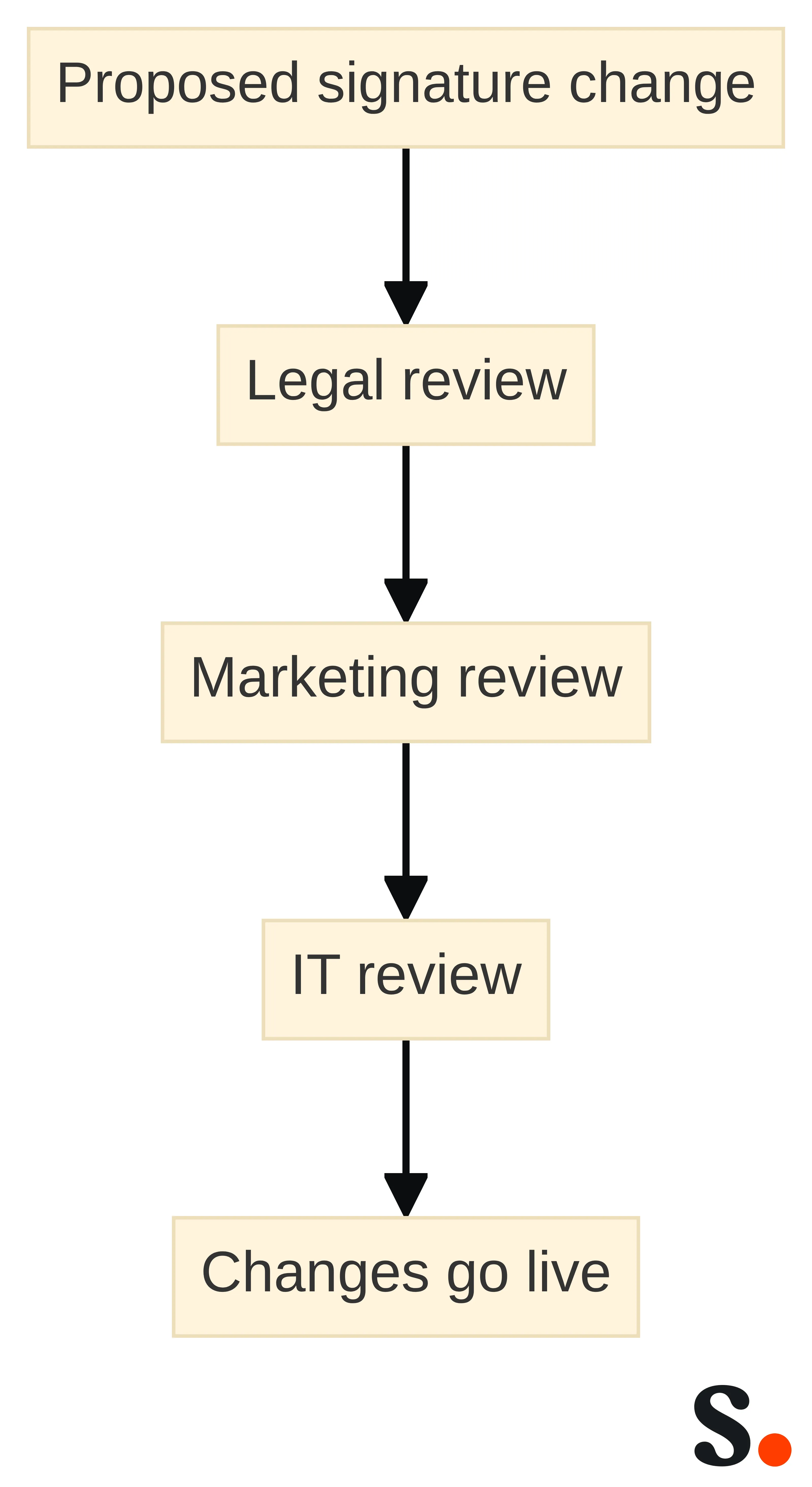
For a financial-services workflow, involve legal and compliance teams early to pre-approve disclaimers, disclosures, and regulatory statements before deployment. A legal, marketing, and IT review before signature-template changes go live can assign separate decisions to the people responsible for meaning, communication, and implementation. Use those roles as a workflow pattern, not as a universal rule: assign each stakeholder a defined decision rather than asking everyone to approve the same question informally.
Record at least these items for each approved element:
- The final wording or field definition.
- The business activity, role, jurisdiction, audience, and channel covered.
- The requirement, policy, or decision rationale.
- The legal, compliance, privacy, marketing, and IT owners involved.
- Approval status, version, approval date, and effective date.
- The implementation location and evidence that the approved result is active.
- The condition or event that requires another review.
- Any approved exception and the scope in which it applies.
Keep unresolved exceptions visible. A record that hides disagreement is less useful than a record that assigns the next decision to a named owner.
Separate content approval from implementation approval. Legal or compliance may approve what the wording means, while IT may need to confirm where the wording is applied and how changes are recorded. Marketing may review optional promotional content without deciding whether a regulatory statement is required. This division prevents technical deployment from being mistaken for substantive approval.
Release with observable controls
Post-approval control should preserve the approved result while allowing legitimate role and business changes. A financial-services guidance approach describes field-level locking, role-based templates, directory synchronization, and audit logs as controls for consistent email-signature compliance. Treat each control as a response to a defined risk, not as a universal package that every organization must adopt.
Field-level locking is relevant when employees must not modify a regulatory disclaimer. Role- or department-based templates are relevant when signature content differs by approved role. Directory synchronization is relevant when role assignments or identity data must remain aligned with an authoritative directory. Audit logs are relevant when you need a record of changes for review. Select only the controls that match the decision recorded in your validation matrix.
Your implementation record should show which approved version is active, which roles receive it, which fields are fixed or editable, and where changes are logged. Define the handling of a missing, stale, or conflicting employee value before release. Do not allow a blank field or manual exception to silently change the approved meaning. If an exception is necessary, record its owner, scope, reason, and expiry or review condition.
For financial-services teams, training on signature-use policies and the implications of manual changes can support the approved boundary. Use training to explain the process for requesting a correction, the difference between an authorized exception and an unreviewed edit, and the point at which a content owner must review a proposed change.
Audit the change and its trigger
Reopen the change record when the approved conditions change, including the disclaimer, legal text, signature component, role, activity, jurisdiction, audience, channel, or applicable requirement. For financial-services workflows, one selected guidance source recommends regular review because requirements can change. Set the timing and triggers with the stakeholders responsible for the applicable requirements rather than carrying one calendar across every organization.
Use a change log that connects each review to the affected version and decision. For every change, record what changed, why it changed, which roles and jurisdictions are affected, who approved it, when it becomes effective, and what implementation evidence was collected. If the review produces a narrower scope, preserve the narrower scope in the active record rather than carrying forward the broader wording.
The objective is a maintained decision, not a permanent declaration that the signature is compliant. A signature remains within its approved boundary only while the underlying role, activity, wording, data, and communication conditions remain aligned. When those conditions shift, pause the affected release or exception and route it back through the responsible review.
Close with the questions stakeholders must answer
Your organization is ready to approve regulated email-signature content only when its applicability, wording, ownership, and maintenance conditions are explicit. Use the following questions to close the review and expose decisions that still need an answer.
Ask legal and compliance:
- Which rule, policy, activity, jurisdiction, role, audience, or channel makes each proposed element relevant?
- Which wording is required, and which wording is optional?
- Could additional text interfere with understanding required information?
- Does the signature remain separate from any formal electronic-signature or execution process?
Ask privacy:
- Which fields and linked content contain or expose personal data?
- Does the assessment change for healthcare information, financial communications, or cross-border activity?
- Who approves privacy wording and data-field changes?
- What happens when displayed data is incomplete, stale, or no longer needed?
Ask IT and operations:
- Which approved version is active for each role and scope?
- Which fields are fixed, which are editable, and how are exceptions handled?
- Where are approvals, changes, and implementation evidence recorded?
- What event triggers revalidation?
- How will the team identify the affected roles when a requirement or approved field changes?
Take the unanswered questions into a documented review with qualified internal or external legal, compliance, privacy, and IT professionals. They can decide whether the proposed content fits your organization’s applicable requirements. After approval, maintain the version, scope, ownership, and change record together so the signature remains a governed communication element rather than an unsupported universal template.
What should each stakeholder verify before approval?
What are the key considerations for privacy in email signatures?
Key considerations include identifying which signature fields contain personal data, ensuring that the displayed information is necessary for the communication purpose, and determining how privacy requirements may vary by industry or jurisdiction.
What is the difference between an email signature and a formal electronic signature?
An email signature serves as a sender-identification and disclosure block in correspondence, while a formal electronic signature is used to execute legal documents and requires a separate approval process.
What actions should organizations take when conditions change regarding email signatures?
Organizations should revalidate email signatures when there are changes in jurisdiction, regulations, business activities, employee roles, or communication contexts, ensuring that the signature remains compliant.
How can organizations manage the approval process for email signature content?
Organizations can manage the approval process by creating a cross-functional approval record that documents the wording, scope, reviewing stakeholders, and evidence of implementation for each signature element.
Get started with Scribe
Signatures for every role on your team
Free 14-day trial — no credit card.