External Email Warning Banners: A Governance-Informed Decision Guide
Learn how regulated US organizations can govern external email warnings through scope, wording, accessibility, approvals, and review.
Sophie Grant
Email Signature Specialist, Scribe

On this page
- What signal should an external email warning provide?
- Separate external origin from legal and required content
- Set the protection boundary before approving the control
- Prefer signal quality over blanket visibility
- Decide which conditions justify a warning
- Review timing and explanation as separate design choices
- Make the wording understandable without overstating certainty
- Check placement, consistency, and accessibility across real experiences
- Assign review ownership before deployment
- Test the banner against operational reality
- Use awareness and training to reinforce, not replace, the signal
- Set the review criteria for continued use
- Close with a governance decision, not a wording shortcut
- Sources
What signal should an external email warning provide?
An external email warning banner tells you that a message originated outside your organization. That is the banner’s primary signal: origin, not a verdict about the sender, the content, or the action requested. In theory, the signal can help you notice when someone may be trying to impersonate a coworker, but it cannot settle that question by itself.
Treat the banner as one point of context in a wider decision. Before you approve one, define four things:
- Purpose: What should the warning help you notice—external origin, a suspicious sender context, a message containing a link or document, or another approved condition?
- Audience: Which employees, contractors, teams, or shared mailboxes need the same explanation, and where might their normal email patterns differ?
- Boundary: What must the warning never imply, such as sender authentication, regulatory approval, confidentiality, or proof that the message is safe?
- Ownership: Who approves the wording, trigger conditions, placement, accessibility review, and later changes?
The decision is therefore not whether a banner can be displayed. The decision is whether its signal remains useful for the people who see it. A warning that appears without a clear purpose can become background decoration. A warning with a defined purpose gives you a basis for deciding its scope, wording, and review process.
Record that purpose before discussing implementation details. A short decision record should identify the signal, the intended audience, the situations that justify attention, and the boundary the warning must not cross. That record gives compliance, legal, security, IT, and communications a shared question to review instead of leaving each group to interpret the banner differently.
Get started with Scribe
See why teams switch to Scribe
Free 14-day trial — no credit card.
Separate external origin from legal and required content
An external-origin warning and required email content answer different questions. The warning identifies where the message came from. A legal disclaimer, confidentiality notice, privacy notice, or other required signature text addresses a separate organizational, legal, or communications purpose. Keeping those jobs distinct makes it easier to approve each element on its own terms.
Do not treat a warning as a substitute for required wording. Do not treat required wording as evidence that an incoming message came from outside the organization. If both appear in the same email experience, give each element a recognizable role and avoid wording that blends them into one general statement.
Use this separation when you review the proposed design:
- Origin: Does the warning plainly communicate that the message came from outside the organization?
- Required content: Has the responsible function identified any text that must accompany outgoing messages, and is that text governed separately from the incoming warning?
- Privacy communication: If the experience describes data collection or processing, is the explanation easy to understand rather than buried beneath formal wording?
- Presentation: Can you tell which text is a security signal, which text is a legal or privacy communication, and which text identifies the sender or organization?
- Approval: Has each content job reached the person responsible for that job before release?
Communications about data collection and processing should be easy to understand, and a simpler explanation may sit alongside legally required wording. That principle supports clear separation: formal language can remain where it is required, while the warning explains its immediate purpose in terms you can act on. The exact legal or regulatory content depends on your organization’s obligations and requires the appropriate professional review.
Apply the same distinction to ownership and change control. A change to a warning trigger is not automatically a change to a legal notice, and a revision to required outgoing text is not automatically a reason to alter an incoming warning. Record which team owns each element, which approval applies to it, and whether a change to one element requires a review of the other.
Set the protection boundary before approving the control
An external email warning is an awareness signal, not an authentication result. The warning may draw attention to a possible impersonation attempt, but attackers can outsmart external warnings and fabricate content inside the message, including native email-client features such as meeting invitations, access invitations, and conversation chains.
That limitation should shape the approval language. A banner can tell you to pause and assess context; it should not tell you that the sender has been verified, that the content has been cleared, or that following the request is safe. A message can carry an external indicator and still contain a convincing display name, a familiar conversation history, or a request that appears to fit your work.
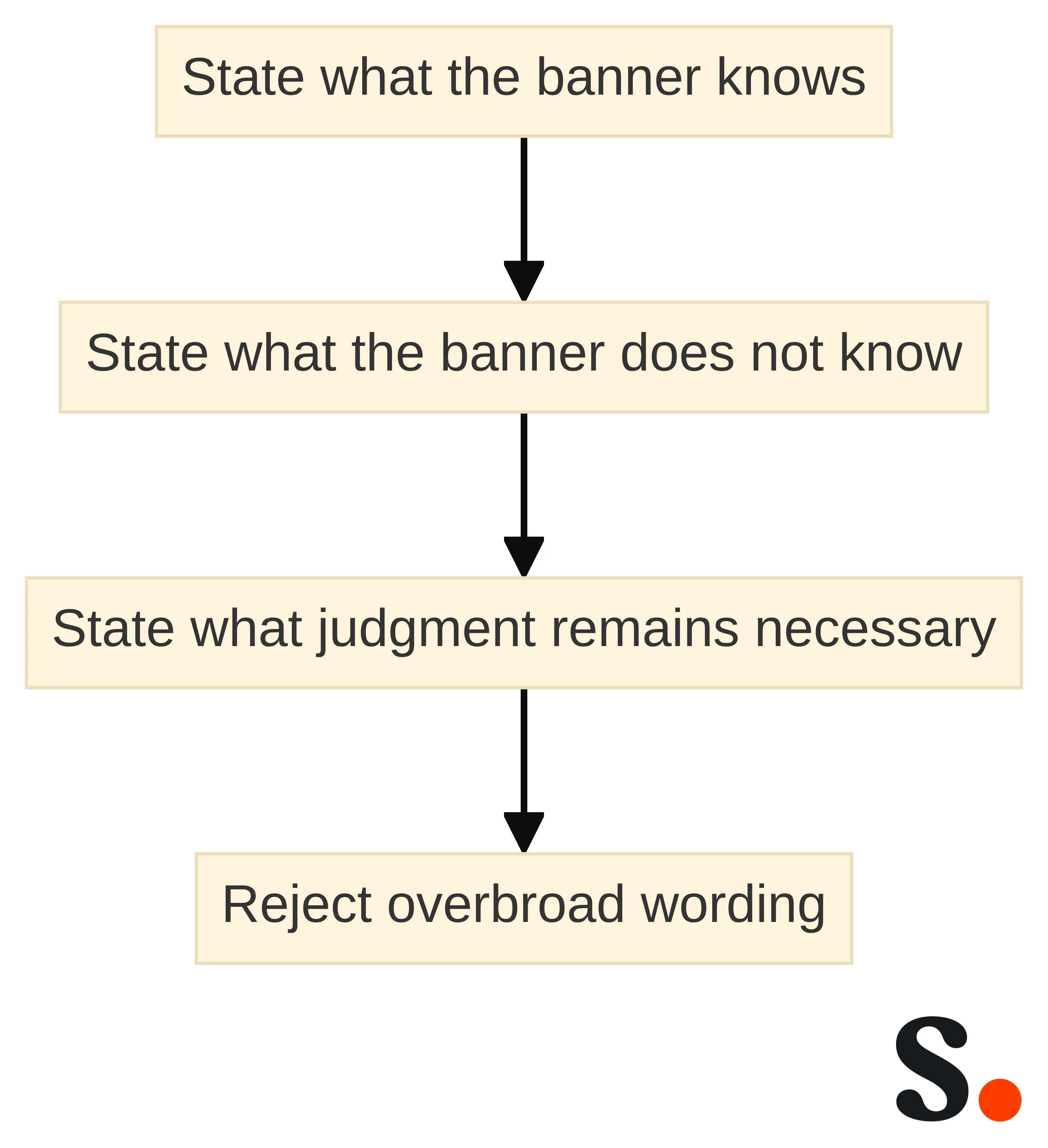
Write the protection boundary into the design record before anyone debates colors or placement:
- State what the banner knows. It identifies an external origin or another defined trigger condition.
- State what the banner does not know. It does not, by itself, establish who controls the sender’s account, whether the request is legitimate, or whether the content is harmless.
- State what judgment remains necessary. Your organization must decide how recipients should interpret the signal and what internal process applies when a message appears suspicious.
- Reject overbroad wording. Remove language that suggests universal protection, legal sufficiency, or a completed security check unless the responsible authority has approved that precise meaning.
This boundary protects the control from being judged by a promise it cannot keep. It also gives training, communications, and incident processes a precise idea to reinforce: the banner changes the context in which you assess a message, but it does not complete the assessment for you.
Use the boundary as an acceptance condition. The proposed wording should describe the signal without certifying the sender, the message, or the requested action. If stakeholders cannot agree on that distinction, the approval question is still unresolved, regardless of whether the banner can technically be displayed.
Prefer signal quality over blanket visibility
Warning scope determines whether the signal stays noticeable. A generic banner fixed above every external email can lead to habituation, while a context- or risk-based warning can preserve signal value when something genuinely stands out. ISACA recommends a risk-based approach that prioritizes suspicious domains or messages containing documents and links instead of applying warnings across all messages.
| Approach | Signal condition | Main governance question | Practical concern |
|---|---|---|---|
| Always-on external banner | Every external message receives the same notice | Does external origin alone justify the same interruption every time? | Fixed text can become familiar background and reduce attention. |
| Context- or risk-based warning | The warning appears when a defined sender or message condition stands out | Which conditions are significant enough to trigger attention? | The organization must define, test, and periodically review the conditions. |
These are not merely visual alternatives. They represent different decisions about the amount of judgment you ask from recipients. An organization with a very high proportion of external mail should examine whether a blanket signal still carries meaning. The cited ISACA example says that when 95% of an organization’s email comes from external sources and a banner appears on 95% of the inbox, the banner may be counterproductive.
Use volume as a design input rather than assuming that more warnings create more awareness. Compare the expected warning frequency with the actual mail patterns of the teams affected. If the warning will appear on nearly everything, document why that frequency still gives you useful information. If it will appear only under selected conditions, document those conditions in language that IT, security, compliance, and communications can review together.
The choice also affects testing effort. An always-on design requires you to examine whether recipients still notice and interpret the same signal after repeated exposure. A context-based design requires you to test whether the selected conditions are understandable and whether exceptions remain governed. Approve neither model on appearance alone; approve the model whose scope supports the stated purpose.
Decide which conditions justify a warning
Warning conditions define what your organization considers worthy of extra attention. A context- or risk-based warning can preserve signal value when something genuinely stands out, such as a first-time sender, a sender address resembling an existing domain, or an external sender using an internal display name. ISACA also recommends prioritizing suspicious domains or messages containing documents and links rather than applying warnings indiscriminately.
Build the trigger decision around explicit questions:
- Sender relationship: Is this the first contact between the sender and the recipient, or is the relationship already established?
- Address appearance: Does the sender address resemble an internal or trusted domain closely enough to create confusion?
- Display identity: Does an external sender use a display name that could be mistaken for an internal colleague, executive, supplier, or system?
- Message content: Does the message contain a link or document that deserves attention under your risk model?
- Audience exposure: Would the same condition have a different meaning for finance, clinical, legal, executive, or operational teams?
- Exception governance: If a condition is excluded, who owns that decision and how will you revisit it when relationships, domains, or workflows change?
A trigger is not a finding of malicious intent. It is a reason to present context. Attackers can fabricate message content and native email-client features, so even a message that does not meet your selected trigger conditions still requires the ordinary judgment your organization expects.
Write each trigger so that another team can understand what activates it, what the recipient sees, and which boundary remains in place. If stakeholders cannot explain why a condition matters, pause the approval and resolve the purpose before expanding the scope.
Keep the trigger record specific enough to test. For each condition, note the sender or message characteristic, the audience affected, the expected warning, any approved exception, and the owner of later changes. This turns a general preference for risk-based scope into a reviewable decision without claiming that any trigger can identify every malicious message.
Review timing and explanation as separate design choices
Warning timing and warning explanation solve different design problems. A warning shown only after an email is opened may not be optimal because the message content can influence you to trust a phishing email more than the warning. A separate question is whether the text explains which part of the message or experience deserves caution; generic email-warning messages may not identify the dangerous element.
Review both dimensions instead of approving a banner because it exists somewhere in the interface:
- Before exposure: When does the recipient first see the signal relative to the sender identity, message body, link, document, or other action?
- At the decision point: Is the warning visible when the recipient is deciding whether to open, reply, click, download, approve, or transfer information?
- Explanation: Does the text identify the relevant concern in plain language, or does it merely repeat that the sender is external?
- Acknowledgment: If your design asks the recipient to acknowledge the warning, what information must be understood before proceeding?
- Channel limits: Does the timing remain meaningful in each email experience your organization supports?
Studies of anti-phishing browser warnings found active warnings more effective than passive warnings when people had to acknowledge and read them before accessing website content. That finding concerns browser warnings, not a universal rule for every email implementation. Use it as a design question: determine whether your own warning reaches the recipient early enough and presents enough context to influence judgment, then test that assumption with the relevant teams.
Do not combine timing and explanation into one acceptance criterion. A clear sentence shown too late can fail to influence a decision. An early label with no explanation can leave the recipient unsure what the signal means.
A timing decision should not be treated as approved merely because the wording is clear, and clear timing should not excuse wording that leaves the concern unexplained.
First, describe the moment at which the warning becomes visible: before the message is opened, after the body is visible, near a link or document, or immediately before another action. Then note what the recipient can understand without searching elsewhere. This makes timing a concrete question about available context rather than a preference for an early or late position.
Next, describe the explanation independently. State whether the wording identifies external origin, names a defined condition, or points to a concern that the recipient should consider. Do not make the explanation carry a conclusion that the available information does not establish. A warning can identify a condition while leaving the recipient to assess the message; it should not turn the condition into a claim that the sender is malicious or that the request has been checked.
Compare the proposed experience with the actions that matter to the organization. If the warning appears after a recipient has already read persuasive content, the review should record that limitation. If it appears earlier but uses only a generic label, the review should record what the recipient is expected to understand from that label. If acknowledgment is part of the design, record what information the recipient must read before continuing and whether the design distinguishes an external message from a dangerous one. Those browser-warning studies support examining these questions, but they do not establish one required pattern for every email environment.
Finally, retain the unresolved cases in the decision record. Note what happens when a message contains a link or document, when the sender context is familiar, and when the same warning appears in a different supported view. These cases connect timing and explanation to the organization’s defined triggers without treating either feature as authentication. A review is complete only when stakeholders can state what the warning communicates at the moment of decision, what it leaves unresolved, and which owner will revisit that judgment when the experience or risk context changes.
Make the wording understandable without overstating certainty
Warning wording should tell you what the message context means without presenting the control as proof that the message is safe. A generic email-warning message may fail to explain which elements of an email or website are dangerous, so a clear review should ask whether the wording gives recipients useful context rather than merely adding a visual label.
Use a wording review that covers these questions:
- Meaning: Can you understand immediately that the message came from outside the organization?
- Reason: If the warning is triggered by more than external origin, does it explain the relevant condition without declaring the sender malicious?
- Action: Does the wording direct attention to the next organizationally approved judgment without telling you that the message has been verified?
- Consistency: Will the same term mean the same thing across teams, message types, and approved channels?
- Accessibility of language: Can people with different levels of security knowledge understand the distinction between an external message and a dangerous message?
Communications about data collection and processing should be easy to understand, and simpler explanations may be useful alongside legally required wording. Apply the same discipline here: keep any formal or required text under its own approval, and keep the user-facing explanation direct.
Avoid turning the warning into a disclaimer catalogue. Each added sentence should have an approved purpose. If a sentence does not improve understanding of the signal, the trigger, or the remaining judgment, remove it or place it under the separate content process that governs it.
Read the proposed wording without surrounding policy language. If the sentence sounds like a certification, a legal conclusion, or a promise of safety when read on its own, narrow it. If the sentence names a trigger, confirm that the trigger is defined elsewhere in the decision record and uses the same meaning across the affected audiences.
Check placement, consistency, and accessibility across real experiences
Warning placement determines whether the signal can be noticed at the moment it matters. Review the warning in the email experiences your organization actually supports, including the views used by the affected teams, rather than approving a single representation in isolation.
Check the following before release:
- Location: Is the warning close enough to the sender context or relevant message element to be understood as part of the same signal?
- Persistence: Does it remain available when the recipient scrolls, opens a thread, views a document, or moves between message details and the body?
- Identity: Can you distinguish the warning from the sender’s own text, branding, quoted content, and other interface elements?
- Consistency: Does the same trigger produce the same meaning across supported desktop and mobile experiences, without changing the apparent level of concern?
- Responsive behavior: Does the text remain readable when the available space changes, and does any action or acknowledgment remain usable?
- Non-text indicators: If color, an icon, border, or other graphic conveys information, can the recipient still understand it when that visual cue is reduced?
For an informational graphical object, W3C guidance says to check whether its least-contrasting area is below a 3:1 contrast ratio and whether the object remains understandable if that area is treated as invisible. Apply that check to graphics that carry meaning; do not assume that a color change alone communicates the warning reliably.
Record the actual experiences reviewed, the conditions tested, and the unresolved limitations. A warning that is clear in one view but hidden, ambiguous, or unreadable in another has not reached a consistent decision boundary.
Include the ordinary reading conditions in the review. Check the warning with long sender names, narrow display areas, threaded messages, quoted content, and the message states that your teams use most often. The purpose is not to approve one attractive example; it is to determine whether the same signal remains recognizable wherever the approved audience encounters it.
Assign review ownership before deployment
Warning governance needs named ownership before deployment, because wording, trigger scope, privacy implications, user communication, and technical behavior can fall under different responsibilities. Do not assume that one team can approve every dimension without input from the functions affected by the control.
Give each group a defined question rather than inviting a general approval:
- Compliance and legal: What purpose is the warning approved to serve, and which wording or organizational obligations require separate review? This review should not turn the warning into a promise of regulatory sufficiency.
- Security and IT: Which conditions activate the warning, where does it appear, and how will changes to those conditions reach the right approver?
- Privacy: Does the warning or its surrounding experience describe data collection or processing, and is that explanation understandable alongside any formal wording?
- Communications and HR: Can the intended audience understand the signal, its limits, and the behavior your organization expects when the signal appears?
- Business owners and relevant vendors: Do the selected conditions fit the workflows and external relationships of the teams that will see the warning?
- Final approver: Who has authority to accept the combined wording, scope, placement, accessibility findings, and operational limitations?
Security-awareness training should be customized to its audience rather than delivered as a one-size-fits-all exercise. Relevant groups can include risk management, HR, and third-party vendors. Use that same audience distinction when you plan the warning review and communication.
Write down the owner for each decision and the owner for later changes. If a proposed exception has no accountable approver, treat that as an unresolved governance issue rather than as a technical detail.
Ownership should cover both approval and operation. Assign someone to maintain the wording record, someone to review trigger changes, someone to receive questions from affected teams, and someone to convene a review when business patterns change. A named owner does not replace cross-functional approval; it ensures that an approved decision remains understandable after deployment.
Test the banner against operational reality
Operational testing shows whether the warning remains meaningful in the mail patterns your organization actually has. A design that looks clear in a controlled review can become easy to ignore if it appears too often, reaches teams with very different external-contact patterns, or does not correspond to the situations stakeholders intended to highlight.
Test the proposed control with a representative set of conditions:
- Measure expected exposure. Estimate how often the warning would appear for each affected audience under ordinary business patterns.
- Compare audiences. Separate teams that receive occasional external mail from teams whose work depends on frequent contact with outside organizations.
- Inspect trigger behavior. Confirm that each selected condition produces the intended warning and that ordinary messages do not create unexplained variations in meaning.
- Review the decision context. Examine what the recipient sees before opening, replying, clicking, downloading, or taking another action that the warning is meant to inform.
- Record confusion points. Capture questions about sender identity, message content, required wording, and what the warning does not establish.
- Set a change trigger. Decide which business, sender, workflow, or message-volume changes require a new review.
ISACA recommends periodic tuning so warning timing and volume remain appropriate as business operations change. Its cited example also warns that a banner appearing on 95% of the inbox may be counterproductive when 95% of the organization’s messages come from external sources. Treat those figures as an example of a volume problem, not as a universal threshold for your organization.
Approve the control only after the operational review answers whether the expected frequency preserves attention and whether the selected conditions still match the stated purpose.
Record the result for each audience rather than relying on one organization-wide impression. A warning may be noticeable for a team with occasional external mail and routine for a team whose work is mostly external. That difference should lead to a documented scope or communication decision, not an unsupported assumption that one exposure pattern represents every employee.
Use awareness and training to reinforce, not replace, the signal
Security awareness gives recipients the context to interpret a warning without treating it as a complete security decision. External email warnings can be outsmarted, and attackers can fabricate message-body content and native email-client features, so training should explain both the signal and its limits.
Build the communication around the situations your teams face:
- Meaning: Explain that the warning identifies an external origin or another defined condition; it does not certify the sender or message.
- Recognition: Show how the approved trigger appears in the relevant email experience, including the placement and wording people will actually encounter.
- Judgment: Explain which details recipients should consider when the warning appears, without presenting the banner as a substitute for the organization’s wider security process.
- Boundaries: Clarify that familiar names, conversation history, meeting invitations, access invitations, and other message features can be fabricated by attackers.
- Audience fit: Adapt the explanation to the work patterns and external relationships of the team receiving it.
- Feedback: Give recipients a defined way to raise confusion about the warning’s meaning, frequency, or presentation so the owner can review it.
Security-awareness training should be customized to the audience rather than treated as a one-size-fits-all program. Relevant groups may include risk management, HR, and third-party vendors. Involve the people who can explain the work context as well as the people who own the security and compliance decisions.
Training should not compensate for an unclear trigger or a poorly placed warning. If people need a long explanation to understand what the banner means, return to the wording and placement review. Awareness can reinforce a usable signal; it cannot turn an ambiguous or overbroad signal into a precise control.
Keep the training material aligned with the approved version. When wording, trigger conditions, or placement changes, update the explanation that recipients receive and identify who owns that update. Otherwise, training can preserve an outdated interpretation even when the visible warning has changed.
Set the review criteria for continued use
Continued use should depend on whether the warning still performs its approved communication job under current business conditions. ISACA recommends a risk-based approach and periodic tuning so timing and volume remain appropriate as operations change. Turn those principles into review criteria that your responsible owners can apply consistently.
Review the control against these questions:
- Purpose: Does the warning still communicate the external-origin or risk signal it was approved to provide?
- Scope: Do the trigger conditions still correspond to situations that deserve additional attention, or has the warning become broad enough to lose meaning?
- Volume: How often does each audience see it, and does that frequency support attention rather than habituation?
- Timing: Does the warning appear early enough and close enough to the relevant decision for the intended audience?
- Explanation: Does the wording identify the signal and its limits without suggesting authentication, legal sufficiency, or certainty about the message?
- Presentation: Is the warning recognizable and understandable across the supported experiences?
- Accessibility: If an informational graphic carries part of the meaning, does its least-contrasting area meet the review approach that checks whether the object remains understandable below a 3:1 contrast ratio?
- Ownership: Are the approvers, change owner, audience communicators, and escalation contacts still correct?
A review should produce a decision, not merely a date on a calendar. Retain the warning when the purpose, scope, wording, presentation, and operational impact remain aligned. Adjust it when a specific criterion has drifted. Pause or discontinue it when the signal no longer supports the approved objective and no bounded correction addresses the problem.
Repeat the review when business operations change, not only when a scheduled governance meeting occurs. Changed sender relationships, workflows, audiences, or message volume can alter the meaning of the same banner.
Keep the review record concise but specific. Capture the approved purpose, trigger conditions, observed exposure, wording version, experiences checked, accessibility findings, ownership, and the decision taken. That record lets the next review compare the control with its prior boundary instead of treating each discussion as a new interpretation.
Close with a governance decision, not a wording shortcut
An external email warning deserves approval only when its purpose, limits, scope, wording, placement, accessibility, ownership, and review conditions are explicit. Start by recording the signal the organization needs, then separate that signal from legal, confidentiality, privacy, and other required content. Define the conditions that justify attention, test the warning against real mail patterns, and tune its timing and volume as operations change.
The final decision should answer three practical questions: Does the warning give recipients useful context? Does its frequency preserve the value of that context? Does the organization understand that attackers can fabricate message content and native email-client features, so the banner cannot establish authenticity or safety on its own?
If the answer is yes, approve the warning within its documented boundary and assign the owner responsible for later review. If the answer is no, revise the trigger, wording, placement, audience communication, or approval record before deployment. A qualified legal, privacy, security, or compliance professional should determine whether the proposed approach suits your organization’s specific obligations and risks.
Get started with Scribe
See why teams switch to Scribe
Free 14-day trial — no credit card.