What is VR? Definition, History, Applications, and Key Features
While virtual reality (VR) promises groundbreaking advancements, its evolving definition raises critical questions about its impact on various industries. VR
Sophie Grant
Email Signature Specialist, Scribe
Introduction
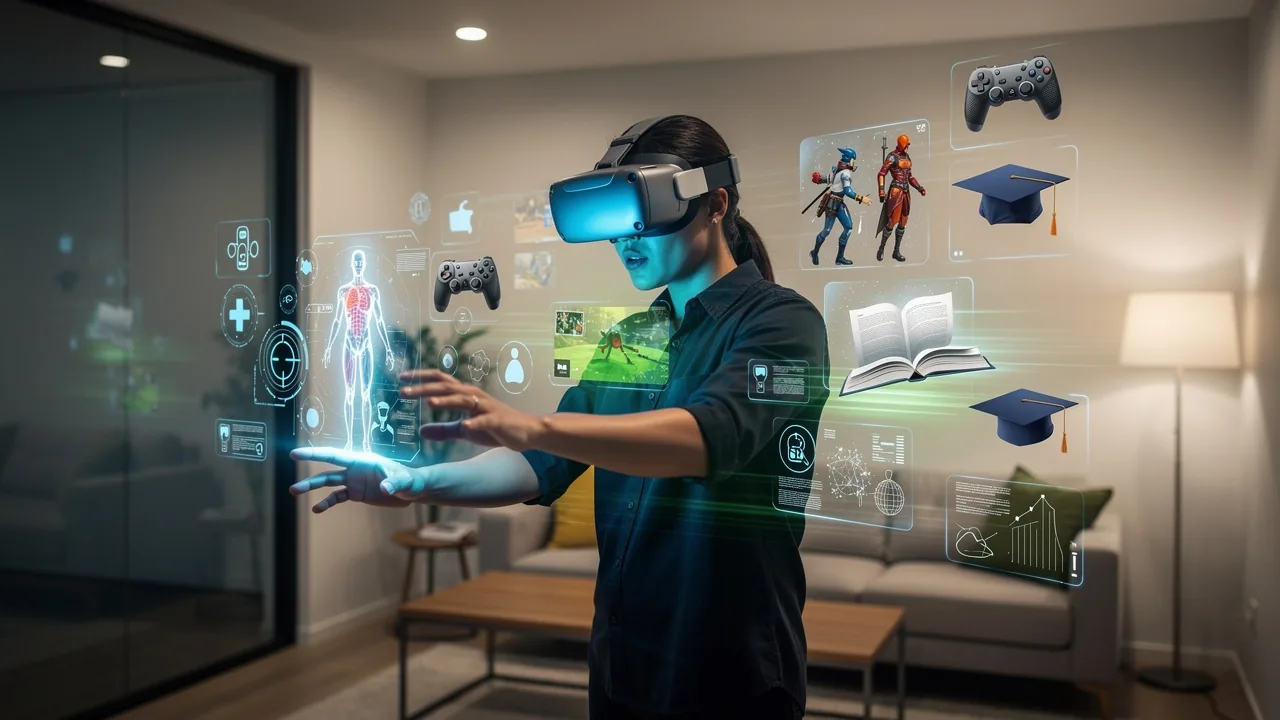
While virtual reality (VR) promises groundbreaking advancements, its evolving definition raises critical questions about its impact on various industries. VR is at the forefront of technological innovation, changing how people engage with digital spaces. By creating immersive experiences that can replicate or diverge from reality, VR has found applications across sectors, including:
- Gaming
- Healthcare
As technology evolves, defining VR and understanding its historical context become increasingly important. Examining these aspects highlights VR's unique features and its capacity to transform industries and improve user engagement.
Define Virtual Reality (VR)
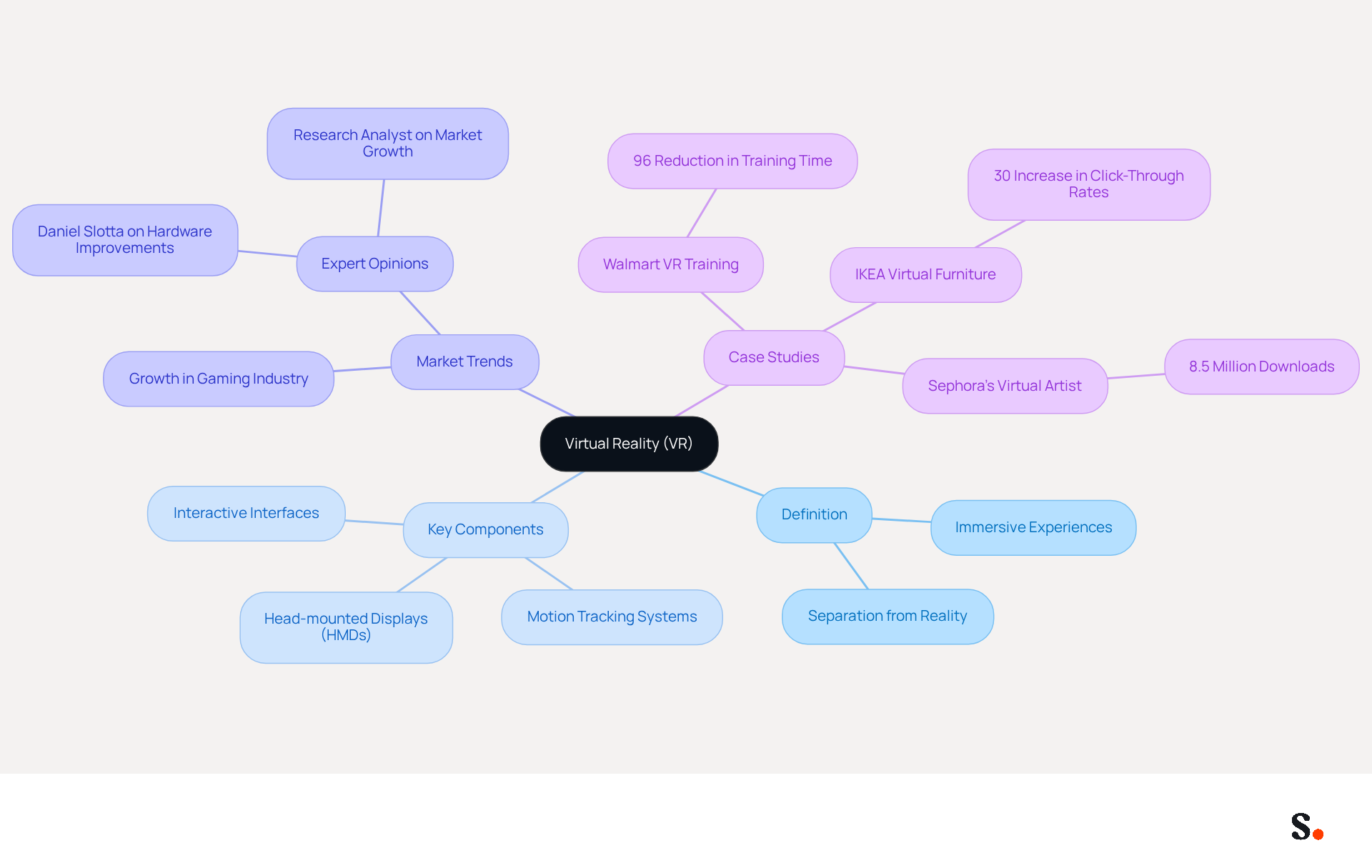
Virtual Reality (VR) represents a significant advancement in technology, offering experiences that can either closely mimic or starkly contrast with reality. It employs computer technology to create a three-dimensional (3D) space, enabling individuals to interact with it in a way that feels authentic or tangible. Typically, individuals engage with VR through headsets equipped with sensors that track their movements, allowing them to explore and interact with the virtual space. This interaction is enriched by visual, auditory, and haptic feedback, fostering a genuine sense of presence in the virtual space.
In 2026, the v/r definition of VR systems highlights their capacity to create fully immersive experiences that separate individuals from their actual surroundings. However, many users still struggle to differentiate between VR and AR experiences. Key components of VR include:
- Head-mounted displays (HMDs)
- Motion tracking systems
- Interactive interfaces that facilitate user engagement
Recent reports show that the global virtual reality market is expected to expand significantly, driven by increasing demand in the gaming industry. Expert opinions highlight the transformative potential of VR technology. For instance, Daniel Slotta, a research expert covering Greater China, states, "Analysts suggest that improvements to VR hardware, such as the introduction of smaller and more fashionable devices, will support the increased adoption of VR by consumers and across industries."
Case studies reveal that brands leveraging VR have achieved significant results; for example, Walmart's deployment of VR training reduced training time by 96%, while IKEA's virtual furniture placement app led to a 30% increase in click-through rates to product pages. These examples clearly show how effective VR can be in crafting powerful marketing campaigns and improving customer engagement.
The ongoing evolution of VR technology will undoubtedly redefine how industries engage with consumers.
Trace the History of Virtual Reality
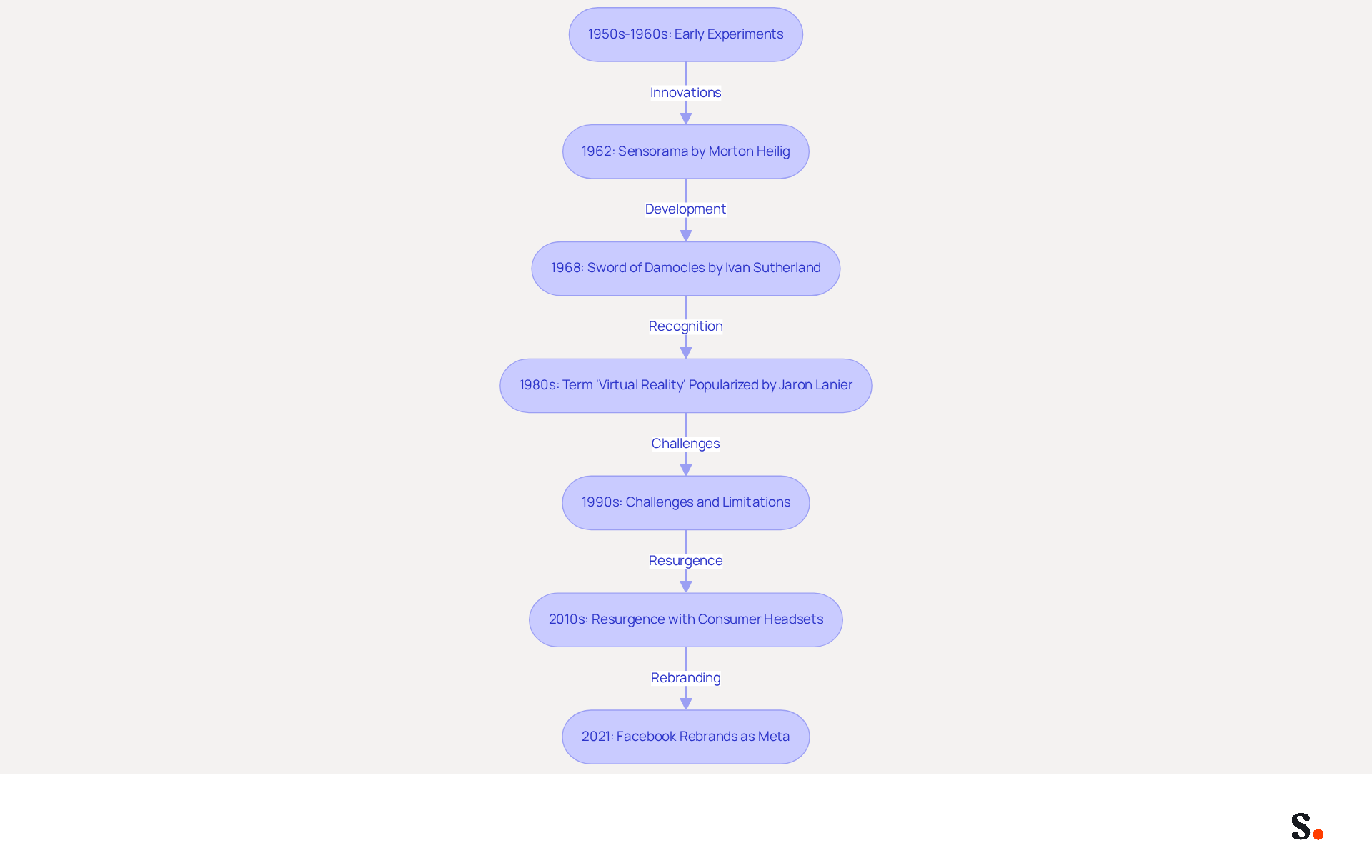
The evolution of Virtual Reality (VR) reflects a journey marked by innovation, challenges, and transformative potential across various sectors. The concept of VR has its roots in the 1950s and 1960s, marked by pioneering experiments aimed at creating immersive environments.
One of the earliest significant inventions was Morton Heilig's Sensorama, developed in 1962, which offered a multi-sensory experience through film, sound, and even scent. In 1968, Ivan Sutherland introduced the 'Sword of Damocles,' recognized as the first head-mounted display (HMD) that allowed users to engage with a basic form of VR.
The term 'virtual reality' gained prominence in the 1980s, largely attributed to Jaron Lanier, who founded VPL Research and was instrumental in developing the first commercial VR products. Despite the initial excitement, VR faced significant hurdles that hindered its growth in the 1990s, particularly due to high costs and technical limitations.
It wasn't until the 2010s, propelled by advancements in computing power and graphics, that VR began to achieve mainstream acceptance. This resurgence marked a turning point, leading to widespread adoption and innovation in VR technology, exemplified by the emergence of consumer headsets such as the Oculus Rift and HTC Vive.
In 2021, Facebook's rebranding as Meta underscored its commitment to pioneering innovations for the Metaverse, showcasing the dynamic evolution of VR technology. Today, VR is leveraged across diverse industries, including gaming, entertainment, education, and healthcare, showcasing its versatility and transformative potential.
Moreover, global consumer and enterprise VR revenue is anticipated to approach nearly $51 billion by 2026, highlighting the increasing significance and market potential of VR. Notably, the collaboration between Georgia Tech and Emory University in 1997 to use VR for PTSD treatment exemplifies the real-world applications and effectiveness of VR in therapeutic settings.
As VR continues to evolve, addressing its challenges will be crucial for unlocking its full potential in diverse applications.
Explore Applications of Virtual Reality
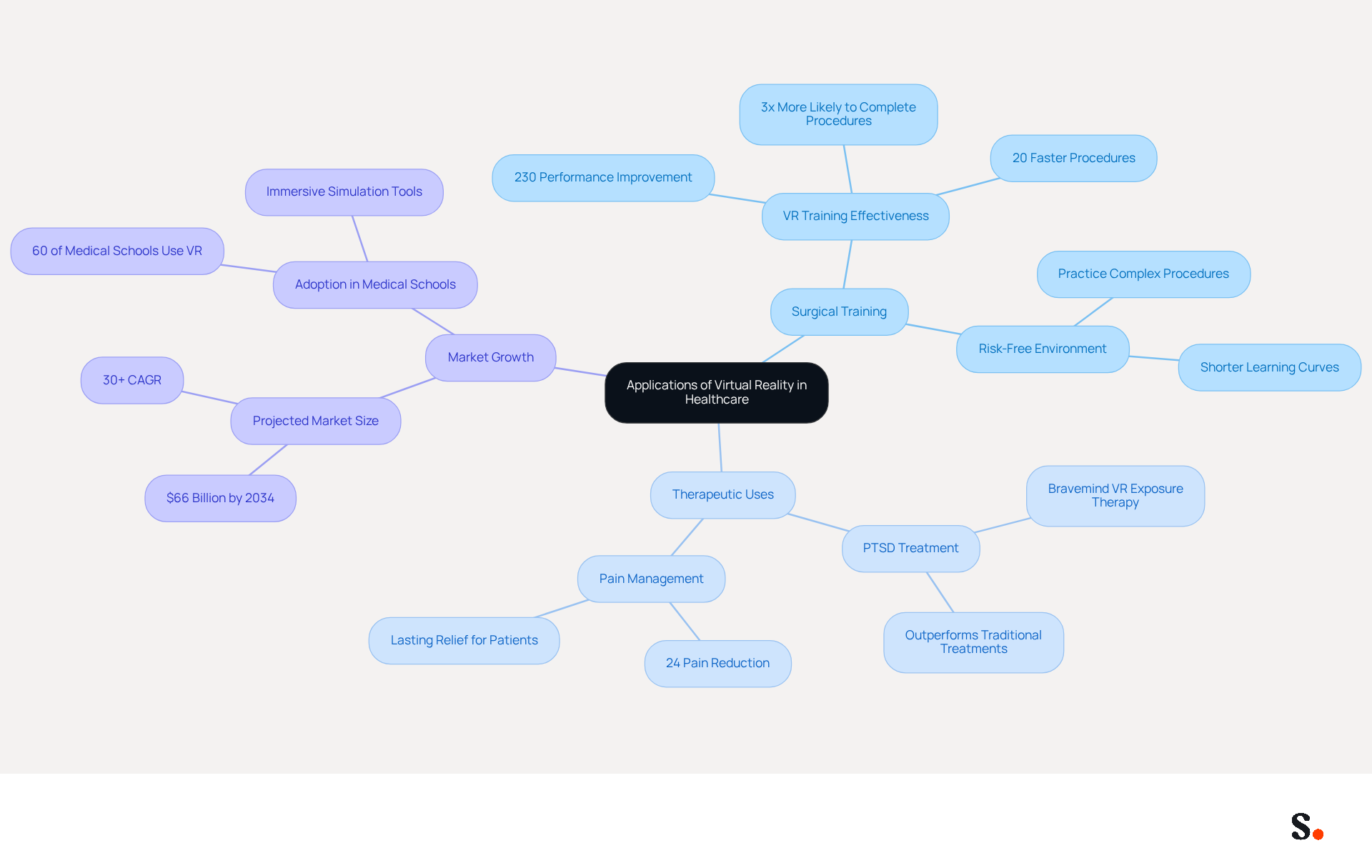
Virtual reality (VR) is revolutionizing healthcare by providing innovative solutions that enhance training, treatment, and patient care. Surgical training has emerged as a primary use case, where VR allows medical professionals to practice complex procedures in a risk-free environment. A 2019 study shows that surgeons trained with VR perform 230% better and 20% faster than those trained traditionally, demonstrating its effectiveness in improving surgical skills.
In addition to surgical training, VR is being utilized for therapeutic purposes, particularly in mental health. Programs like USC's Bravemind VR exposure therapy have shown promising results in treating PTSD, matching and even outperforming traditional treatments. This approach allows patients to confront their fears in a controlled setting, leading to improved therapeutic outcomes.
The VR-in-healthcare market is projected to grow significantly, with estimates suggesting it could reach $66 billion by 2034, driven by a 30%+ CAGR. This growth is fueled by the rising adoption of VR innovations in medical education and patient care. For instance, over 60% of medical schools now incorporate immersive simulation tools, enhancing the learning experience for future healthcare professionals.
Additionally, studies at Cedars-Sinai have shown that therapeutic VR can reduce pain by 24% for over 300 hospitalized patients. This approach not only reduces pain but also offers lasting relief, establishing it as a viable alternative to drug-based pain management.
As VR technology evolves, its role in healthcare will likely redefine how medical professionals are trained and how patients receive care. The integration of VR into medical curricula and therapeutic practices illustrates its transformative potential in enhancing healthcare outcomes.
Identify Key Characteristics of VR Technology
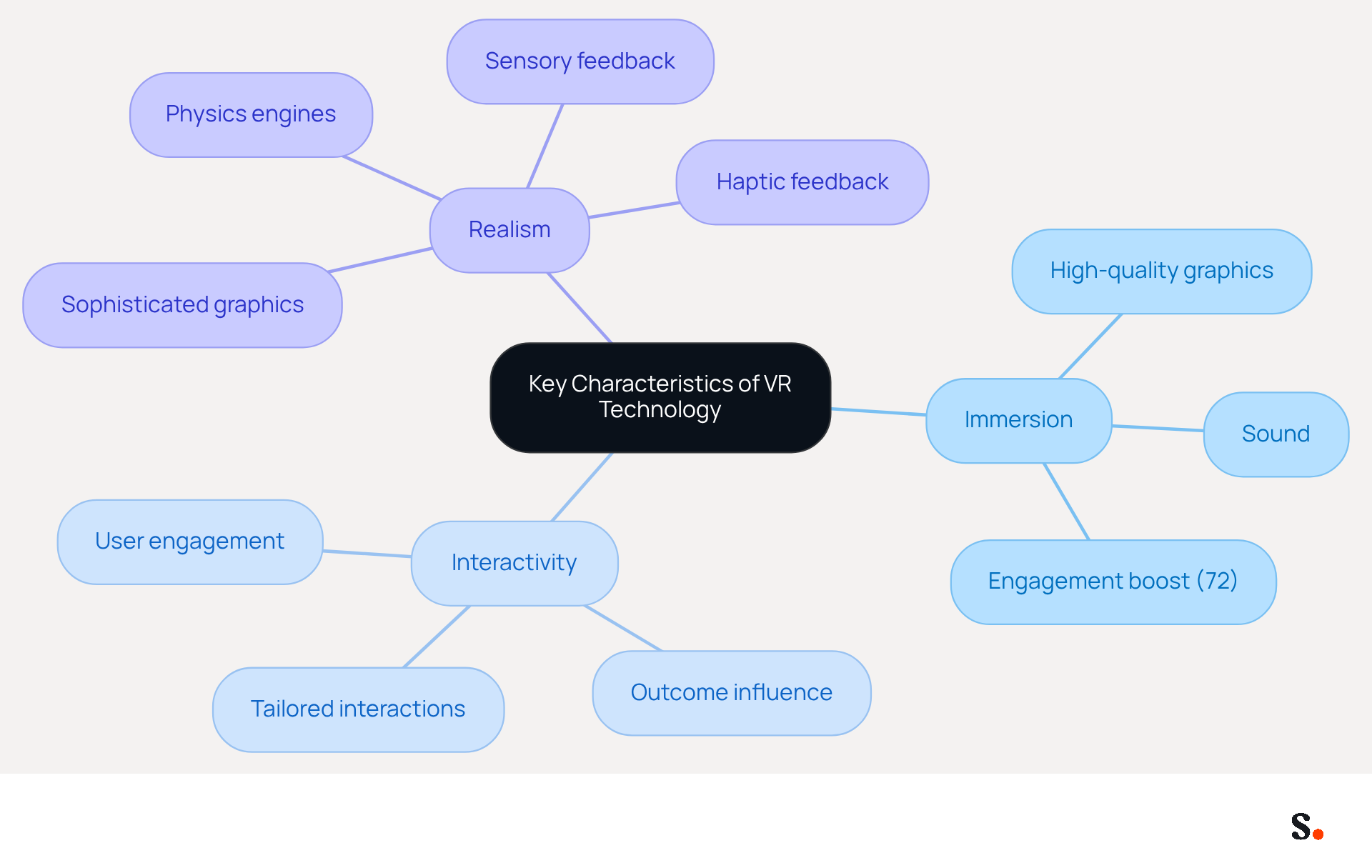
As industries evolve, the defining traits of Virtual Reality (VR) technology - immersion, interactivity, and realism - are becoming increasingly vital. Immersion is characterized by the extent to which individuals feel enveloped in a virtual environment, often facilitated by high-quality graphics and sound. Studies indicate that VR applications in education can boost engagement by as much as 72%, highlighting the power of immersive experiences. Interactivity allows individuals to engage with the virtual realm, influencing outcomes based on their actions, which is essential for crafting tailored interactions. Realism is achieved through sophisticated graphics, physics engines, and sensory feedback, creating a convincing setting that enhances user interaction. Notably, VR incorporates haptic feedback, providing tactile sensations that further deepen immersion. Case studies, such as Boeing's use of VR in design processes, illustrate how these traits lead to enhanced collaboration and efficiency in manufacturing. Workers acquire practical skills in a virtual environment that minimizes errors and improves safety protocols. The integration of these elements positions VR as a pivotal force in reshaping industry practices and enhancing user experiences in the coming years.
Conclusion
Virtual Reality (VR) is not just a technological novelty; it is reshaping how we engage with digital environments. By utilizing advanced computer technology, VR creates three-dimensional spaces that users can explore and engage with, facilitated by headsets and motion tracking systems. This unique capability enhances entertainment and revolutionizes various sectors, including healthcare, education, and marketing.
This article explores the evolution of VR, highlighting its journey from early experiments in the 1950s to its current applications across diverse industries. Key milestones, such as the development of the first head-mounted display and the resurgence of VR in the 2010s, underscore the technology's path toward mainstream acceptance. Furthermore, the significant impact of VR in healthcare is evident, showcasing its effectiveness in surgical training and therapeutic applications, as well as its potential for substantial market growth.
As VR technology continues to advance, its implications for various fields are profound. The ability to create immersive, interactive, and realistic experiences positions VR as a transformative force that can enhance learning, improve patient care, and drive marketing engagement. Embracing VR not only opens new avenues for innovation but also encourages industries to rethink their approaches to consumer interaction and training. Looking ahead, VR holds immense promise for transforming how we interact with technology. As industries adapt to this evolving landscape, those who embrace VR will likely lead the charge in redefining consumer experiences.
Frequently Asked Questions
What is Virtual Reality (VR)?
Virtual Reality (VR) is a technology that creates a three-dimensional (3D) space, allowing individuals to interact with it in a way that feels authentic or tangible. It can closely mimic or starkly contrast with reality.
How do individuals engage with VR?
Individuals engage with VR through headsets equipped with sensors that track their movements, enabling them to explore and interact with the virtual space. This experience is enhanced by visual, auditory, and haptic feedback.
What are the key components of VR?
The key components of VR include head-mounted displays (HMDs), motion tracking systems, and interactive interfaces that facilitate user engagement.
How is the global virtual reality market expected to change?
The global virtual reality market is expected to expand significantly, driven by increasing demand in the gaming industry and improvements in VR hardware, such as smaller and more fashionable devices.
What are some examples of brands successfully using VR?
Walmart's deployment of VR training reduced training time by 96%, and IKEA's virtual furniture placement app led to a 30% increase in click-through rates to product pages, demonstrating the effectiveness of VR in marketing and customer engagement.
What is the future potential of VR technology?
The ongoing evolution of VR technology is expected to redefine how industries engage with consumers, highlighting its transformative potential across various sectors.
List of Sources
- Define Virtual Reality (VR)
- Virtual reality helps people understand and care about distant communities (https://woods.stanford.edu/news/virtual-reality-helps-people-understand-and-care-about-distant-communities)
- Immersive virtual reality news: A study of user experience and media effects (https://sciencedirect.com/science/article/abs/pii/S1071581920301786)
- The Augmented Reality and Virtual Reality Industry 2026 (https://blog.shayaikehassan.com/the-augmented-reality-and-virtual-reality-industry-an-in-depth-overview-in-2026)
- Topic: Virtual reality (VR) (https://statista.com/topics/2532/virtual-reality-vr?srsltid=AfmBOop7cFowjfz4OJOssO4Hs3_t8gUNUwKSWmQ5j_N6SIaOHROiIEwq)
- Virtual Reality Market Size, Share, Growth, Statistics, 2032 (https://zionmarketresearch.com/report/virtual-reality-market-size)
- Trace the History of Virtual Reality
- History Of Virtual Reality - Virtual Reality Society (https://vrs.org.uk/virtual-reality/history.html)
- Virtual reality - Wikipedia (https://en.wikipedia.org/wiki/Virtual_reality)
- A Brief History of Virtual Reality: Major Events and Ideas (https://coursera.org/articles/history-of-virtual-reality)
- How Virtual Reality Technology Has Changed Our Lives: An Overview of the Current and Potential Applications and Limitations - PMC (https://pmc.ncbi.nlm.nih.gov/articles/PMC9517547)
- History of VR – Timeline of Events and Tech Development (https://virtualspeech.com/blog/history-of-vr)
- Explore Applications of Virtual Reality
- How Virtual Reality Is Changing Education | LSU Online (https://online.lsu.edu/newsroom/articles/how-virtual-reality-changing-education)
- (PDF) Virtual reality in education: The promise, progress, and challenge (https://researchgate.net/publication/348136839_Virtual_reality_in_education_The_promise_progress_and_challenge)
- Virtual Reality in Healthcare: 2026 Use Cases & Market Data (https://vrvisiongroup.com/vr-in-healthcare)
- Schools Set Their Sights on VR Learning Opportunities (https://edtechmagazine.com/k12/article/2025/09/schools-set-their-sights-vr-learning-opportunities)
- Identify Key Characteristics of VR Technology
- Top 10 VR Trends of 2026: Future of Virtual Reality (https://hqsoftwarelab.com/blog/virtual-reality-trends)
- Virtual Reality Market Key Trends and Insights Shaping 2026 (https://nextmsc.com/blogs/virtual-reality-in-2026-platform-shifts-and-content-evolution?srsltid=AfmBOoonC9nRxkS24Rm9vTwDIEGpMrHTgpb1iRvE4chLSqupthQDJ-jR)
- The Role of Emerging Technologies in Enhancing Immersive Literacy in News Media Organizations: A Qualitative Case Study Approach - The Journal of Media Literacy (https://ic4ml.org/journal-article/the-role-of-emerging-technologies-in-enhancing-immersive-literacy-in-news-media-organizations-a-qualitative-case-study-approach)
- Why Virtual Reality Is Important: Exploring the Benefits of VR (https://cornerstoneondemand.com/resources/article/why-virtual-reality-is-important-and-benefits-of-vr)
- Current State and Four Future Trends in VR Technology (https://allpcb.com/allelectrohub/current-state-and-four-future-trends-in-vr-technology)
Get started with Scribe
See why teams switch to Scribe
Free 14-day trial — no credit card.