10 Reasons Why 'Kindly' is a Good Email Sign-Off for Marketers
The choice of email sign-off can either enhance or undermine the effectiveness of communication in marketing. Here are ten compelling reasons why 'kindly'
Sophie Grant
Email Signature Specialist, Scribe
On this page
- Introduction
- Enhance Tone with 'Kindly' Sign-Off
- Establish Professionalism with Contextual Use
- Boost Engagement through Thoughtful Sign-Offs
- Navigate Cultural Nuances in Email Sign-Offs
- Utilize 'Kindly' Across Diverse Email Scenarios
- Align Sign-Offs with Overall Message Tone
- Avoid Missteps with Inappropriate Usage
- Influence Perception with Psychological Insights
- Leverage Scribe for Consistent 'Kindly' Sign-Offs
- Summarize Key Benefits of 'Kindly' Sign-Off
- Conclusion
- Frequently Asked Questions
- List of Sources
Introduction
The choice of email sign-off can either enhance or undermine the effectiveness of communication in marketing. Here are ten compelling reasons why 'kindly' serves as an effective sign-off for marketers, enhancing professionalism, boosting engagement, and navigating cultural nuances. But how can a simple word transform email communication and drive better responses?
Enhance Tone with 'Kindly' Sign-Off
Concluding a message with a courteous sign-off can significantly enhance communication effectiveness. 'Kindly' is often viewed as a respectful way to end a message, as it is kindly a good email sign-off. This sign-off softens requests and conveys consideration towards the recipient. For example, instead of saying, 'Please send the report,' you might say, 'I would kindly appreciate it if you could send the report.' This subtle shift can make a significant difference in how your message is received, fostering a more positive interaction.
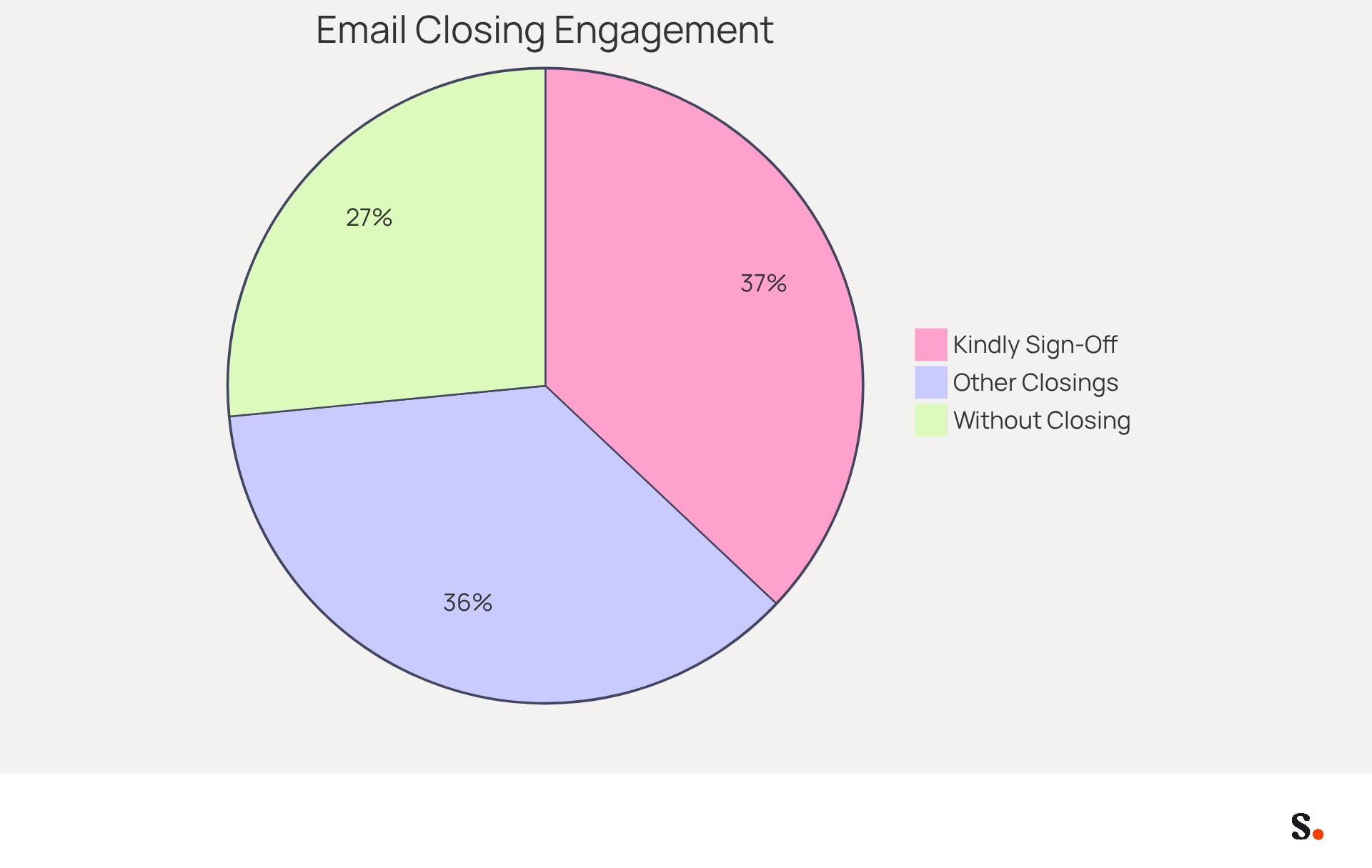
Data indicates that gratitude-based closings, which incorporate courteous phrases, such as 'is kindly a good email sign-off,' can improve engagement rates by 54-66%. Moreover, messages without a closing average a 43% engagement rate, in contrast to 52-66% for properly concluded messages, emphasizing the significance of a considerate sign-off.
Case studies show that emails with considerate closings, which is kindly a good email sign-off, not only improve the likelihood of a reply but also enhance overall communication effectiveness. For instance, a study showed that using 'please' in requests resulted in a 20% rise in positive responses among marketing professionals. By incorporating a friendly tone, marketers can create a more inviting atmosphere, encouraging collaboration and engagement, which is essential in building strong professional relationships.
Establish Professionalism with Contextual Use
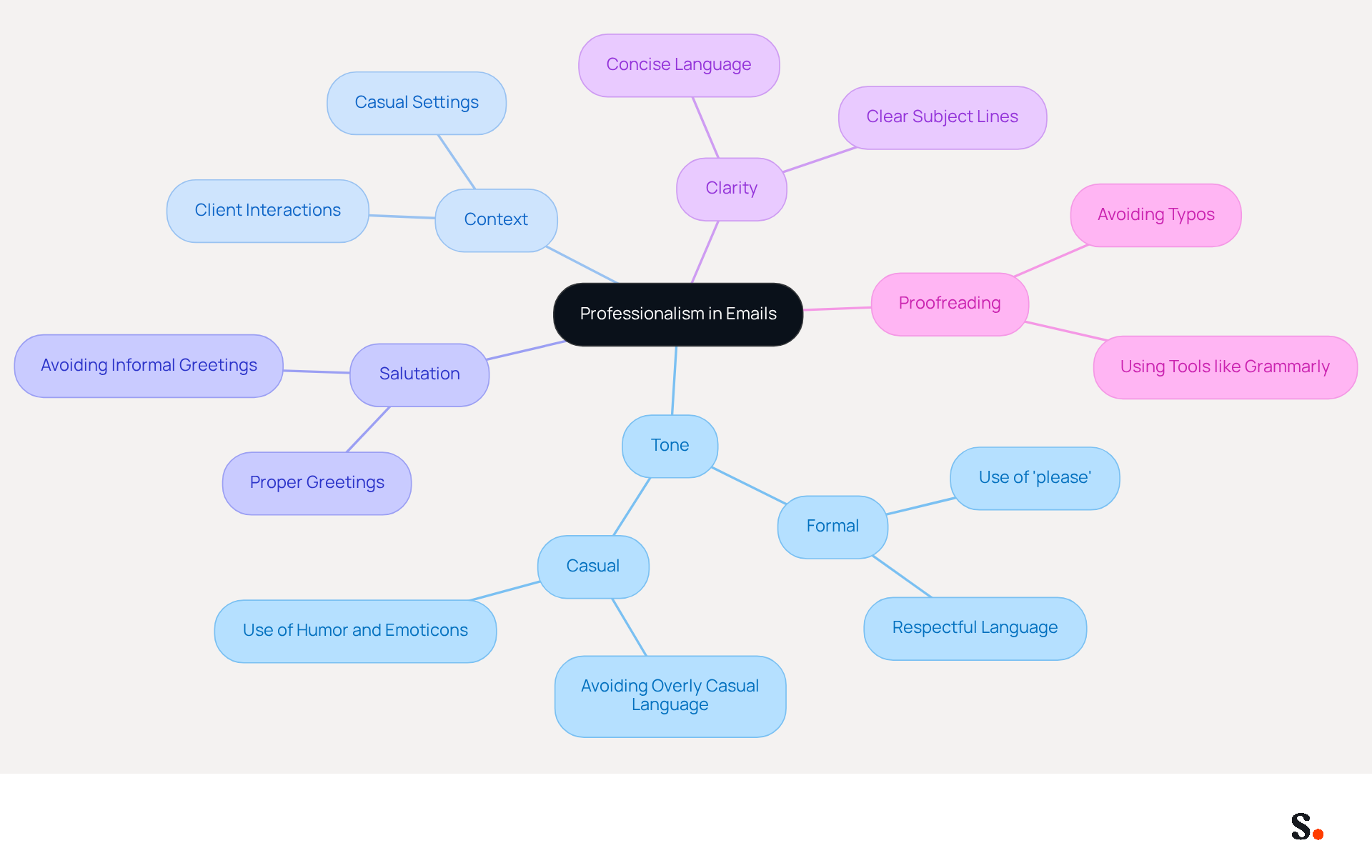
Striking the right tone in emails is kindly a good email sign-off for ensuring effective communication. Utilizing 'please' in the appropriate context can enhance the professionalism of your emails. For instance, in formal exchanges, such as proposals or client interactions, stating, 'I kindly request your feedback on the attached document' shows respect and professionalism. However, it's important to find the right context; while using 'kindly' too often in casual settings can seem insincere or overly formal, it is kindly a good email sign-off.
Interestingly, many recipients only glance at the first couple of lines before deciding to keep or toss a message, highlighting the need for clarity in expression. Expert insights suggest that maintaining a professional tone is crucial, especially when addressing new contacts. Starting with a proper salutation, such as 'good morning' or 'hello,' and using respectful language sets a positive tone for the interaction.
Case studies illustrate the influence of professionalism in written correspondence. For example, brief messages that honor recipients' time result in more effective communication. Additionally, careful proofreading to avoid typos and grammatical errors is vital, as careless mistakes can diminish the perceived professionalism of the sender. As Smith observes, 'careless messaging mistakes will only make you appear unprofessional to your recipients.' By mastering these elements, you can elevate your professional image and foster stronger connections.
Boost Engagement through Thoughtful Sign-Offs
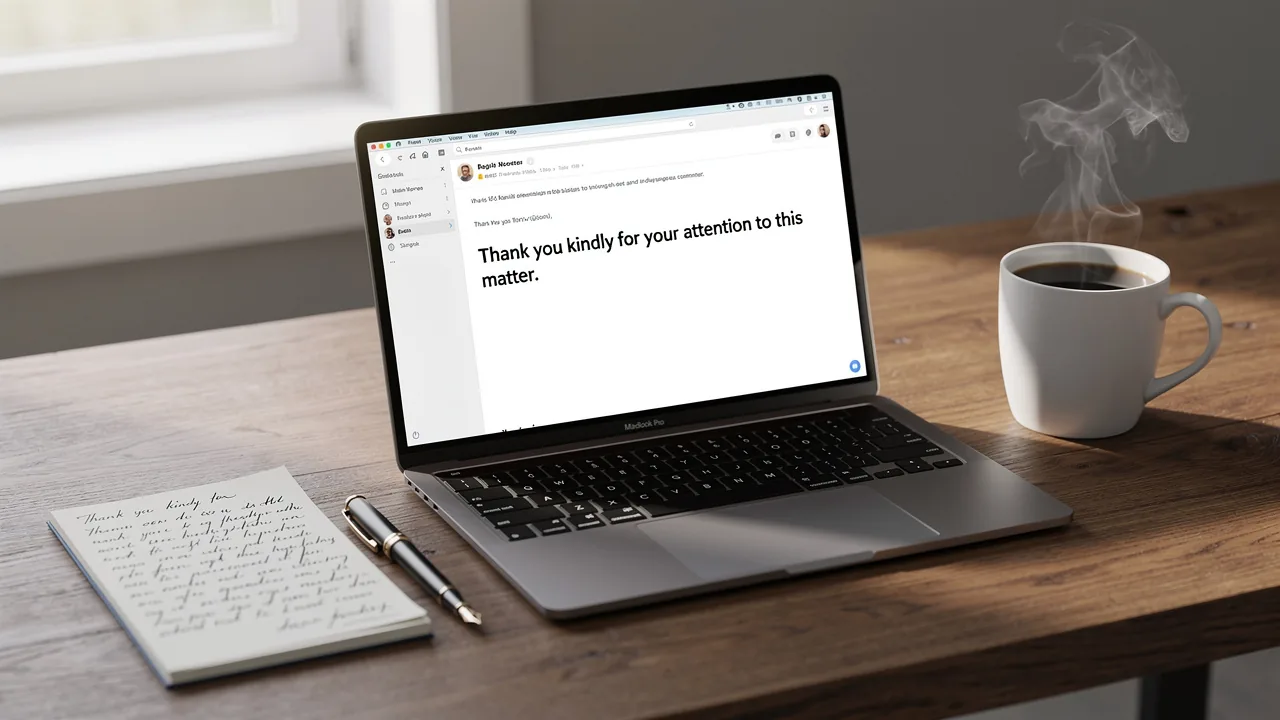
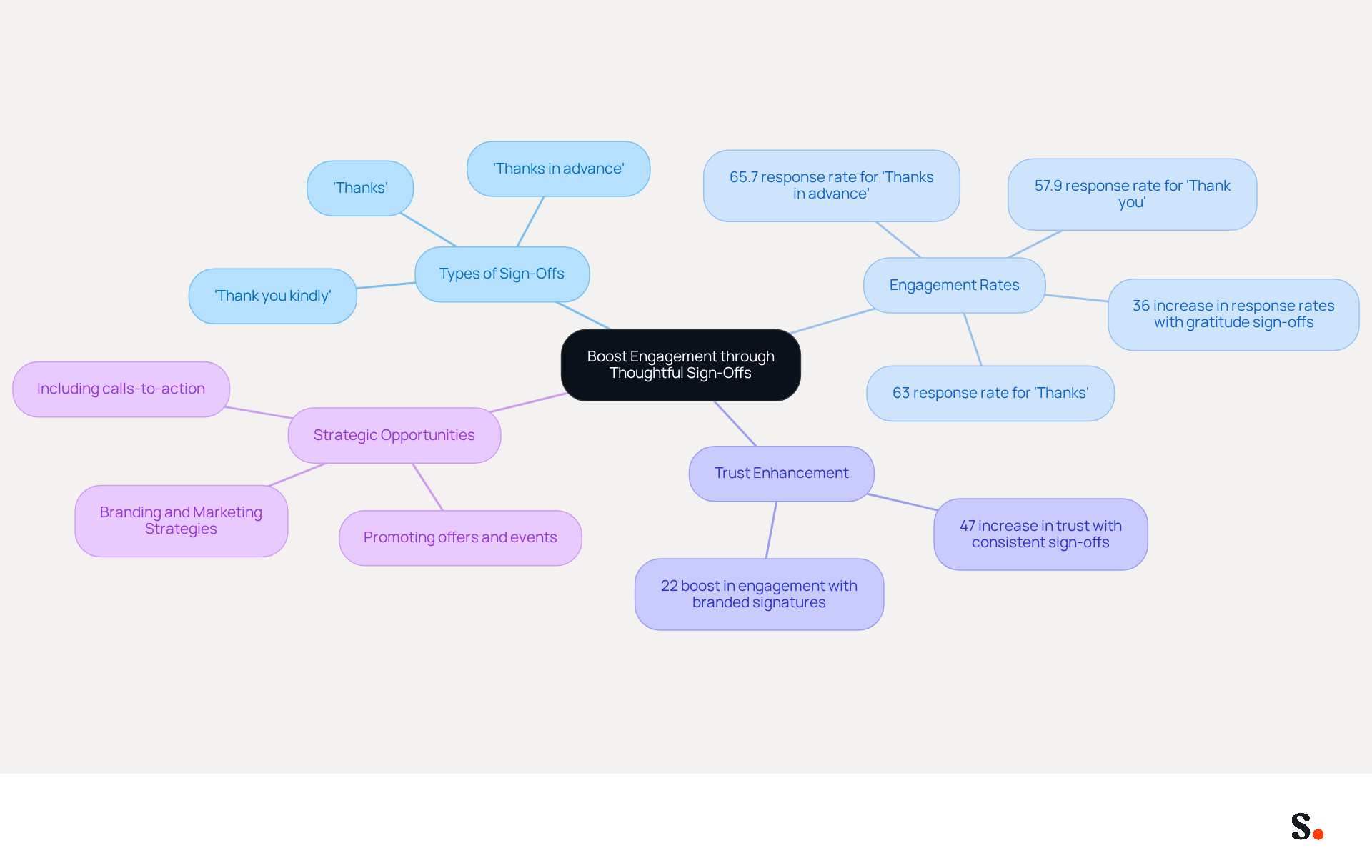
Thoughtful sign-offs can transform the effectiveness of written communications. For instance, concluding a message with 'Thank you kindly for your attention to this matter' not only conveys appreciation but also encourages a reply. Emails that conclude with 'Thanks in advance' achieve engagement rates of up to 65.7%, while those ending with 'Thanks' receive replies 63% of the time. This strategy shows appreciation, which makes recipients more likely to engage.
Moreover, consistent and professional sign-offs across all interactions can enhance trust by 47% and engagement by 22%. A case study titled 'Impact of Consistent Email Sign-Offs' revealed that organizations implementing thoughtful sign-offs saw engagement rates increase by up to 30%. By leveraging email sign-offs as strategic opportunities for branding and marketing - such as promoting offers, events, and new product launches - marketers can effectively turn routine communications into meaningful interactions, ultimately driving higher engagement rates. Embracing this strategy can redefine how organizations connect with their audience.
Navigate Cultural Nuances in Email Sign-Offs
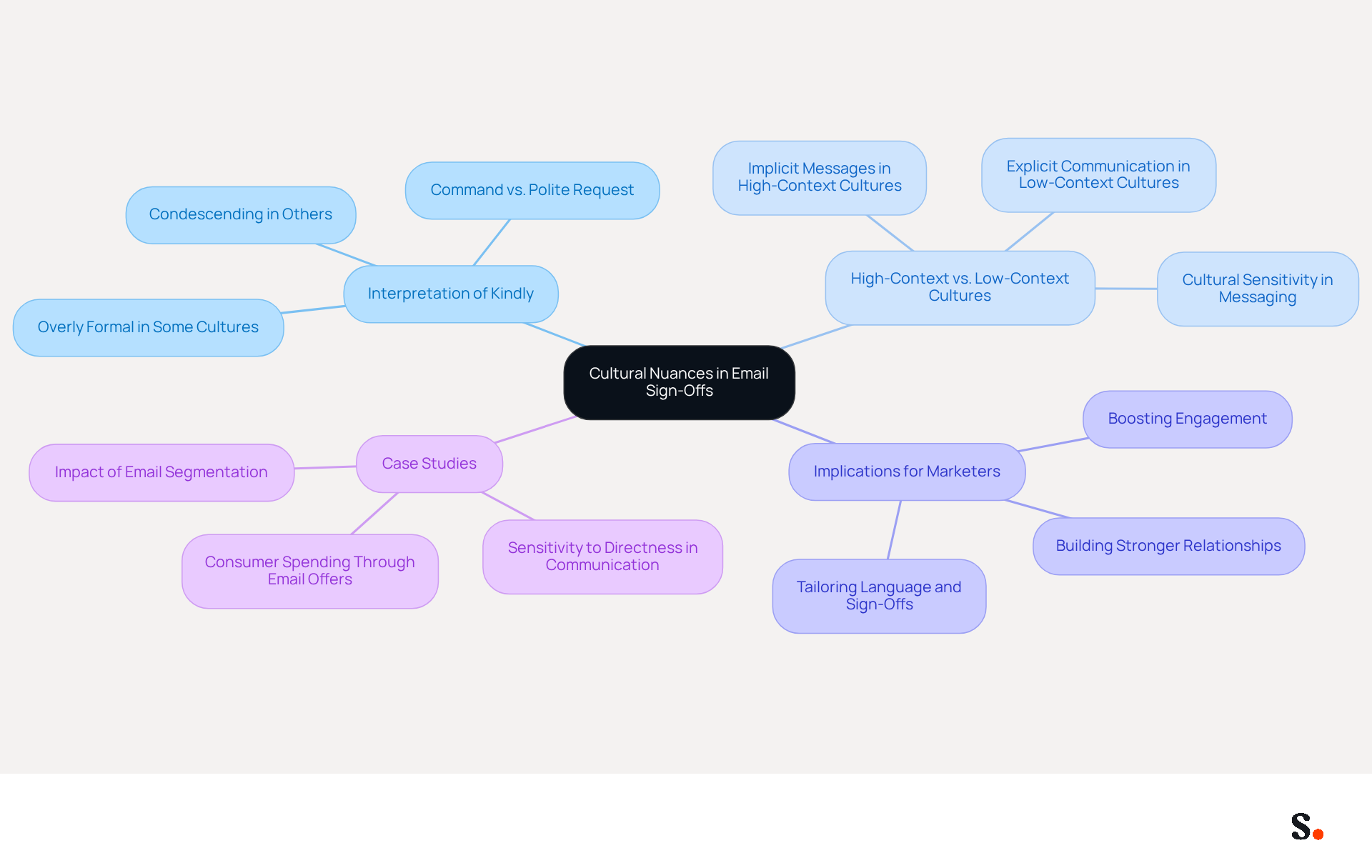
The word 'kindly' can elicit mixed reactions across different cultures, impacting communication effectiveness. In some regions, it may be seen as overly formal or even condescending, while in others, it is viewed as a courteous expression. For example, in Western cultures, 'kindly' might be interpreted as a command rather than a polite request, which can lead to misunderstandings.
Marketers must navigate these cultural subtleties to ensure their messages are effective and well-received. Research shows that cultures differ in their preference for directness; high-context cultures often favor implicit messages, while low-context cultures tend to prefer explicit communication. This highlights the necessity for marketers to tailor their language and sign-offs, as 'is kindly a good email sign-off,' to meet the cultural expectations of the recipient.
By grasping these dynamics, marketers can boost engagement and build stronger relationships in varied markets. With global users expected to reach 4.73 billion by 2026, cultural sensitivity in electronic communication is increasingly vital. Case studies on low-context versus high-context communication further illustrate how different cultures interpret language, reinforcing the need for marketers to adapt their messaging strategies accordingly.
Utilize 'Kindly' Across Diverse Email Scenarios
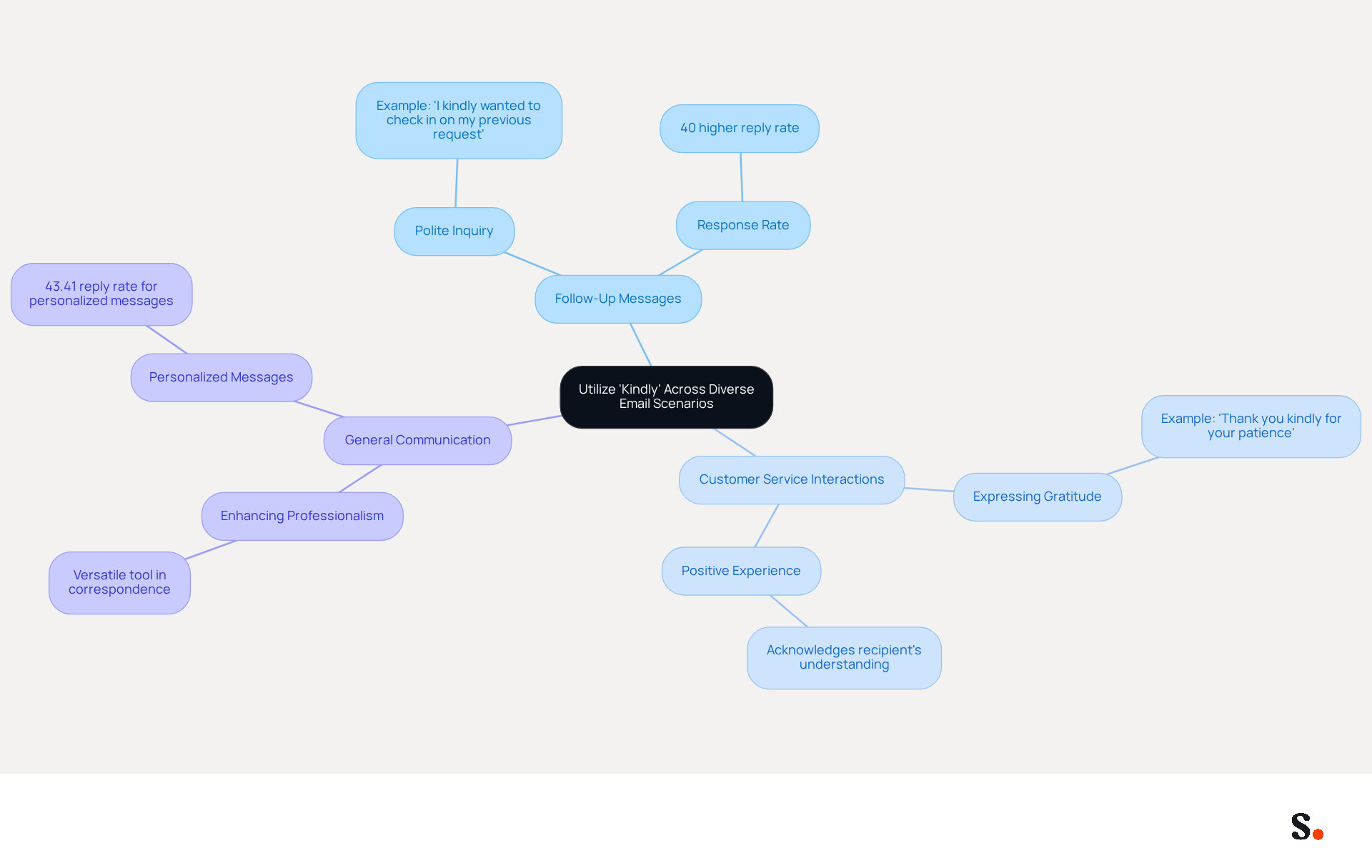
In the realm of professional communication, the choice of sign-off can greatly influence response rates. The sign-off 'kindly' is kindly a good email sign-off that serves as a versatile tool in various correspondence contexts, enhancing both professionalism and politeness. For example, in follow-up messages, saying 'I kindly wanted to check in on my previous request' keeps the tone polite and encourages a reply. This method is effective; first follow-up messages typically receive a 40% higher reply rate compared to subsequent ones. In customer service interactions, expressing gratitude with 'Thank you kindly for your patience' acknowledges the recipient's understanding and fosters a positive customer experience. Studies show that using polite language can boost engagement, with personalized messages getting reply rates as high as 43.41%. By incorporating 'kindly' thoughtfully, marketers can enhance their effectiveness in conveying messages, as 'kindly' is kindly a good email sign-off that strengthens relationships with clients and colleagues alike. Ultimately, the thoughtful use of 'kindly' can transform routine correspondence into opportunities for meaningful engagement.
Align Sign-Offs with Overall Message Tone
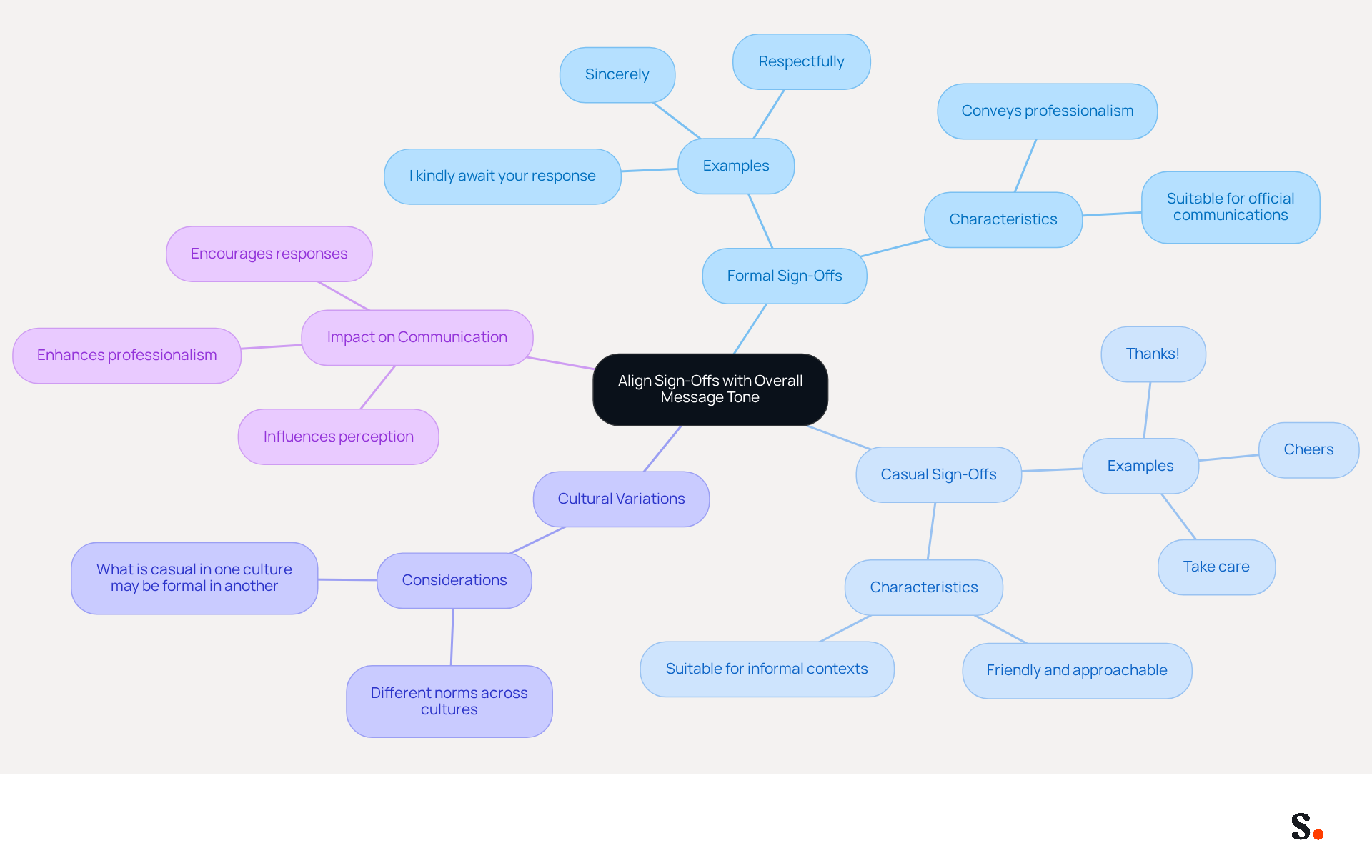
Misaligned sign-offs can lead to confusion and weaken your message's impact. A formal proposal should end with a sign-off like 'I kindly await your response' to maintain professionalism. In contrast, a more casual message may warrant a simpler sign-off, such as 'Thanks!' Aligning your sign-off enhances clarity and professionalism, making it easier for recipients to engage.
Research shows that concise message endings boost credibility and improve deliverability. Experts suggest that every message closing should have a 2-3-word phrase that matches the tone of the communication. Therefore, ensuring your sign-off aligns with the tone of your message is essential for fostering positive relationships and encouraging responses.
Furthermore, it's crucial to consider cultural variations in sign-offs, as what may be acceptable in one culture could be viewed differently in another. Choosing the right sign-off can significantly enhance your professional interactions.
Avoid Missteps with Inappropriate Usage
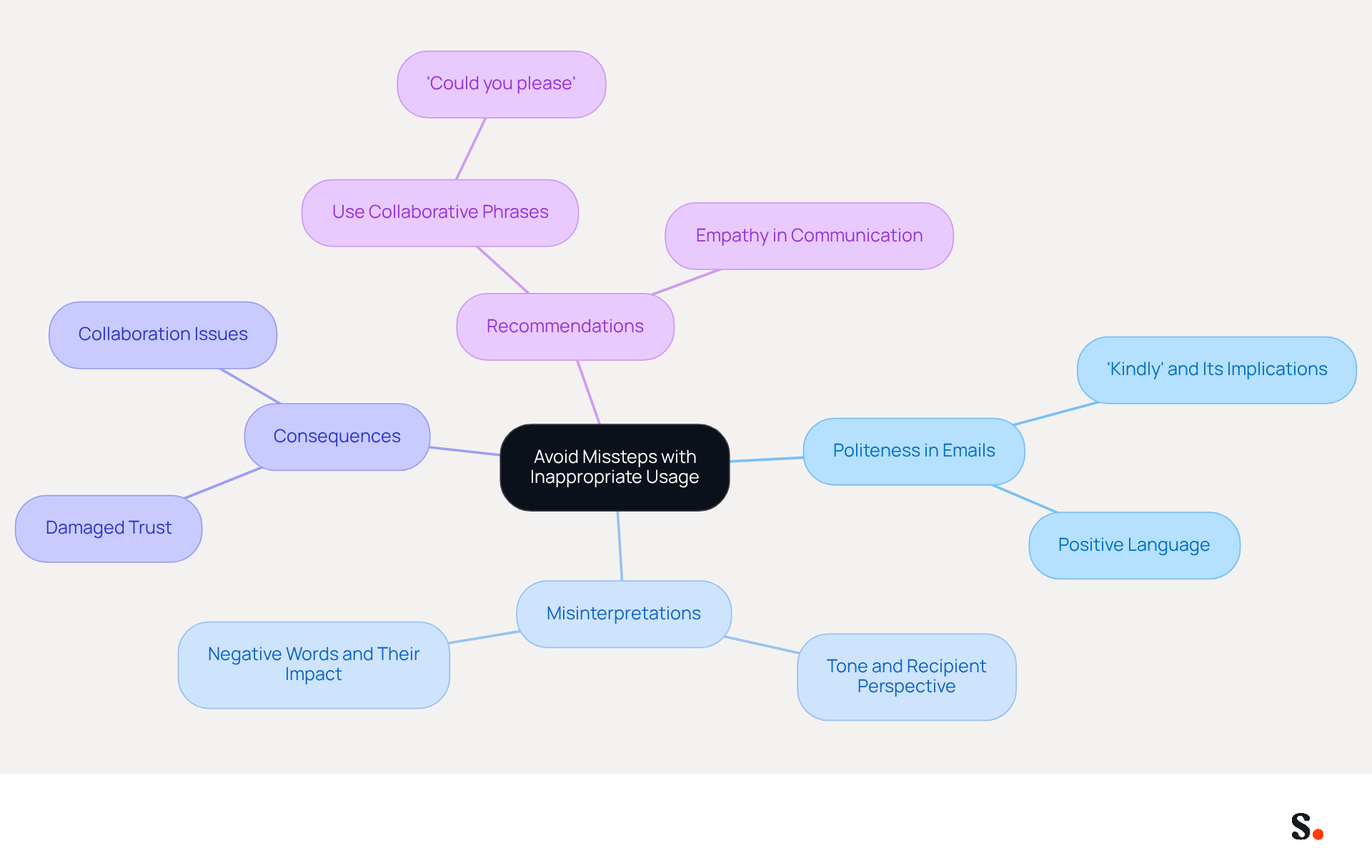
While politeness is essential in emails, misusing terms like 'kindly' can lead to unintended interpretations. For example, saying 'Kindly complete this task by tomorrow' might come off as condescending instead of polite. To avoid such missteps, it is crucial to use 'kindly' judiciously and in contexts where it genuinely contributes to the message's tone. Always consider the recipient's perspective to ensure that your message is received positively.
Misunderstandings often stem from the tone used in polite language, leading to unintended consequences. This can ultimately damage collaboration and trust in professional relationships. Using positive language not only conveys your message better but also builds goodwill. Approaching your communication with empathy can greatly improve how the recipient perceives your message.
Lastly, consider rephrasing directives to be more collaborative, such as 'Could you please complete this task by tomorrow?' which fosters a positive working relationship.
Influence Perception with Psychological Insights
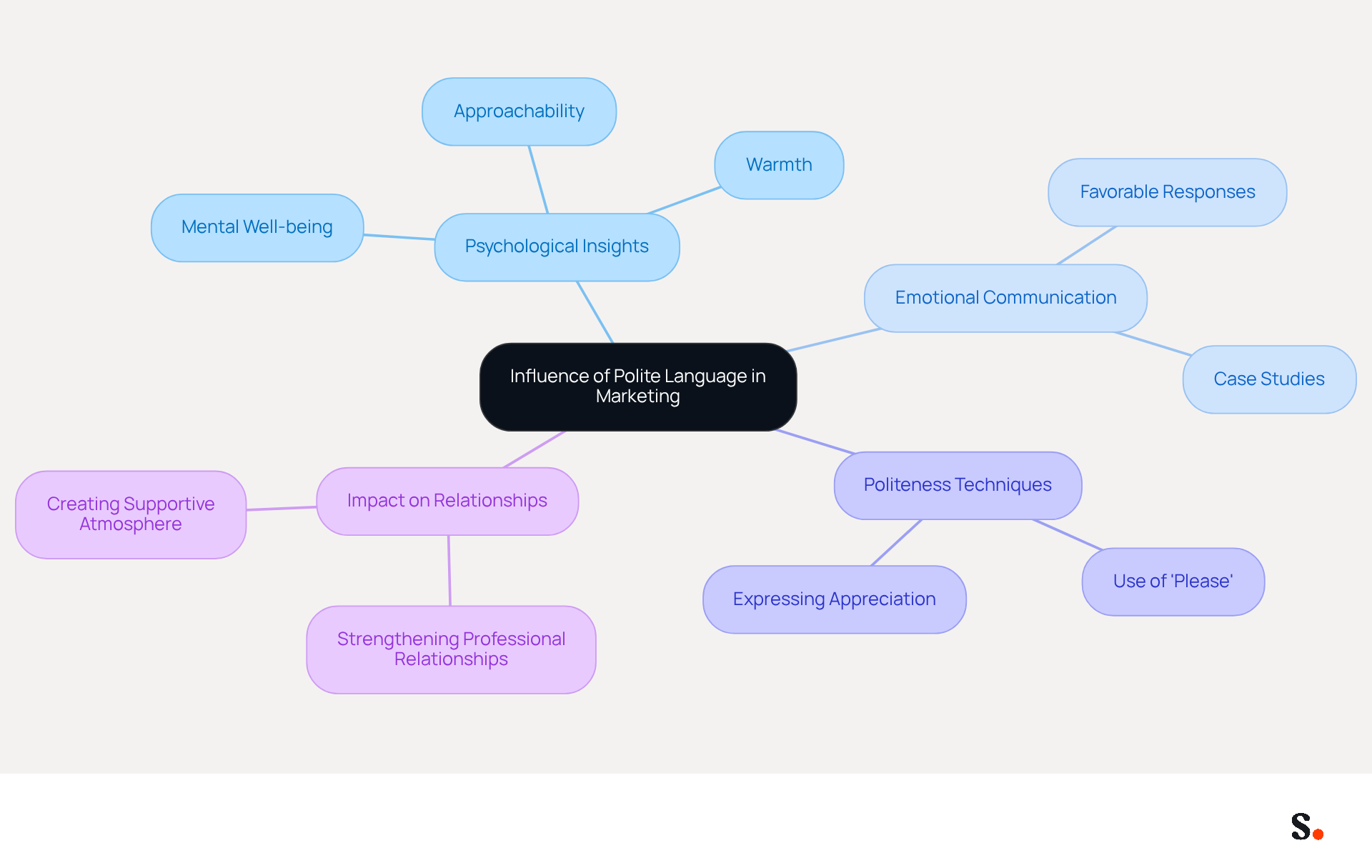
Polite language can significantly influence the effectiveness of communication in marketing. Research shows that using polite expressions enhances feelings of warmth and approachability. For instance, including 'please' in requests can make recipients feel valued and respected, which often leads to more favorable responses. A study of 850 marketing messages from 2020 to 2021 revealed that emotional communications are more likely to get replies than those that are purely factual. Additionally, case studies show that messages incorporating courteous language, like 'please,' create a supportive atmosphere that benefits mental well-being and strengthens professional relationships.
Marketers should leverage these psychological insights, employing persuasive techniques that appeal to both emotion and authority, to craft messages that resonate positively with their audience. This approach ultimately enhances the effectiveness of their communications.
Leverage Scribe for Consistent 'Kindly' Sign-Offs
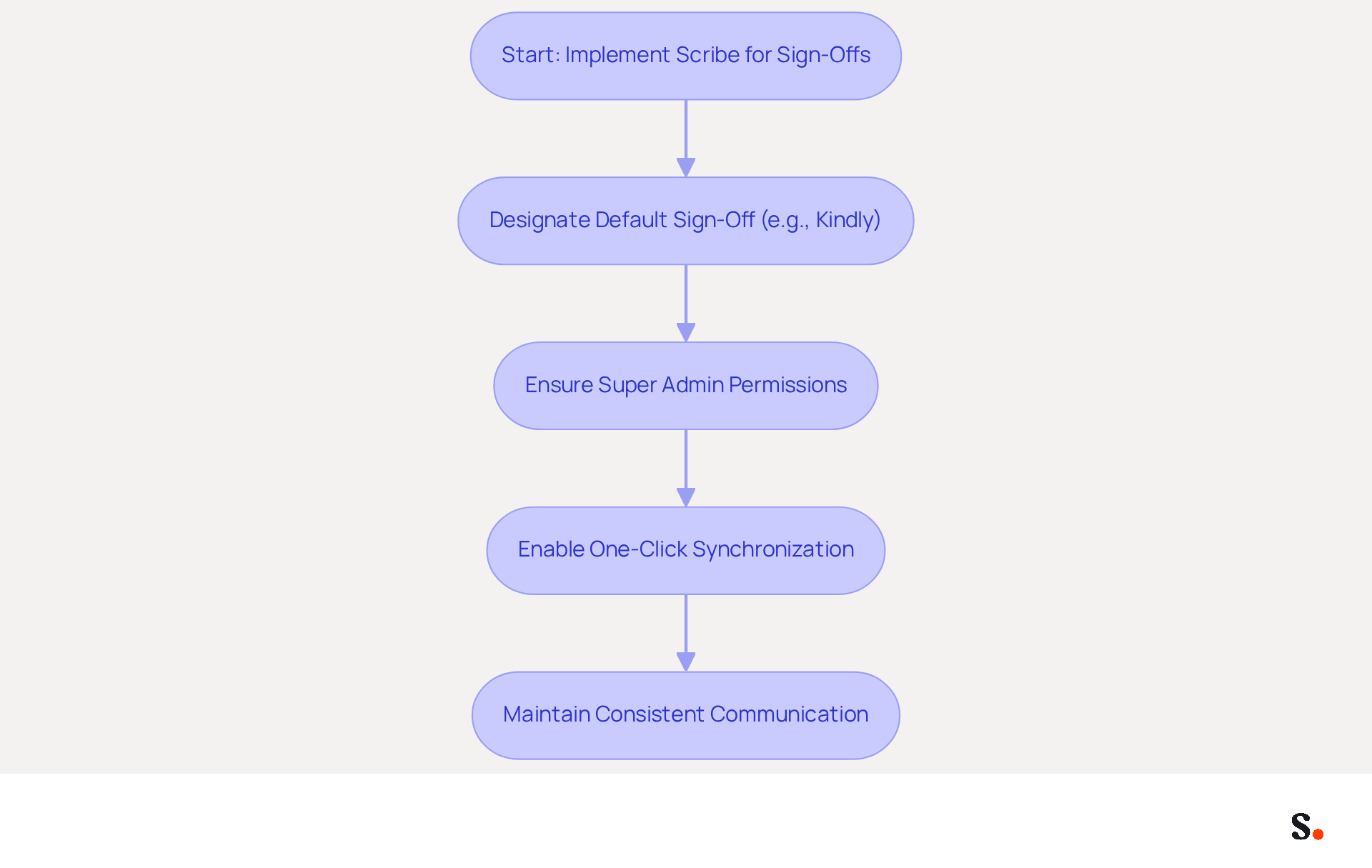
Ensuring consistent communication is vital for maintaining a professional image, and Scribe plays a crucial role in this process. Scribe automates signatures with one-click synchronization, helping businesses maintain a professional image and ensuring every team member uses the same sign-off. This uniformity not only enhances brand identity but also boosts the overall professionalism of interactions.
For instance, Scribe allows you to designate 'kindly' as the default sign-off, which is kindly a good email sign-off, ensuring that every message sent embodies your brand's tone and values. Consistent branded signatures can boost response rates by 22%, demonstrating the importance of a cohesive communication style. Furthermore, outdated signatures can misrepresent your brand, as many users update their signatures infrequently.
To enable one-click synchronization, Super Admin permissions are necessary, ensuring that your team can seamlessly integrate their signatures with Scribe. Using Scribe helps organizations improve their communications, making sure every interaction shows their dedication to professionalism and brand consistency. Scribe's SOC 2 Type II compliance ensures your data is secure, allowing you to concentrate on maintaining brand consistency.
Summarize Key Benefits of 'Kindly' Sign-Off
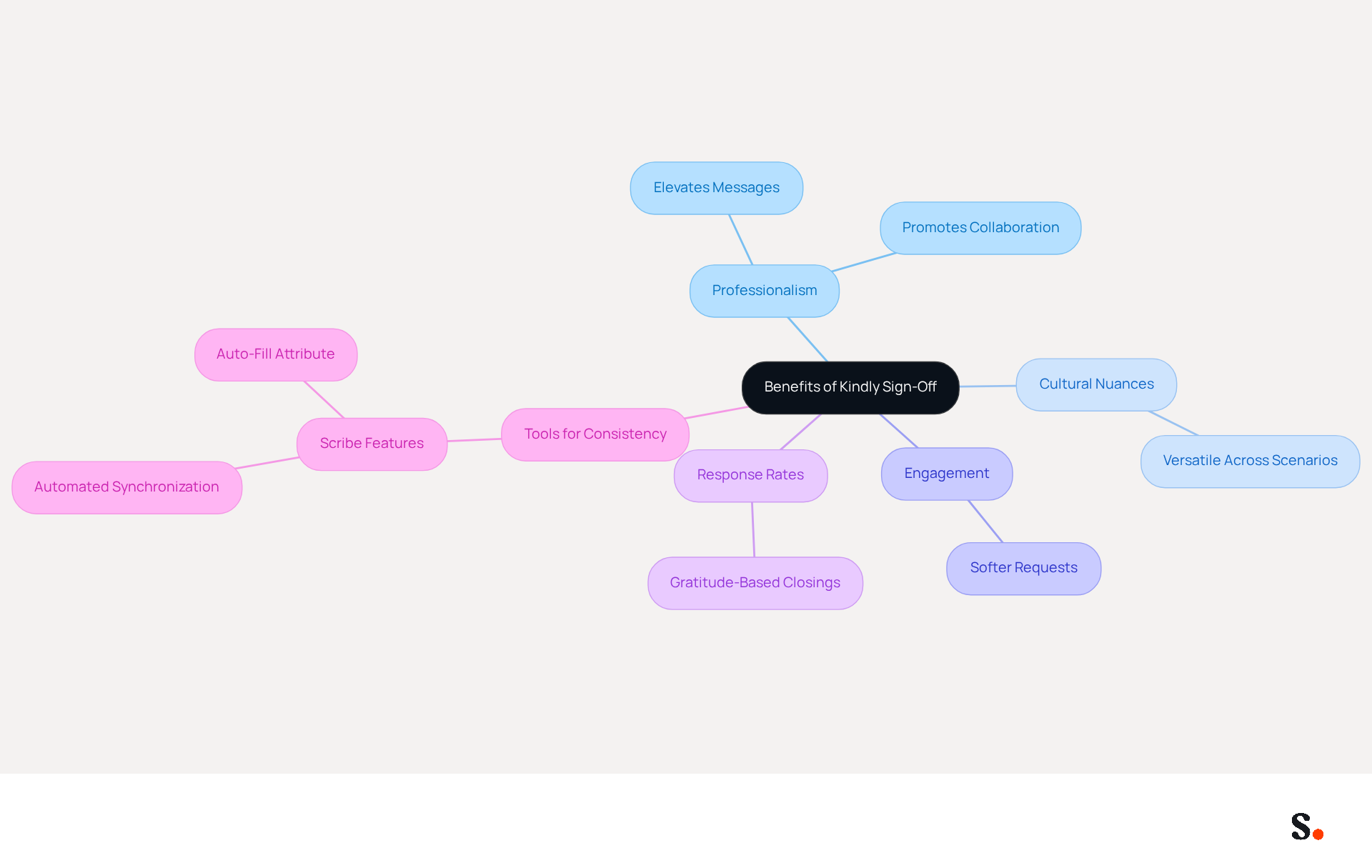
Incorporating 'please' as a sign-off can significantly elevate the professionalism of your messages while fostering engagement. This sign-off is particularly effective in navigating cultural nuances, making it versatile across various email scenarios. Experts suggest that adding 'please' can make requests feel softer, promoting collaboration rather than sounding commanding. However, misinterpretations can arise if 'please' is perceived as condescending in certain contexts.
Research shows that polite sign-offs, like 'kindly,' can boost response rates. For example, gratitude-based closings, such as 'Thanks in advance,' have a response rate of 65.7%.
Using tools like Scribe helps maintain consistent sign-offs, which strengthens your brand's professionalism and values in every interaction. With Scribe's automated synchronization of signatures with Google Workspace and Aircall, any updates to your teammates' information are effortlessly reflected, saving time and ensuring brand consistency across all communications.
Additionally, Scribe's auto-fill attribute feature allows for quick updates to signature information, further enhancing efficiency. This capability not only enhances your email professionalism but also aligns with Scribe's commitment to secure data handling, reinforcing trust in your communications.
Conclusion
The use of 'kindly' in email sign-offs can transform communication dynamics for marketers. This courteous phrase not only softens requests but also conveys respect and consideration towards recipients, fostering a more positive interaction. Using 'kindly' thoughtfully helps marketers foster a welcoming atmosphere that promotes collaboration and strengthens professional relationships.
Key insights include:
- Aligning sign-offs with the message's tone
- Understanding cultural nuances
- Using tools like Scribe for consistent branding
Research indicates that polite sign-offs can boost engagement rates, with gratitude-based closings achieving impressive response rates. Furthermore, maintaining professionalism through thoughtful sign-offs enhances trust and credibility in communications, ultimately leading to more favorable outcomes.
As email communication evolves, thoughtful sign-offs like 'kindly' become increasingly important. Marketers are encouraged to adopt this practice to improve engagement and professionalism in their correspondence. By leveraging Scribe's capabilities, organizations can ensure consistent and effective communication, reinforcing their brand identity while fostering meaningful connections with their audience. Adopting thoughtful sign-offs like 'kindly' can redefine how brands are perceived, ultimately enhancing their market presence.
Frequently Asked Questions
Why is using 'kindly' as a sign-off effective in communication?
Using 'kindly' as a sign-off softens requests and conveys consideration towards the recipient, enhancing the overall effectiveness of communication.
How does a courteous sign-off impact engagement rates?
Data indicates that gratitude-based closings, which include courteous phrases like 'kindly,' can improve engagement rates by 54-66%, compared to a 43% engagement rate for messages without a closing.
What are the benefits of using 'please' in professional emails?
Utilizing 'please' in the appropriate context enhances professionalism and respect in emails, particularly in formal exchanges, leading to a 20% increase in positive responses among marketing professionals.
How important is the tone of an email when addressing new contacts?
Maintaining a professional tone is crucial when addressing new contacts, as it sets a positive tone for the interaction and increases the likelihood of effective communication.
What role do thoughtful sign-offs play in written communications?
Thoughtful sign-offs, such as 'Thank you kindly for your attention to this matter,' convey appreciation and encourage replies, significantly boosting engagement rates.
How can consistent sign-offs affect trust and engagement?
Consistent and professional sign-offs can enhance trust by 47% and engagement by 22%, leading to improved communication effectiveness.
What strategies can marketers use to leverage email sign-offs?
Marketers can use email sign-offs as strategic opportunities for branding and marketing by promoting offers, events, and new product launches, turning routine communications into meaningful interactions.
List of Sources
- Enhance Tone with 'Kindly' Sign-Off
- 12 Email Sign-Offs That Get Responses [2026 Data] (https://lagrowthmachine.com/email-sign-offs-get-responses)
- How to End Email Informal: 4 Steps for Effective Sign-Offs (https://scribe-mail.com/en-US/blog/how-to-end-email-informal-4-steps-for-effective-sign-offs)
- Best Email Sign-Offs: 15 Examples for Every Situation (https://beanstalkconsulting.co/blogs/best-email-sign-offs)
- Forget “Best” or “Sincerely,” This Email Closing Gets the Most Replies – The Boomerang Blog (https://blog.boomerangapp.com/2017/01/how-to-end-an-email-email-sign-offs)
- Establish Professionalism with Contextual Use
- Email Etiquette in the Workplace (https://adminvc.ucla.edu/news/email-etiquette-workplace)
- Email Etiquette: Dos and Don’ts of Professional Emails (https://businessnewsdaily.com/8262-email-etiquette-tips.html)
- Email Etiquette: Best Practices for Professional Communication (https://memberportal.gfwc.org/news/communications-public-relations/111/111-Email-Etiquette-Best-Practices-for-Professional-Communication)
- 10 rules for email etiquette (https://lawsociety.com.au/resources/resources/career-hub/10-rules-email-etiquette)
- Boost Engagement through Thoughtful Sign-Offs
- Forget “Best” or “Sincerely,” This Email Closing Gets the Most Replies – The Boomerang Blog (https://blog.boomerangapp.com/2017/01/how-to-end-an-email-email-sign-offs)
- Ending Your Emails With this One Word Vastly Improves the Response Rate | Team Referral Network (https://teamreferralnetwork.com/news/2017/03/ending-your-emails-with-this-one-word-vastly-improves-the-response-rate)
- 40+ Email Signature Statistics for 2026 (Data + Insights) (https://wavecnct.com/blogs/email-signature-statistics)
- Master Proper Email Sign-Offs to Boost Your Brand Image (https://scribe-mail.com/en-US/blog/master-proper-email-sign-offs-to-boost-your-brand-image)
- Navigate Cultural Nuances in Email Sign-Offs
- How To Avoid Disaster When Sending Emails Across Cultures (https://forbes.com/sites/darrenmenabney/2020/07/12/how-to-avoid-disaster-when-sending-emails-across-cultures)
- 100 Compelling Email Statistics for 2026 | PGM Solutions (https://porchgroupmedia.com/blog/100-compelling-email-statistics-to-inform-your-strategy-in-2023)
- Cultural Considerations in Email Communication (https://linkedin.com/top-content/communication/email-etiquette-in-professional-settings/cultural-considerations-in-email-communication)
- Utilize 'Kindly' Across Diverse Email Scenarios
- Why seeing the word "kindly" in texts, emails should raise concern (https://turnto10.com/i-team/consumer-advocate/why-seeing-the-word-kindly-in-texts-emails-should-raise-concern-british-scams-scammers-legitimacy-respond-website-company-direct-nov-20-2024)
- B2B Cold Email Statistics 2026: Benchmarks & What Works Now (https://martal.ca/b2b-cold-email-statistics-lb)
- Three words that tell you it’s a scam (https://fox59.com/news/three-words-that-tell-you-its-a-scam)
- These Numbers Will Show You Why Sending Follow-up Emails Is Crucial (https://woodpecker.co/blog/follow-up-statistics)
- Email follow-up statistics: Why persistence pays off in business communication — Stripo.email (https://stripo.email/blog/email-follow-up-statistics-why-persistence-pays-off-in-business-communication)
- Align Sign-Offs with Overall Message Tone
- Email Sign Offs Professional: Best Practices for Business Emails (https://mailwarm.com/blog/professional-email-sign-offs-best-practices)
- Email Sign Offs for Every Industry and Situation | Mailchimp (https://mailchimp.com/resources/email-sign-offs)
- How to Sign Off on an Email Correctly | Rocketseed (https://rocketseed.com/blog/correct-way-to-sign-off-emails)
- Best Email Sign-Offs for Any Correspondence (https://wisestamp.com/examples/email-sign-offs)
- Master Proper Email Sign-Offs to Boost Your Brand Image (https://scribe-mail.com/en-US/blog/master-proper-email-sign-offs-to-boost-your-brand-image)
- Avoid Missteps with Inappropriate Usage
- Don't patronise me: How to handle condescending language | Australian HR Institute (https://ahri.com.au/insights/dont-patronise-me)
- 10 Tips To Avoid Misinterpreting Tone In Emails | Fortress Learning Articles & Insights (https://fortresslearning.edu.au/blog/10-tips-to-avoid-misinterpreting-tone-in-emails)
- 5 Communication Traps that Make You Sound Condescending | Rachel Beohm (https://rachelbeohm.com/5-communication-traps-that-make-you-sound-condescending)
- How can I avoid coming across as condescending when telling a coworker I can't work on an issue right now? (https://interpersonal.stackexchange.com/questions/14824/how-can-i-avoid-coming-across-as-condescending-when-telling-a-coworker-i-cant-w)
- Tired of Receiving Condescending Emails? (https://linkedin.com/pulse/tired-receiving-condescending-emails-delcia-marrs)
- Influence Perception with Psychological Insights
- Having problems with unread emails? Entice the recipients with more emotion (https://news.umich.edu/having-problems-with-unread-emails-entice-the-recipients-with-more-emotion)
- Persuasive Strategies in Email Marketing: An Analysis of Appeal and Influence in Business Communication (https://immi.se/index.php/intercultural/article/view/Rababahetal-2024-2)
- Unraveling the Power and Influence of Language | Newswise (https://newswise.com/articles/unraveling-the-power-and-influence-of-language)
- What role does email etiquette play in mental health? (https://paubox.com/blog/what-role-does-email-etiquette-play-in-mental-health)
- Words That Influence Reader Behavior in Emails (https://linkedin.com/top-content/writing/email-writing-best-practices/words-that-influence-reader-behavior-in-emails)
- Leverage Scribe for Consistent 'Kindly' Sign-Offs
- 40+ Email Signature Statistics for 2026 (Data + Insights) (https://wavecnct.com/blogs/email-signature-statistics)
- The impact of email signatures on your branding (https://signitic.com/en/resources/the-impact-of-email-signatures-on-your-branding)
- More than half of critical business communication still flows through email, say global IT leaders (https://businesswire.com/news/home/20250611789729/en/More-than-half-of-critical-business-communication-still-flows-through-email-say-global-IT-leaders)
- Email signature statistics and trends in 2024 (https://wisestamp.com/blog/email-signature-statistics)
- Summarize Key Benefits of 'Kindly' Sign-Off
- Best Email Sign-Offs: 15 Examples for Every Situation (https://beanstalkconsulting.co/blogs/best-email-sign-offs)
- Best Email Sign-Offs for Any Correspondence (https://wisestamp.com/examples/email-sign-offs)
- 19 Professional Alternatives to "Kindly" in Emails | Outsales Blog (https://outsales.ai/blog/professional-alternatives-to-kindly-in-emails)
- Fore the Love of What Is A Kindly Reminder Email? (https://ccg.castlerockgc.co.uk/castlerockgc-news/what-is-a-kindly-reminder-email-1764799655)
- 110 Best Ways to Sign Off an Email Correctly - Warmup Inbox (https://warmupinbox.com/blog/email-marketing/email-sign-offs)
Get started with Scribe
Build a professional email signature
Free 14-day trial — no credit card.