Email Closings: How to Choose the Right Sign-Off for Any Professional Message
Choose email closings by tone, relationship, and purpose with examples for formal, warm, casual, and professional messages.
Sophie Grant
Email Signature Specialist, Scribe

On this page
- Choose a closing by checking tone, relationship, and next step
- Know what belongs directly above your name
- Start with neutral closings for most US professional emails
- Use formal closings for official requests and unfamiliar contacts
- Use semi-formal closings for ongoing professional relationships
- Use gratitude when the message thanks someone or continues a thread
- Use friendly closings when the relationship supports them
- Put the requested action before the final sign-off
- Check cultural and workplace context before using marked expressions
- Run a four-line check before sending
- Which email closing should you use in a professional message?
- How should I choose an email closing based on the recipient?
- What is the importance of matching the tone of an email closing?
- When should I use gratitude-based closings in emails?
- What should I consider when using casual email closings?
- How can I encourage a response in my email closing?
- What are the cultural considerations for email closings?
- Sources
Choose a closing by checking tone, relationship, and next step
An appropriate email closing should be courteous, clear, and appropriate to the context of the communication. Choose its level of formality based on your relationship with the recipient..
Start with the message rather than with a favorite sign-off. A formal proposal, a first contact, a follow-up, and a quick note to a close colleague each create different expectations. The closing should support that context instead of competing with it.
A practical closing decision uses three questions:
- What tone does the email already have? Match a formal message with a formal sign-off, and avoid a stiff phrase in a friendly exchange.
- What relationship do you have with the recipient? An unfamiliar professional contact usually calls for more distance than a long-time colleague.
- What response or action does the message require? If you need further communication, place the question or call to action in the last lines, thank the recipient when appropriate, and finish with the sign-off.
The three-question check gives you a choice that is specific to the message without treating any phrase as suitable for every situation.
Know what belongs directly above your name
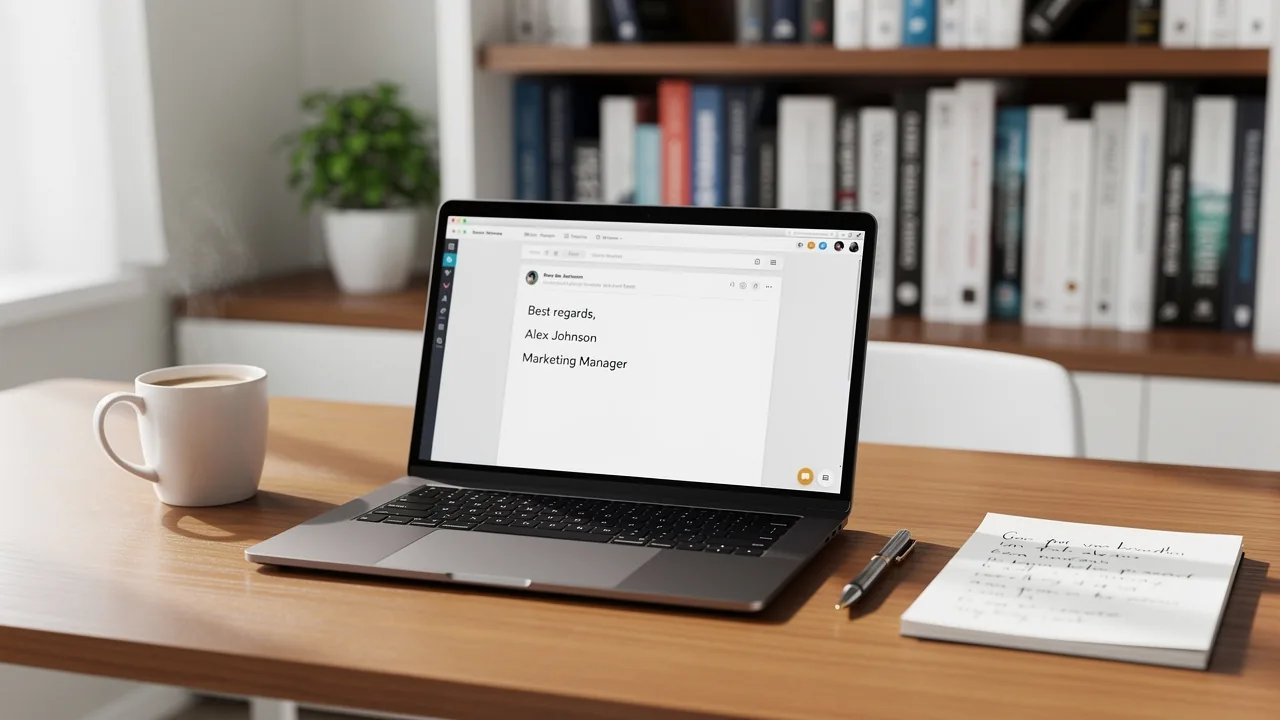
An email sign-off is the word or phrase placed directly above your name. Examples include “Regards,” “Best regards,” “Sincerely,” and “Thanks.” The sign-off is the brief expression that ends the message; your name follows it.
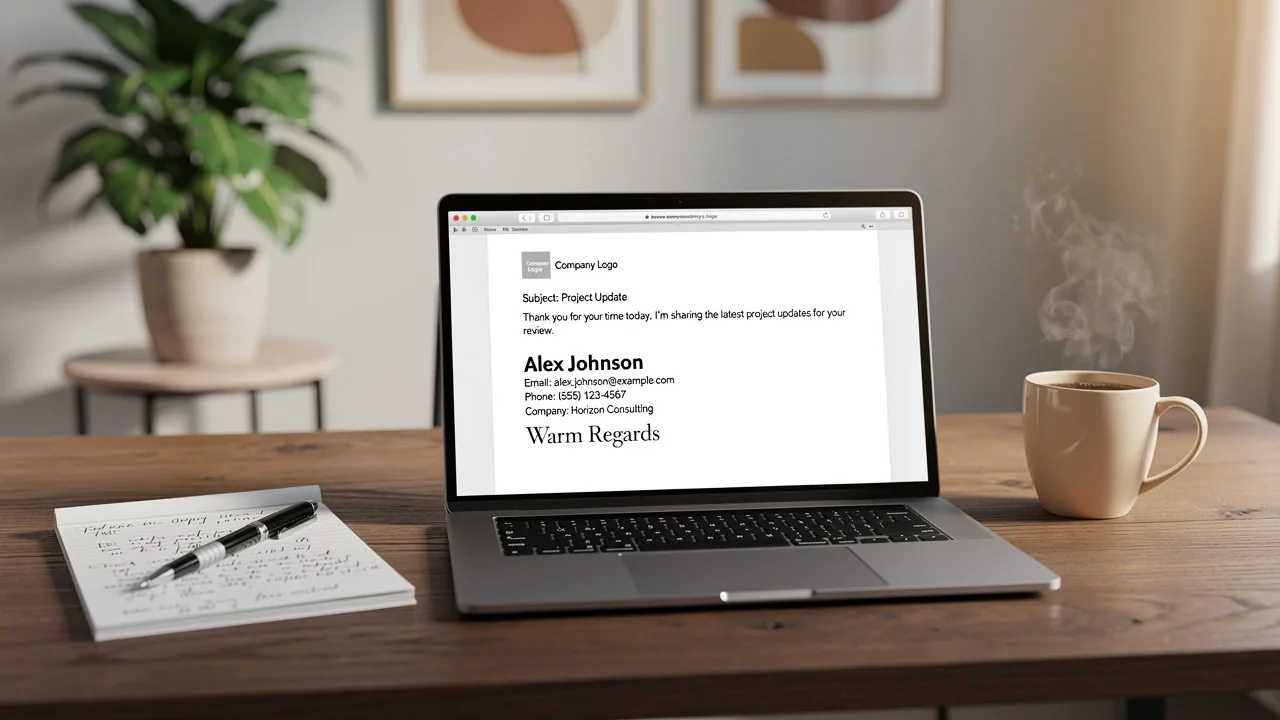
Keeping that distinction clear helps you judge the phrase on its own. A closing does not need to carry every detail about your role, contact information, or organization. Those details may appear after your name as part of a separate signature block, but the sign-off is the short expression immediately before your name.
A simple professional ending shows the placement clearly:
Best regards, Jordan Lee
“Best regards” is the closing, and “Jordan Lee” is the sender’s name. If you add other contact details below the name, those details do not change the function of the closing.
A clear email ending normally separates the requested response from the courtesy that follows it. Write the request in the final body line, leave a blank line, place the sign-off underneath, and put your name below the sign-off. That arrangement makes the action and the sender easy to identify without asking the closing to do more than end the message.

Start with neutral closings for most US professional emails
Common professional options give you a dependable starting point when the message is businesslike but does not require unusual formality. “Best regards,” “Kind regards,” and “Sincerely” are widely accepted in professional business communication, while “Regards” is described as neutral in United States usage.
Choose among them by the impression you want the final line to create:
- Regards, keeps the ending restrained and neutral.
- Best regards, remains professional while sounding a little warmer.
- Kind regards, adds a courteous tone without becoming personal.
- Sincerely, is more direct and formal, so it can work when the message has a letter-like quality.
These options are starting points, not fixed rules. The surrounding message still determines whether the phrase fits.
A neutral closing works best when the body is clear, respectful, and professional. For example:
I’ve attached the revised agenda for Monday’s meeting. Please share any changes by Friday.
Best regards, Jordan Lee
A more restrained version could read:
Thank you for reviewing the request. I welcome your comments.
Regards, Jordan Lee
Both endings match a conventional business tone. The choice depends on the relationship and the degree of warmth already present in the message.
US professional usage gives “Regards” a neutral quality, but local norms can change how other phrases land. “Cheers” can be professional in Australia, while informal German emails may use “LG,” meaning “Liebe Grüße.” If you are writing across borders, use the recipient’s workplace and market as part of the context instead of assuming that a familiar phrase has the same tone everywhere. Consistency is another useful tie-breaker once the context is clear. Guidance on email closings recommends maintaining some consistency with the same people or within the same organization, while still tailoring the phrase when the message calls for a different level of formality. In practice, do not change a neutral closing merely to sound novel. Change it when the email’s purpose or relationship genuinely changes—for example, a formal request may need “Sincerely” even if routine messages use “Regards.” This keeps personalization subordinate to clarity and context. The goal is a recognizable communication pattern, not a requirement to use one phrase in every message.
Use formal closings for official requests and unfamiliar contacts
Formal email closings suit official written requests, job applications, institutional correspondence, and letter-like messages to unfamiliar professional contacts. “Sincerely” is described as formal and direct, while “Sincerely yours” fits a conventional, formal message to someone you do not know.
“Respectfully” requires a narrower condition. Use it when the institution’s correspondence style calls for a deliberately deferential tone. It is not a default replacement for every professional email.
A formal request can end in a direct, uncomplicated way:
Thank you for considering my application. I would welcome the opportunity to discuss my qualifications.
Sincerely, Jordan Lee
A letter-like message to an unfamiliar professional contact may use:
Thank you for your time and consideration.
Sincerely yours, Jordan Lee
The wording before the sign-off supports the same level of formality. A highly formal closing attached to a casual, abbreviated body can feel inconsistent.
A formal closing should not be used simply because the topic feels important. A negotiation or official request may call for distance, but an internal message written in a relaxed workplace style may sound stiff if it ends with an overly formal phrase. Read the complete email once before choosing, then keep the sign-off at the same level of formality as the message.
Use semi-formal closings for ongoing professional relationships
A cold email needs a polite, professional ending that respects the recipient’s time without sounding pushy. Keep the sign-off simple, especially when the recipient does not know you and the message already contains a request.
For example:
If this is relevant to your team, would you be open to a brief conversation next week?
Best regards, Jordan Lee
The question states the requested next step, and the sign-off closes the message without adding pressure.
A follow-up to an existing contact can use the same professional register with slightly more warmth:
I’m following up on the proposal we discussed. > Kind regards, Jordan Lee
A semi-formal choice works because the message preserves courtesy while acknowledging an ongoing professional exchange. Keep the body and closing aligned. The relationship also helps distinguish two messages that may ask for a similar next step. In a cold email, the recipient has no established exchange to supply warmth, so a simple professional sign-off respects the recipient’s time and avoids adding pressure. In a follow-up, the existing exchange supports a slightly warmer semi-formal choice, provided the body remains professional. The distinction is not about making one category sound more persuasive; it is about choosing a level of familiarity the recipient can reasonably recognize. The same principle applies to networking and customer-service messages: polite does not have to mean stiff, and friendly does not require an intimate expression.
Use gratitude when the message thanks someone or continues a thread
Gratitude-based email closings work when appreciation is part of the message’s purpose. “Thanks” is described as simple, friendly, and widely used internally, while “Thanks again” suits a follow-up or ongoing thread.
Use “Thanks” when the email asks for a straightforward favor or responds to help:
Could you add the updated figures to the shared file?
Thanks, Jordan Lee
Use “Thanks again” when the message follows an earlier exchange:
Thanks again for walking me through the reporting changes. I’ll send the revised draft tomorrow.
Thanks again, Jordan Lee
A gratitude closing should reflect genuine appreciation already established by the body. Avoid using “Thanks” as a substitute for a clear request or as a way to make a demanding message sound casual. State the action first, express the appropriate level of appreciation, and then place the closing above your name.

Use friendly closings when the relationship supports them
Friendly email closings suit familiar relationships when the body already has a relaxed, respectful tone. “Talk soon” is friendly and forward-looking, while “Speak soon” is a slightly more professional version. Both work better when you already have a reason to expect continued contact.
For example:
I’ll send over the notes after our team meeting. Talk soon, Jordan
Or, in a more professional exchange:
I’ll review the draft before our call. Speak soon, Jordan
The first option feels more conversational; the second keeps more distance. Choose the version that matches the relationship and the rest of the email.
“Cheers” is described as a casual closing common in UK and European Union workplaces. That regional context matters, so do not assume the phrase will carry the same professional meaning for every recipient. Use it when the workplace culture and relationship support a casual expression; otherwise choose a neutral or semi-formal alternative.
Overly personal or emotional sign-offs generally do not belong in ordinary business communication unless you have a very close relationship with the recipient. A familiar exchange can be warm without becoming intimate, and an internal note can be relaxed without using humor that may not travel well. Keep the closing professional when the relationship or workplace context is uncertain.
Put the requested action before the final sign-off
A requested action belongs in the final lines before the thank-you and sign-off when an email needs a response or decision. If you need further communication, place a question or call to action in the last lines, thank the recipient, and then sign off normally.
Use this order:
- State the requested action or question.
- Add a brief expression of thanks when it fits.
- Place the sign-off directly above your name.
For example:
Could you confirm whether Tuesday works for the review? Thanks for your help.
Best regards, Jordan Lee
A direct request can use a neutral ending:
Would you send the final invoice when it is ready?
Regards, Jordan Lee
An appreciative request can use gratitude:
Thanks again.
Kind regards, Jordan Lee
The question or action remains in the body. The closing does not promise a response, and it does not replace the information the recipient needs to act.
A quick email to a friend or acquaintance may end with a question without a formal sign-off. That exception depends on the informality of the relationship and message. For a professional contact, keep the request and sign-off separate so the ending remains courteous and easy to interpret.
Check cultural and workplace context before using marked expressions
Cultural and workplace context can change how an email sign-off is understood. “Cheers” can be professional in Australia and casual in UK or European Union workplace contexts, while “Regards” is described as neutral in the United States. Informal German emails may use “LG,” short for “Liebe Grüße.”
These differences do not make one expression universally right or wrong. They mean you should consider the recipient’s local norms, workplace, relationship with you, and the tone of the message before choosing a marked expression.
A context check is useful when you are considering a regional, humorous, abbreviated, or highly personal ending:
- Location: Does the expression carry a familiar meaning in the recipient’s market?
- Workplace: Does the organization use formal, neutral, or conversational communication?
- Relationship: Have you exchanged enough messages for a relaxed sign-off to feel natural?
- Message tone: Does the body support the level of warmth or informality?
- Professional boundary: Could the phrase feel overly personal or emotional in this setting?
If you cannot answer these questions confidently, choose a clear neutral option such as “Regards,” “Best regards,” or “Kind regards.”
International email requires attention to local norms as well as your own communication style. A phrase that feels friendly to you may sound too casual, too cold, or unfamiliar elsewhere. Use a sign-off that the recipient is likely to recognize in context, and avoid relying on slang when the relationship or market is unfamiliar. A simple fallback rule follows from these checks. If you know the recipient’s local convention, account for it; if you know the workplace but not the local convention, let the organization’s communication style guide the level of formality; if both are uncertain, use a neutral professional option rather than a marked expression. That approach does not make the neutral choice universally best. It limits avoidable ambiguity while leaving room to use a warmer, more regional, or more informal closing when the relationship and context support it. Before sending, compare the sign-off with the rest of the email rather than evaluating it as an isolated phrase. That comparison is especially useful when a marked expression feels familiar to you but the recipient’s convention is unknown.
Run a four-line check before sending
A four-line check can help you choose and place the closing before you send:
- Relationship: Identify whether the recipient is unfamiliar, an ongoing professional contact, a colleague, or a close acquaintance.
- Tone: Reread the message and choose a sign-off that matches its formality and warmth.
- Next step: Put any question or requested action in the final body lines, followed by thanks when appropriate.
- Placement: Put the closing directly above your name.
Use “Sincerely” for a formal, direct request; “Best regards,” “Kind regards,” or “Regards” for many professional messages; “Thanks” for a simple internal request; “Thanks again” for an ongoing thread; and “Talk soon” or “Speak soon” when the relationship supports a friendly ending. The right choice is the one that fits the message, the recipient, and the purpose without forcing a tone the email does not have.
Which email closing should you use in a professional message?
How should I choose an email closing based on the recipient?
Consider the relationship you have with the recipient.
What is the importance of matching the tone of an email closing?
Matching the tone of your email closing to the overall tone of the message is important for maintaining consistency. A casual closing may feel out of place in a formal email, while a formal closing can seem stiff in a friendly exchange.
When should I use gratitude-based closings in emails?
Use gratitude-based closings like "Thanks" or "Thanks again" when your email expresses appreciation or follows up on a previous conversation.
What should I consider when using casual email closings?
Casual email closings, such as "Talk soon" or "Cheers," should be used when the relationship supports a relaxed tone. Ensure that the body of the email is also informal to match the closing.
How can I encourage a response in my email closing?
To encourage a response, place a question or call to action in the final lines of your email, followed by a thank you and then your sign-off. This structure helps clarify what you need from the recipient.
What are the cultural considerations for email closings?
Cultural norms can affect how email closings are perceived. Always consider the recipient's location and workplace culture when choosing a closing.
Get started with Scribe
Build a professional email signature
Free 14-day trial — no credit card.