Best Regards or Warmest Regards: Choosing the Right Sign-Off
The choice of email sign-off plays a crucial role in shaping professional communication and its effectiveness. With options like "Best Regards" and "Warmest
Sophie Grant
Email Signature Specialist, Scribe
Introduction
The choice of email sign-off plays a crucial role in shaping professional communication and its effectiveness. With options like "Best Regards" and "Warmest Regards," understanding the subtle differences between these phrases is essential for fostering positive relationships in the workplace.
Professionals often find themselves uncertain about the appropriate sign-off to use in various contexts, which can result in miscommunication and hinder relationship-building in professional settings.
What should professionals keep in mind to choose a sign-off that reflects their message and the dynamics of their relationships?
Define 'Best Regards' and 'Warmest Regards'
For effective professional communication, it is crucial to choose the right email sign-off, such as best regards or warmest regards.
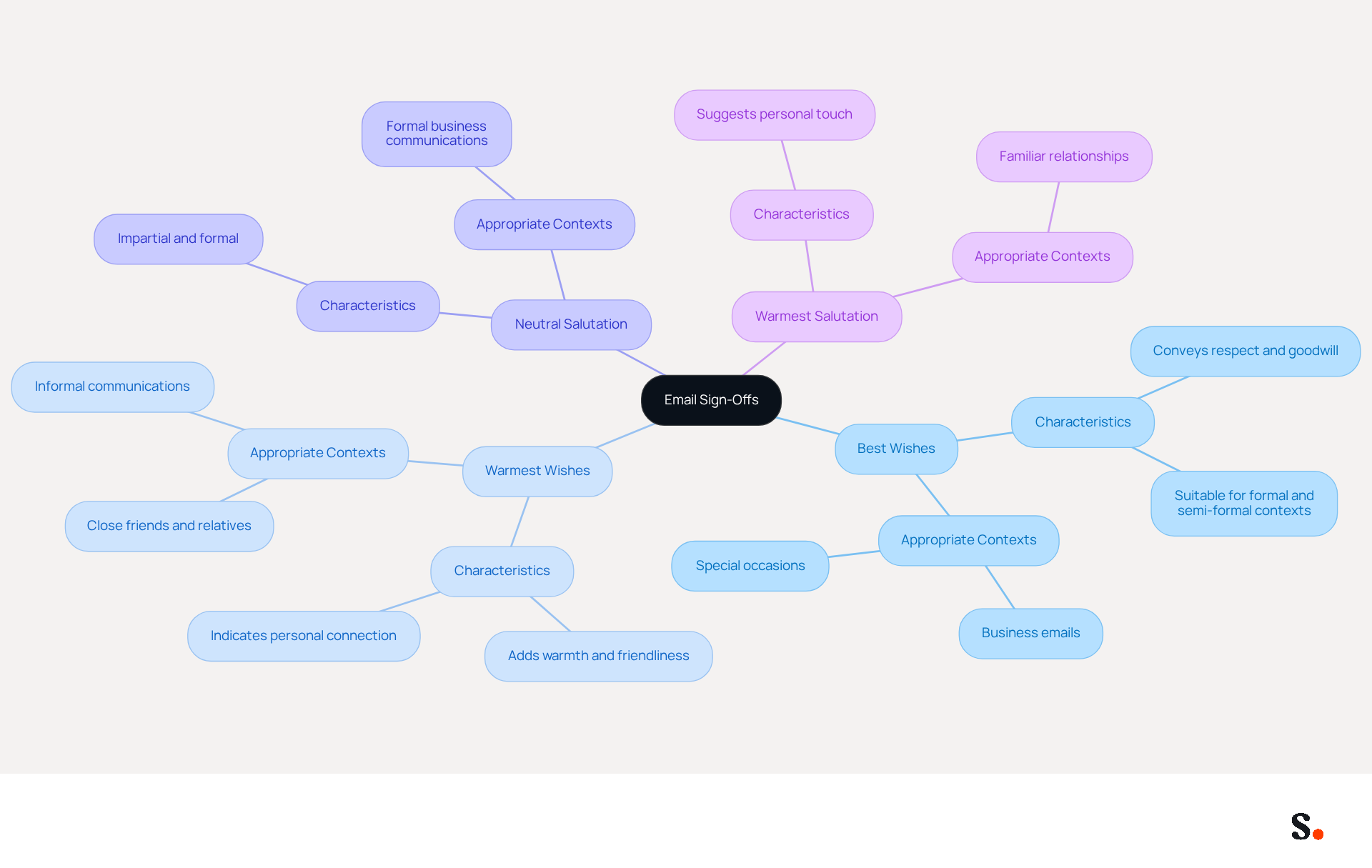
- 'Best Wishes' is a commonly used sign-off in business emails, conveying a sense of respect and goodwill. This sign-off is suitable for both formal and semi-formal contexts, enhancing its versatility in professional interactions.
- On the other hand, 'Warmest Wishes' adds an extra layer of warmth and friendliness, indicating a more personal connection with the recipient.
- While 'Neutral Salutation' is impartial, 'Warmest Salutation' suggests a more personal touch, often reserved for emails where a degree of familiarity exists.
Understanding these definitions helps you select the right sign-off, like best regards or warmest regards, based on your relationship with the recipient and the context of your email. Understanding the nuances of these sign-offs can significantly impact the tone of your correspondence.
Identify Appropriate Contexts for Each Sign-Off
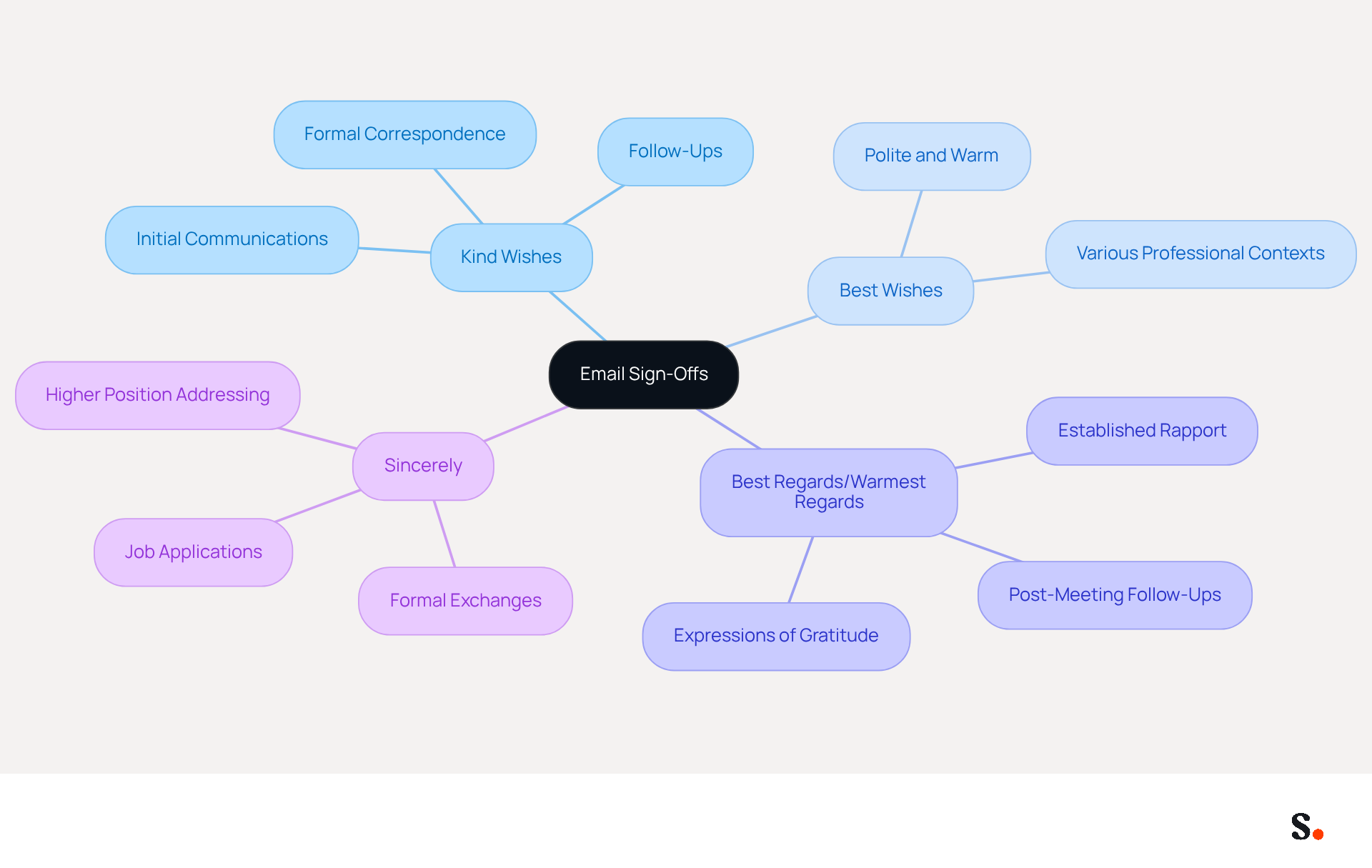
The choice of email sign-off plays a crucial role in shaping professional interactions and perceptions. 'Kind Wishes' is a flexible sign-off appropriate for various professional situations, including initial communications, follow-ups, and formal correspondence. It conveys respect and professionalism, making it particularly effective when addressing colleagues, clients, or superiors.
The sign-off 'Best Wishes' conveys politeness and warmth, making it suitable for various professional contexts. In contrast, 'best regards or warmest regards' is best reserved for situations where there is an established rapport, such as after a successful meeting or when expressing gratitude. This closing is ideal for emails to team members or clients with whom one has a friendly relationship, building rapport and improving clarity in communication.
Understanding these contexts is essential, as the choice of sign-off can greatly affect workplace interactions and the recipient's perception of the message. Case studies, such as those on the impact of email sign-offs on workplace relationships, indicate that tailored sign-offs can positively influence interactions, with 'best regards or warmest regards' establishing a warm tone while 'Sincerely' is reserved for more formal exchanges.
By selecting the right sign-off, professionals can significantly improve their communication outcomes. Additionally, Scribe powers 15 million daily brand impressions, showcasing the effectiveness of using appropriate sign-offs in email interactions.
Analyze Tone and Perception in Professional Communication
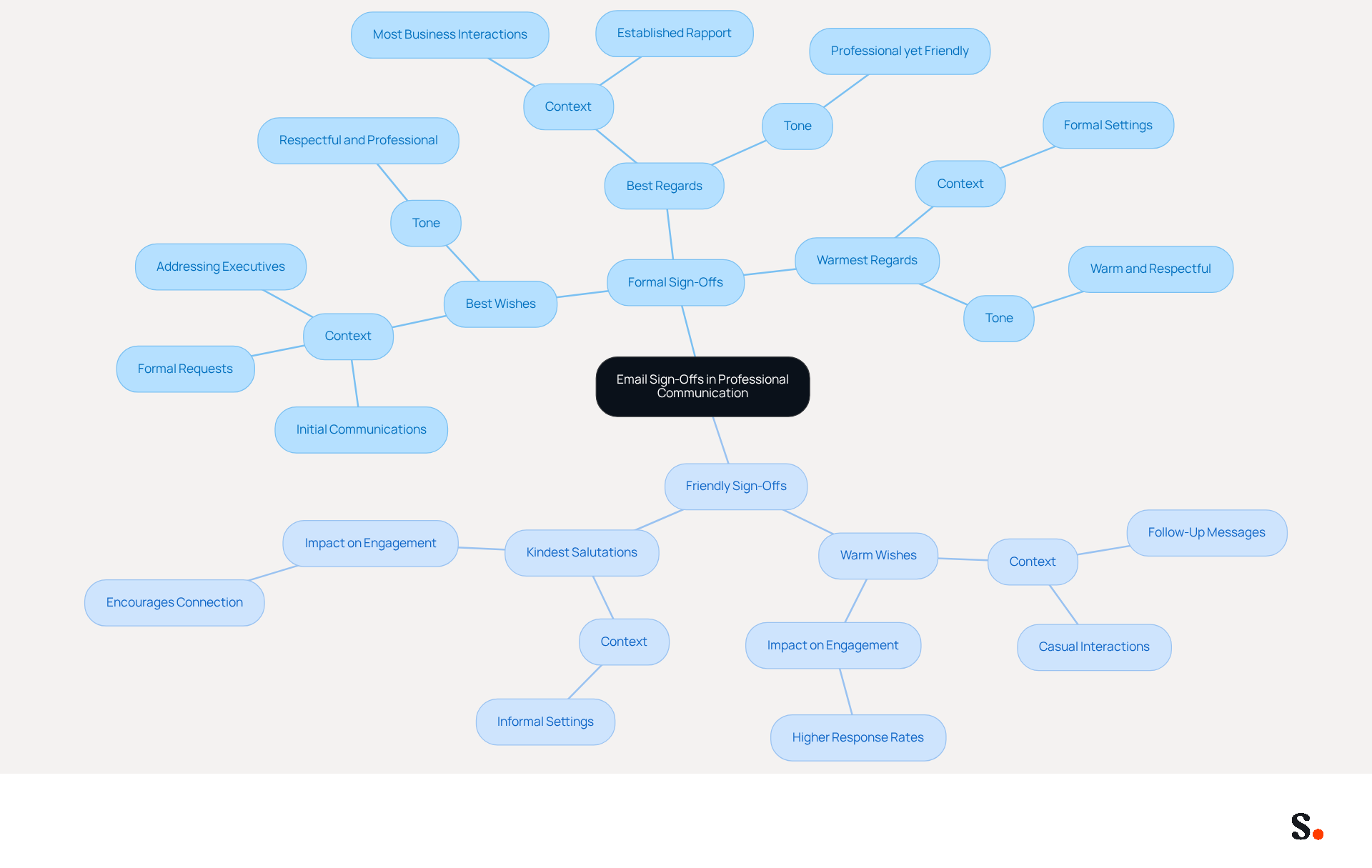
For effective business communication, it is crucial to select the right email sign-off, including options like best regards or warmest regards. The sign-off 'Best Wishes' is recognized for its formal and polite tone, making it a reliable choice for business communications. This sign-off suggests respect while maintaining a degree of formality, which is essential in workplace environments. Conversely, using 'best regards' or 'warmest regards' introduces a more personal and friendly tone, fostering a sense of connection and warmth.
However, choosing the appropriate sign-off can be challenging in formal settings, where maintaining professionalism is paramount. Moreover, the phrase 'Best Wishes' is especially suitable for initial interactions and formal requests, offering a respectful tone that aligns with workplace expectations. Understanding these tonal distinctions is vital for professionals who seek to achieve the right balance between friendliness and professionalism in their interactions.
Studies indicate that thoughtful sign-offs significantly impact engagement, with emails containing friendly closings such as 'Warm Wishes' and 'Kindest Salutations' receiving up to 22% more replies compared to those that are excessively formal. Case studies reveal that aligning the sign-off with the email's tone and the recipient's expectations enhances effectiveness, preventing misunderstandings and improving overall engagement.
Furthermore, being aware of cultural sensitivities surrounding email sign-offs can prevent potential miscommunications. Getting the hang of sign-offs like 'Warm Wishes' and 'Kind Salutations' can really elevate your everyday messages. As Sophie Grant, an Email Signature Specialist, observes, 'Best Wishes' maintains a level of professionalism suitable for formal exchanges, while 'Warm Wishes' is best suited for casual interactions where a personal touch is advantageous. Ultimately, using best regards or warmest regards as a sign-off can significantly enhance the quality of professional interactions.
Address Common Misconceptions and Mistakes
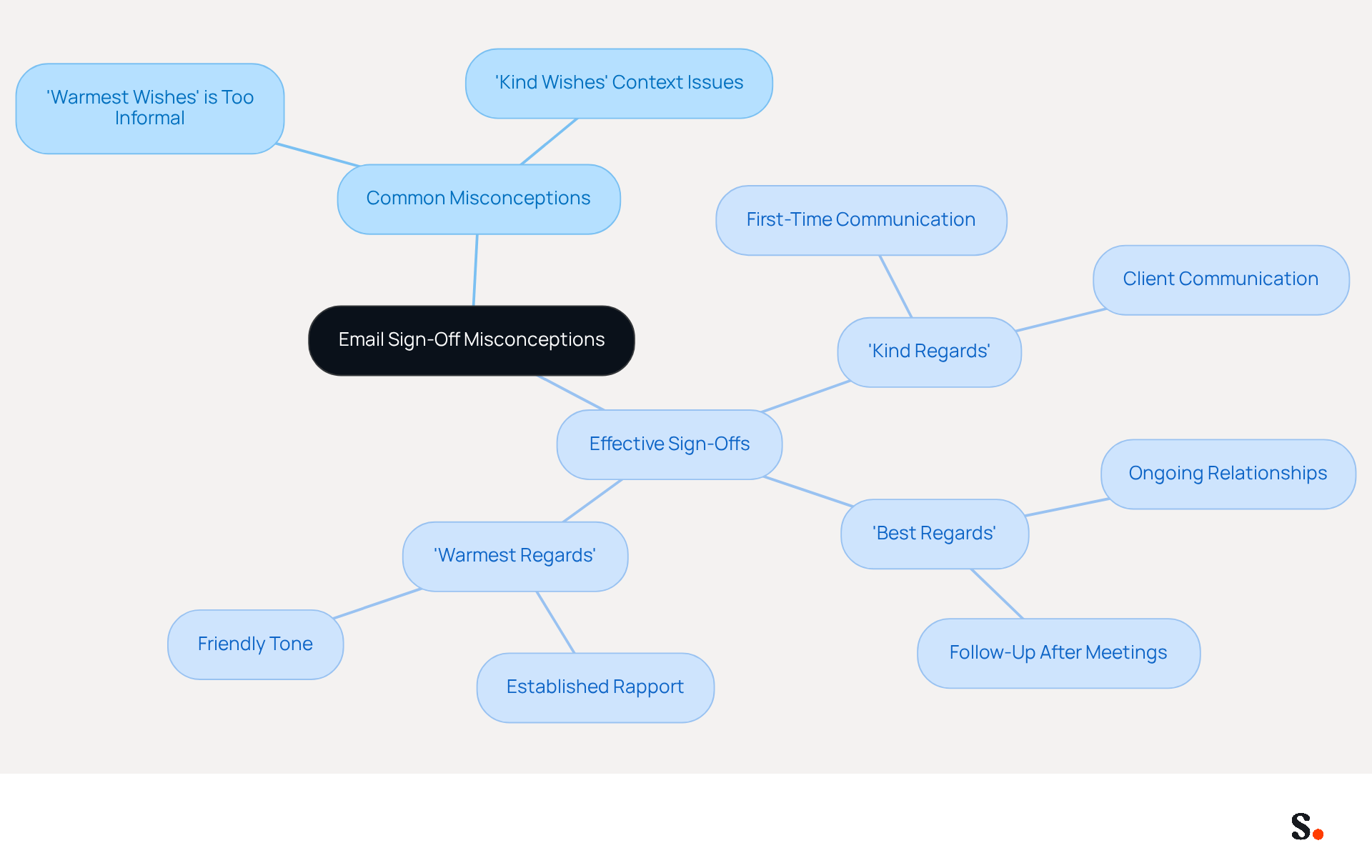
Many professionals mistakenly believe that 'Warmest Wishes' is too informal for business emails. When used appropriately, this sign-off adds warmth to communication while maintaining professionalism. Research indicates that emails featuring friendly closings often receive significantly higher response rates, highlighting the effectiveness of 'Warmest Wishes' in fostering engagement.
On the other hand, using 'Kind Wishes' in excessively informal situations may seem disingenuous. It's crucial to understand that while both sign-offs are generally acceptable, their effectiveness hinges on the context and the nature of the relationship with the recipient.
For example, case studies show that:
- 'Kind Regards' is often favored in initial interactions, demonstrating respect and professionalism.
- 'Best Regards' or 'Warmest Regards' is effective for sustaining ongoing relationships.
Utilizing this sign-off can lead to improved engagement and response rates in professional emails. Understanding the nuances of these sign-offs can lead to more effective and engaging communication strategies.
Conclusion
The choice of email sign-off, like "Best Regards" or "Warmest Regards," is crucial for effective professional communication. Each sign-off carries its own tone and implications, influencing how messages are perceived and received. However, many professionals struggle to choose the most effective sign-off. This article highlighted the appropriate contexts for each sign-off, allowing professionals to tailor their correspondence to fit the context and relationship with the recipient. This understanding can lead to more effective communication and stronger professional relationships.
In conclusion, the choice of email sign-off is more than just a formality; it is a strategic decision that can significantly affect communication outcomes. Ultimately, the right sign-off can transform a simple email into a powerful tool for connection.
Frequently Asked Questions
What does "Best Regards" mean in professional communication?
"Best Regards" is a commonly used email sign-off that conveys respect and goodwill, making it suitable for both formal and semi-formal contexts.
When should I use "Warmest Regards"?
"Warmest Regards" adds an extra layer of warmth and friendliness, indicating a more personal connection with the recipient, and is often used in emails where a degree of familiarity exists.
How does "Best Wishes" differ from "Warmest Wishes"?
"Best Wishes" is a versatile sign-off suitable for various professional interactions, while "Warmest Wishes" suggests a more personal touch and is typically reserved for closer relationships.
Why is it important to choose the right email sign-off?
Choosing the right email sign-off, such as "Best Regards" or "Warmest Regards," helps set the appropriate tone for your correspondence based on your relationship with the recipient and the context of the email.
What impact do email sign-offs have on communication?
Understanding the nuances of email sign-offs can significantly impact the tone of your correspondence, influencing how your message is received by the recipient.
List of Sources
- Define 'Best Regards' and 'Warmest Regards'
- Warm Regards vs Best Regards vs Kind Regards: Choosing the Right Email Sign-Off (https://salesforge.ai/blog/warm-regards-vs-best-regards-vs-kind-regards)
- Difference between "Warm regards" and "Best regards" (https://english.stackexchange.com/questions/46977/difference-between-warm-regards-and-best-regards)
- Warm Regards Meaning: Understanding the Significance of This Common Email Sign-Off (https://serchen.com/blog/warm-regards-meaning)
- Identify Appropriate Contexts for Each Sign-Off
- Warm Regards vs Best Regards: Choosing the Right Sign-Off (https://scribe-mail.com/en-US/blog/warm-regards-vs-best-regards-choosing-the-right-sign-off)
- Warm Regards vs Best Regards vs Kind Regards: Choosing the Right Email Sign-Off (https://salesforge.ai/blog/warm-regards-vs-best-regards-vs-kind-regards)
- Best Regards vs Sincerely: Choosing the Right Sign-Off for Impact (https://scribe-mail.com/en-US/blog/best-regards-vs-sincerely-choosing-the-right-sign-off-for-impact)
- Analyze Tone and Perception in Professional Communication
- Warm Regards vs Best Regards: Choosing the Right Sign-Off (https://scribe-mail.com/en-US/blog/warm-regards-vs-best-regards-choosing-the-right-sign-off)
- Best Regards vs Sincerely: Choosing the Right Sign-Off for Impact (https://scribe-mail.com/en-US/blog/best-regards-vs-sincerely-choosing-the-right-sign-off-for-impact)
- The beautiful ways different cultures sign emails (https://bbc.com/worklife/article/20190508-why-the-way-you-close-your-emails-is-causing-confusion)
- Address Common Misconceptions and Mistakes
- Warm Regards vs Best Regards vs Kind Regards: Choosing the Right Email Sign-Off (https://salesforge.ai/blog/warm-regards-vs-best-regards-vs-kind-regards)
- Are people misinterpreting your email sign-off? (https://bbc.com/worklife/article/20180413-best-wishes-kind-regards-or-an-icy-yrs)
- Warm Regards vs Best Regards: Choosing the Right Sign-Off (https://scribe-mail.com/en-US/blog/warm-regards-vs-best-regards-choosing-the-right-sign-off)
- 10 Professional email sign-offs to make your email stand out · Career.io (https://career.io/career-advice/professional-email-sign-offs)
Get started with Scribe
Build a professional email signature
Free 14-day trial — no credit card.